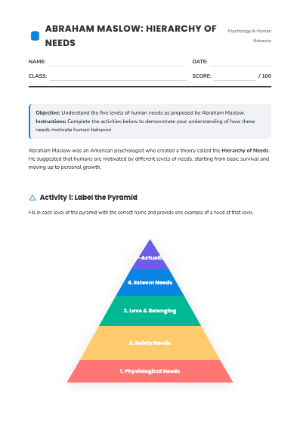
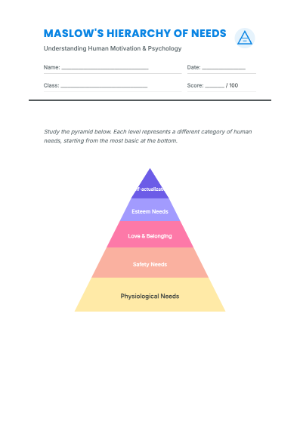
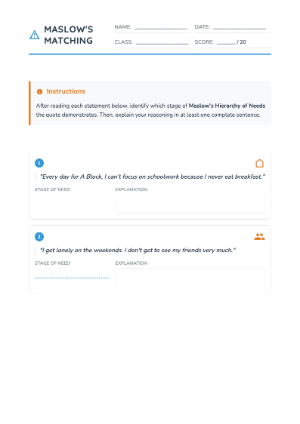
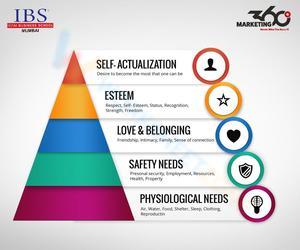
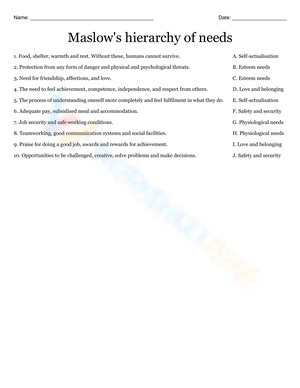
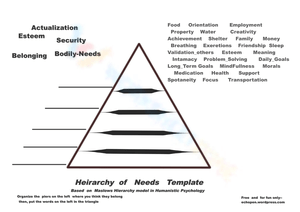
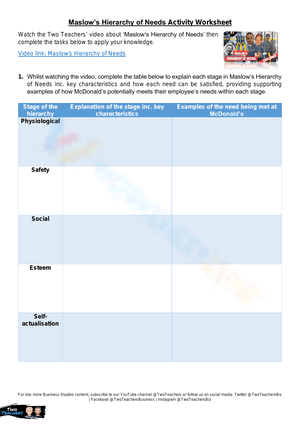
These maslows hierarchy of needs printable worksheets for 10th grade give teachers a research-grounded entry point into motivational psychology at exactly the right developmental moment — when students are old enough for genuine abstract analysis but still close enough to Maslow's lower-tier concerns to find the theory personally legible. The set targets all five levels of the pyramid through labeling tasks, real-world scenario analysis, reflective writing prompts, and character-based evidence exercises that connect directly to work students are already doing in ELA and social studies.
The Specific Skills Each Worksheet Builds
Students work with Maslow's five tiers in progressively more demanding ways across the set. Early worksheets ask students to define each level and generate original examples — what counts as a physiological need for a teenager today differs more than students expect from what Maslow described in 1943, and that gap alone produces productive discussion. Later worksheets move toward cross-curricular application: mapping a literary protagonist's decisions onto the pyramid, or analyzing a historical population's behavior through the lens of disrupted safety and physiological need.
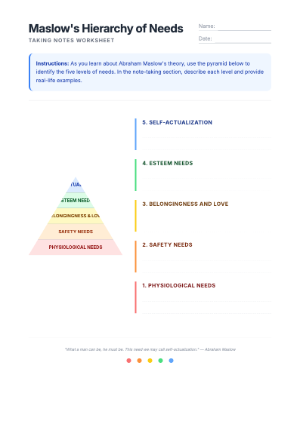
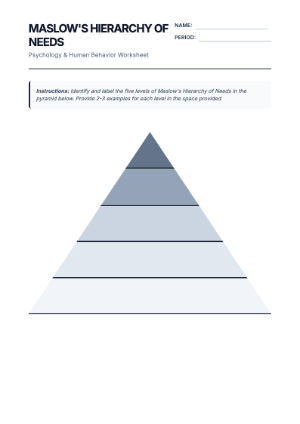
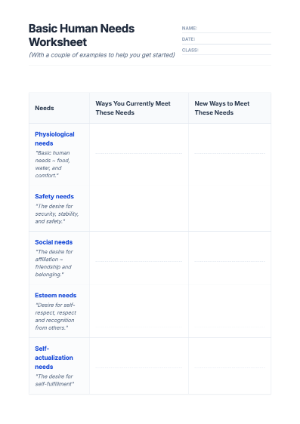
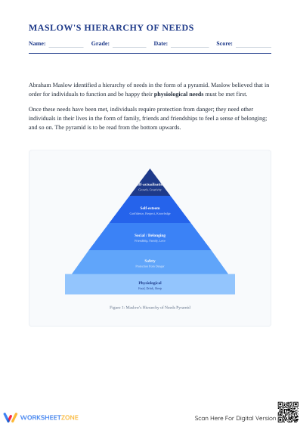
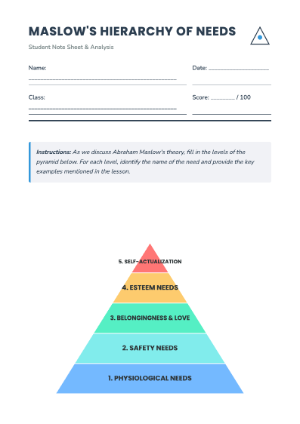
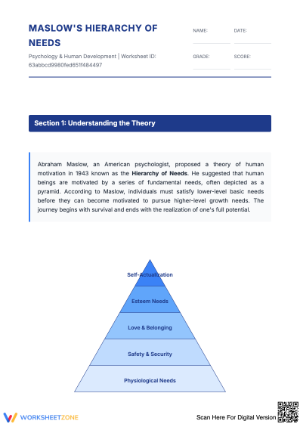
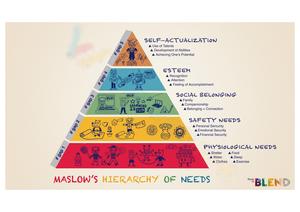
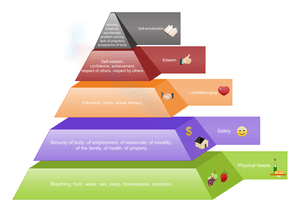
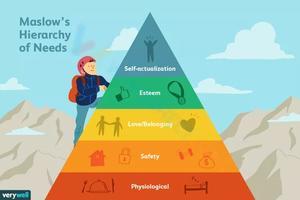
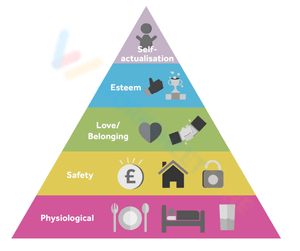
- Pyramid labeling and definition: Students identify all five levels by name, write original definitions, and supply examples drawn from their own experience and from course content.
- Scenario sorting: Students read short vignettes — a student who skips class after two nights without sleep, a teenager who runs for class office primarily to earn peer respect — and assign each to a tier, defending their placement in writing.
- Deficiency vs. growth needs distinction: Students sort the five tiers into Maslow's two broader categories and explain what happens to motivation when a deficiency need goes unmet for an extended period.
- Character Needs Inventory: Students map a fictional or historical figure onto the pyramid and support each placement with textual or historical evidence — a task that reinforces evidence-based argument writing at the same time it tests psychological understanding.
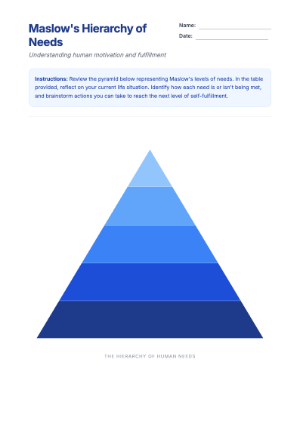
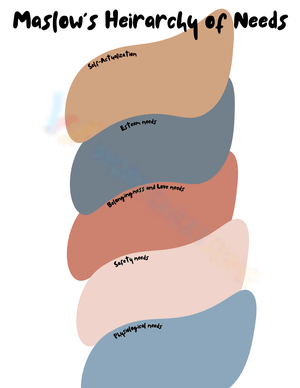
- Reflective self-assessment: Students shade or annotate a blank pyramid based on which needs feel most active for them personally, then write about what that pattern suggests about their current motivations.
Why This Content Sits in the Right Place at Tenth Grade
There is a reason this theory shows up in 10th grade psychology, health, and social studies courses rather than earlier. Cognitive development at 15 and 16 supports genuine abstract reasoning — students can hold a theoretical model in mind while simultaneously applying it to a real-world case. Younger students frequently treat the pyramid as a vocabulary list; tenth graders are capable of using it as an analytical tool. The maslows hierarchy of needs printable worksheets for 10th grade in this set are built around that distinction, moving students past recitation toward interpretation and argument. There is also a developmental resonance worth naming: Erikson's fifth stage, identity vs. role confusion, runs parallel to Maslow's esteem and self-actualization levels. Students actively wrestling with questions of reputation, belonging, and future direction are not just studying human motivation in the abstract — they are living inside it, which is precisely what makes the content stick.
Common Misconceptions Students Bring Into the Unit
The most persistent error is what experienced teachers sometimes call the rigid staircase assumption — students read the pyramid as a system of locked gates where each level must be fully satisfied before the next one can be addressed at all. A student who internalizes that model will insist that a character experiencing poverty cannot simultaneously feel love and belonging, which flattens both the theory and the character analysis. Maslow himself clarified that needs overlap and that partial satisfaction shifts motivation upward. Building explicit correction of this misconception into the scenario-sorting activity — by including vignettes where multiple tiers are active simultaneously — saves significant reteaching time two weeks later.
A subtler confusion involves conflating esteem needs with self-actualization. When students encounter someone who has achieved public recognition — winning a state championship, reaching a position of authority — they frequently place that person at the top of the pyramid. The distinction matters: esteem centers on external validation and internal dignity; self-actualization is the ongoing process of becoming what one is fully capable of becoming. A person can have strong esteem satisfaction while self-actualization remains a work in progress across decades. Students who understand that distinction write more precise analysis across every application task in the set.
How to Build These Worksheets Into Your Lesson Planning
The labeling and definition worksheets function well at the opening of the unit — a 15-minute warm-up that establishes shared vocabulary before lecture or discussion. The scenario-sorting task is most effective as a formative check midway through the unit, particularly if run as a think-pair-share before students commit to individual written responses. The Character Needs Inventory connects naturally to any literary or historical text already in the course; assigning it as a culminating task ties psychological vocabulary to the analytical writing students are developing simultaneously in ELA. In health or advisory contexts where the self-assessment activity is the primary goal, giving students the explicit option to keep their personal pyramids private — stated clearly before they begin — makes the reflection more honest and more useful.
The advertisement analysis extension (assigning a real ad to a tier of the pyramid and explaining the marketing logic in writing) runs well in the 20 minutes before a class ends. It generates reliably heated disagreement about whether a given ad targets safety needs or esteem needs, and the vocabulary students use to argue their position carries past this unit into media literacy work.
Differentiating Across Ability Levels in the Same Classroom
Students who need additional support generally struggle most with the move from personal examples to character-based analysis — they can articulate that they feel belonging needs at lunch with their friend group, but they freeze when asked to apply the same logic to a 1930s sharecropper or a fictional protagonist under duress. Pairing a structured evidence sentence frame ("This character prioritizes ___ because the text shows ___") with the Character Needs Inventory gets those students producing defensible analysis rather than guesses. Students working above grade level benefit from the extension task that interrogates the model's limits: give them a case where a character appears to reach self-actualization while deficiency needs remain unmet — a painter who produces transformative work while living in poverty — and ask them to write about what that case means for the theory's explanatory range. The maslows hierarchy of needs printable worksheets for 10th grade in this set include enough structural variation across tasks that a single classroom can run different worksheets simultaneously without the differentiation becoming obvious to students.
Standard Alignment
These worksheets align with CASEL's SEL competencies, specifically self-awareness (identifying one's own needs and motivations) and social awareness (recognizing how different levels of need fulfillment shape others' perspectives and behavior). For schools using the American School Counselor Association's Mindsets and Behaviors framework, the content maps to Mindset Standard M 1 (belief in development of the whole self) and Behavior Standard B-SMS 7 (demonstrating effective coping skills). Teachers using these materials in a psychology elective will find the motivation and emotion content aligned with the APA's National Standards for High School Psychology Curricula, Unit 7, which asks students to describe contemporary theories of motivation and connect them to observed behavior. The evidence-based writing tasks embedded in the Character Needs Inventory connect to CCSS.ELA-LITERACY.W.9-10.1, specifically the requirement that students support claims with relevant evidence and clear, logical reasoning from source material.
Frequently Asked Questions
Do these worksheets introduce the theory or assume students already know it?
The labeling and definition worksheets function as introductory tasks — students build their understanding of each tier through the process of completing them, not after reading an assigned chapter first. That said, if teachers have already delivered direct instruction on Maslow before distributing those worksheets, they work equally well as consolidation practice rather than redundant repetition.
How should the self-assessment activity handle students whose unmet needs are sensitive?
The reflective pyramid worksheet asks students to identify which needs feel most active for them — it does not require disclosure to the class or to the teacher. Stating clearly before students begin that they may keep their completed pyramids private removes pressure while preserving the reflective value. For advisory or counseling contexts where a teacher or counselor wants to use responses as a check-in tool, transparency about that purpose before students start is worth the 30 seconds it takes.
Can these worksheets travel across disciplines, not just psychology?
The maslows hierarchy of needs printable worksheets for 10th grade work across English, social studies, health, and advisory settings without modification. The Character Needs Inventory is the most portable task — any class working with a novel, memoir, or historical case study can assign it directly. The scenario-sorting worksheet is written to be discipline-neutral by design, so it fits a psychology elective and a 10th grade English unit with equal ease.
What if students push back on the theory as culturally limited?
That challenge is worth welcoming. Cross-cultural critiques of Maslow — the argument that collectivist cultures weight community and belonging differently relative to individual safety and esteem than the pyramid's structure implies — generate substantive discussion that extends students' critical thinking past the model itself. A teacher who lets students interrogate the theory's limits is teaching more psychology, not less. The worksheets provide a starting analytical framework; the interrogation of that framework is where the deepest learning happens.












 Interactive Worksheet Maker
 Quiz Maker
 Word Search Maker
 Crossword Puzzle Maker
 Word Scramble Generator
 Sentence Scramble Generator
 Handwriting Worksheet Generator
 Name Tracing Generator
 Fill In The Blank Generator