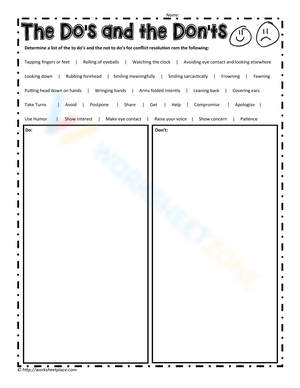
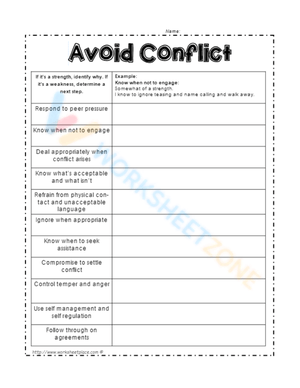
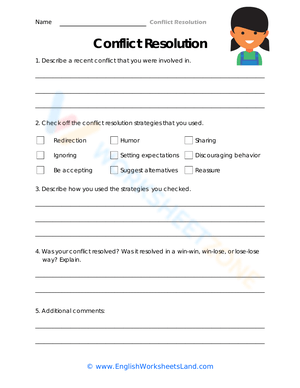
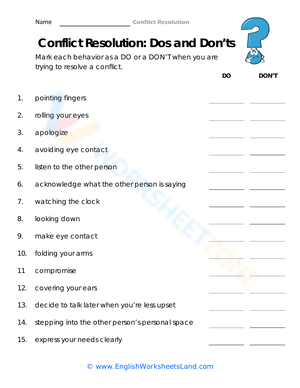
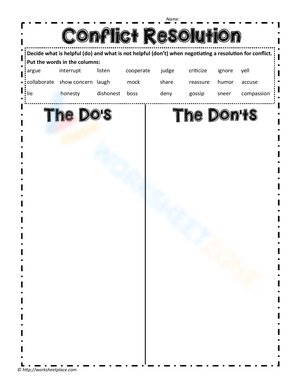
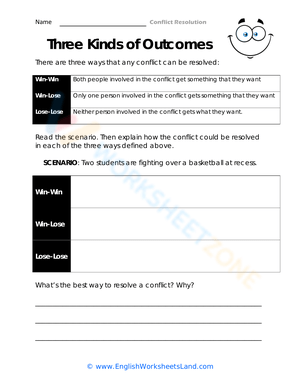
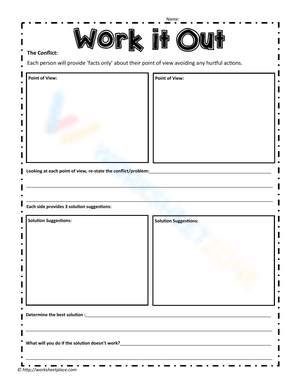
These conflict resolution worksheets printable for 10th grade give school counselors, health teachers, and SEL facilitators a set of targeted, standalone resources built around the social pressures fifteen- and sixteen-year-olds are actually navigating — group-project breakdowns, social media misunderstandings, early workplace friction, shifting friend dynamics. Each worksheet stands alone, so teachers pull exactly what a class needs on a given day rather than working through a fixed sequence.
The Skills Each Worksheet Targets
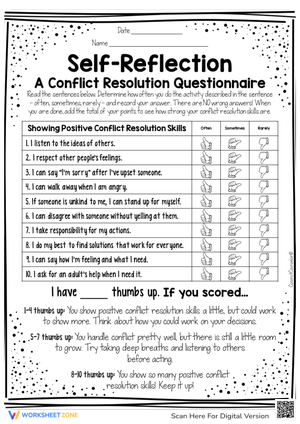
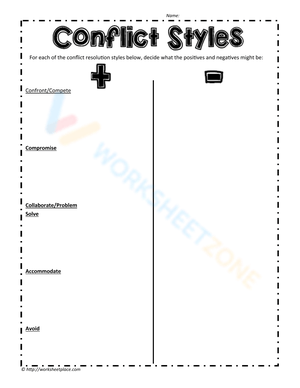
The set covers a sequence of discrete, teachable competencies. A conflict-style self-assessment asks students to mark their instinctive reactions — avoidance, competition, accommodation, collaboration — across a series of brief scenarios and then examine what those default patterns cost them in different relationships. Scenario-based role-play worksheets present realistic disputes drawn from high school life: an unequal division of labor on a required group presentation, a comment meant as private that was screenshotted and forwarded, a part-time job where a coworker claims credit for shared work. Students read the situation, identify each party's underlying need rather than just the stated position, and draft two possible responses — one reactive, one deliberate.
A separate worksheet works through the mechanics of an "I" statement in three parts: the feeling, the specific behavior that triggered it, and a direct request. Students who write out all three components before a difficult conversation rarely conflate what happened with what they assumed. There is also a worksheet that maps the anatomy of an effective apology — not "I'm sorry you felt that way," but a structured acknowledgment of the behavior, its impact, and a concrete commitment to changed action. Tenth graders are perceptive enough to recognize a non-apology when they hear one, and many of them have already learned to distrust the reflexive "sorry" that ends a mediation session without repairing anything.
Student Mistakes These Worksheets Surface Early
The most consistent error at this grade level is conflating position with interest. A student writes that the conflict is "because she told everyone I cheated" — that is the position. The underlying interest, which the worksheet prompts them to identify, is usually something like "I want people to trust me" or "I worked hard on that assignment and I need that to be known." Students who never make that distinction argue about the surface event indefinitely without moving toward resolution, and they do it in live mediations exactly as they do it on paper. Teachers who review completed worksheets before a group discussion can identify which students are still stuck at the surface and press them with a targeted follow-up question before the class debrief.
A second recurring pattern: when asked to write the other person's perspective, students produce a distorted or hostile version. "She probably thinks she can do whatever she wants because she's popular." That is not perspective-taking — it is narrative. Catching that in writing, before a live conversation begins, is precisely where these worksheets earn their place in a lesson. The exercise requires students to rewrite the opposing view in a way the other person would actually recognize, which demands separating observation from interpretation. Most tenth graders cannot do that on a first attempt without a structured prompt forcing them to try.
Building These Worksheets Into Your Weekly Instruction
Advisory periods are the natural home for this work. A twenty-minute block is enough time for a self-assessment worksheet followed by a brief pair-share before students leave for first period. Health teachers often use the scenario-based role-play worksheets as a midunit activity during a broader mental health or relationships unit, pairing the written work with a short Socratic discussion. School counselors find the apology-anatomy and "I" statement worksheets most useful during individual sessions following a disciplinary referral — filling out the worksheet gives the conversation structure and slows the student down enough to think rather than defend.
One strong classroom-management move: assign the conflict-style self-assessment on a Monday after a weekend, when social tensions tend to spike. Students arrive already thinking about an unresolved situation, and the worksheet channels that energy into analysis rather than gossip. The conflict resolution worksheets printable for 10th grade also work well as pre-mediation preparation — give each student a worksheet independently before both parties meet, so they each arrive with a written account of their underlying interests and a drafted request rather than walking in cold and reactive.
Standard Alignment
These worksheets align with CASEL's Relationship Skills competency, which calls on students to communicate clearly, listen actively, cooperate, and negotiate conflict constructively. They also address the Responsible Decision-Making competency — specifically the strand requiring students to evaluate consequences of personal actions and consider others' perspectives before responding. Within most state SEL frameworks, those skills appear at the high school band as graduation-readiness indicators rather than developmental checkpoints, meaning there is an expectation that students can demonstrate them, not simply encounter them. Teachers using these worksheets in advisory or health contexts are building toward measurable, demonstrated proficiency. CASEL identifies relationship skills and self-management as the two competencies most directly connected to school climate outcomes, which places instruction in this area at the center of whole-school SEL implementation rather than at its margins.
Adjusting the Worksheets Across Student Readiness Levels
The conflict resolution worksheets printable for 10th grade work across a range of student readiness with some deliberate preparation. Students who already have strong self-awareness — typically those with prior SEL instruction or family cultures that name emotions explicitly — move through the self-assessment quickly. For those students, add a second layer after the perspective-taking task: ask them to identify one assumption embedded in their own written account and describe what evidence would be needed to test it. That extension takes about five minutes and produces noticeably more sophisticated thinking about attribution and bias.
For students with limited experience labeling emotions, the "I" statement worksheet benefits from a printed emotion vocabulary reference. Avoid the laminated feelings chart with cartoon faces — at this age, it reads as condescending. A two-column reference distinguishing primary emotions (frustrated, scared, embarrassed) from secondary ones (angry, defensive, dismissive) is more useful and more age-appropriate. Students who struggle with the "I" statement task are usually trying to name a feeling they do not have a word for, not resisting the exercise — that is a different problem with a different solution. Students with IEPs or those who process written text slowly can complete the scenario-based worksheets with abbreviated scenarios — three sentences rather than a full paragraph — without reducing the cognitive demand of the perspective-taking task itself.
Frequently Asked Questions
How do these worksheets fit into a class period that's already packed?
Most worksheets in the set complete in fifteen to twenty minutes when used as written. Teachers who have used conflict resolution worksheets printable for 10th grade inside a fifty-minute advisory block typically run the worksheet as the opening activity, reserve ten minutes for whole-class discussion, and still have time for transitions. If the period is tighter, the self-assessment worksheets function as take-home assignments reviewed at the next session without losing the reflection value.
Do these worksheets work for peer mediation training, not just individual reflection?
Yes, and the perspective-taking and underlying-interest worksheets are the most useful for that purpose. The core skill of peer mediation is separating what someone says from what they actually need, and both of those worksheets target exactly that competency. Student mediators who complete those worksheets before their first live session arrive with a framework for asking better follow-up questions rather than defaulting to "just say sorry and move on."
What's the best approach when a student refuses to engage honestly with a self-reflection worksheet?
This happens most often when a student has been referred following a specific incident and believes the worksheet will be used as evidence against them. Framing it as preparation for a conversation — and making clear that written responses stay private unless the student chooses to share — typically produces more candid engagement than direct persuasion does. The written format itself helps: many students write more honestly than they speak, particularly when there is no audience in the room watching their face while they think.












 Interactive Worksheet Maker
 Quiz Maker
 Word Search Maker
 Crossword Puzzle Maker
 Word Scramble Generator
 Sentence Scramble Generator
 Handwriting Worksheet Generator
 Name Tracing Generator
 Fill In The Blank Generator