These 1st grade biology printable worksheets cover the three central life science strands first graders encounter: the basic needs of living things, the external structures of plants and animals, and the observable similarities between parents and their offspring. Each worksheet targets one skill tightly — a plant-parts labeling task stays a labeling task; a living/non-living sort stays a sort — so teachers can fit them into any point in a unit without restructuring a lesson. The collection spans enough topics to carry a full unit, and every worksheet stands on its own.
What Each Worksheet Covers
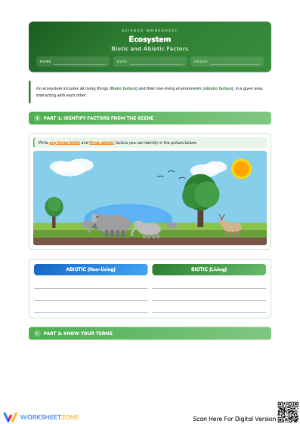
Living, Non-Living, and Once-Living Classification — Students sort objects and pictures into three categories, not two. The "once-living" category is the hard one; a dried leaf, a wooden table, and a piece of cotton thread all trip students up in predictable ways. Worksheets in this strand ask students to record why they placed each item in its column, forcing them to articulate reasoning rather than guess.
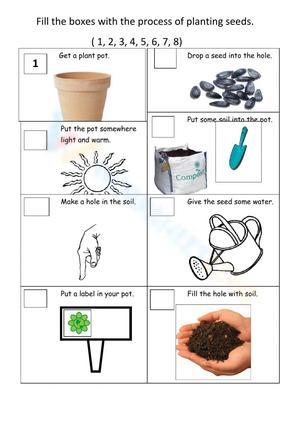
Plant Structures and Growth Needs — Students label diagrams of a flowering plant, match each structure to its function, and complete sequence strips tracking seed germination. One worksheet pairs a cross-section drawing with sentence frames: students explain why roots grow downward while the shoot grows upward, connecting structure to behavior before they have the word "tropism."
Animal Coverings and Survival Structures — Students sort animals by body covering — fur, feathers, scales, shells, smooth skin — and connect each type to a habitat or survival advantage. A companion worksheet asks students to draw and label the external body parts of one animal they choose, giving teachers a quick read on vocabulary retention without a formal quiz.
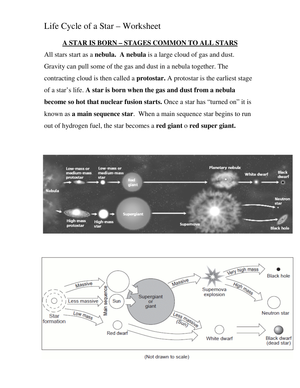
Life Cycles — Cut-and-sequence strips walk through the stages of a butterfly, a frog, and a flowering plant. Students arrange the stages, label each one, and write one sentence about what changes between two consecutive stages. The frog cycle is deliberately included alongside the butterfly because students this age often overgeneralize "metamorphosis" to mean any kind of growth and need the contrast.
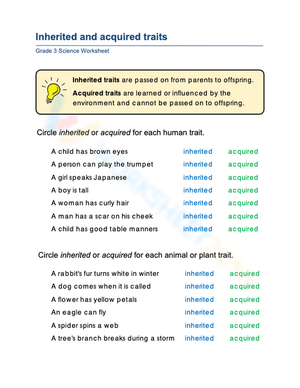
Parent and Offspring Traits — Students compare adult animals with their young, circling shared features and writing one observable difference. This maps directly to NGSS 1-LS3-1 and regularly surfaces in unit assessments, so these worksheets function as both practice and formative check.
Frequent Student Errors Worth Watching For
The living/non-living classification generates the most persistent confusion at this grade level. First graders reliably sort "living" and "dead" correctly but stall completely when they hit something that was once living — a piece of paper, a wood plank, a leather shoe. They lack the vocabulary to articulate that a wooden table was once a living tree and often default to "non-living" because it doesn't move. The worksheets address this directly with sentence frames built into the "once-living" column, giving students language before they need to produce it independently.
Life cycle sequencing produces a different error pattern. When working with the butterfly cycle, many students place the egg stage last — not because they misunderstand the sequence, but because they see the adult butterfly illustration at the top of the strip and read it as the starting point. Running one cycle together as a class before releasing students to independent work prevents this before it takes hold.
Parent-offspring comparisons trip up students who focus on size rather than structure. A student might write "the kitten looks nothing like the cat" because the size difference is the most obvious feature. Directing students to look specifically at ear shape, tail shape, and fur pattern — rather than overall body size — shifts attention to the heritable traits the standard actually targets, and several of these worksheets include that focusing prompt explicitly.
How to Build These Worksheets Into Your Lesson Plans
The living/non-living classification worksheet works best on the second day of a unit introduction, after students have completed a hands-on sort with real objects. Running the printable before that concrete experience produces mechanical guessing rather than genuine reasoning. Do the physical sort first — rocks, leaves, seeds, pencils, insects — and then distribute the worksheet as a structured follow-up that transfers what students just did with objects to pictures on a page.
Life cycle strips fit naturally into a 20-minute science center rotation. Students who finish the cut-and-sequence task early can move immediately to the sentence-writing prompt on the back, which keeps the center self-managing. The 1st grade biology printable worksheets tasks in this collection work especially well at stations because the instructions are visual enough for early readers to follow without teacher support — freeing the teacher to work with small groups on the parent-offspring comparison tasks, which benefit most from guided discussion.
Parent-offspring worksheets make strong end-of-unit assessment tools. Administer the comparison sheet without a word bank and use student responses as a formative read: which students have internalized the vocabulary, and which are still defaulting to size-based comparisons? The results directly inform grouping decisions for the next lesson.
Standard Alignment
The collection aligns to two NGSS performance expectations. 1-LS1-1 asks students to use materials to design a solution that mimics how animals use external parts to survive and meet their needs. The animal coverings worksheets build the prerequisite understanding that standard requires — a student who can explain why a duck's webbed feet help it move through water is positioned to apply that logic to a design task. 1-LS3-1 asks students to construct an evidence-based account showing that young animals are like, but not exactly like, their parents. The parent-offspring comparison worksheets target that standard directly: students examine photographs, identify shared features, and record one observable difference, practicing the evidence-based account format in a format accessible to early writers. These two standards appear across most state frameworks that draw from NGSS, though specific code designations vary — confirm exact numbering in your state's framework before logging alignment in a gradebook.
Differentiating These Worksheets Across Ability Levels
For students still developing print literacy, the cut-and-sequence strips and sorting tasks carry the full cognitive load without requiring fluent reading. Those worksheets function as designed for students who cannot yet decode sentence-frame prompts. The labeling diagrams can be adjusted by pre-filling one or two labels — a straightforward modification that reduces retrieval demand without changing the content standard being assessed.
Students who move quickly through basic labeling tasks benefit from the "explain your reasoning" follow-up questions embedded in several worksheets. A student who labels a plant diagram in three minutes and then writes a sentence explaining what each structure does is working at a substantially higher cognitive level than simple identification. This 1st grade biology printable worksheets set builds those extension prompts into the design, so teachers don't need to generate separate challenge questions on the fly.
For students who need more support with life cycle sequencing, pre-cutting the strips before distributing them and letting students physically arrange the pieces before committing with glue reduces the anxiety that comes from making permanent decisions on paper. The kinesthetic step between manipulating and committing is meaningful for students who freeze when the task feels irreversible.
Frequently Asked Questions
What prior knowledge do students need before using these worksheets?
Students benefit from at least one hands-on observation session before working with the classification or labeling worksheets. Familiarity with the word "living" is sufficient to start — the worksheets build and refine the concept rather than assume mastery of it. The life cycle worksheets, specifically the butterfly and frog sequences, assume students have seen an image or brief video of each organism. Without that visual reference, the stage drawings can confuse early readers who can't decode the printed labels independently.
How many worksheets focus on plants versus animals?
Roughly half the set addresses plants and half addresses animals, with the parent-offspring strand covering both. This distribution reflects the actual balance in Grade 1 NGSS expectations, which weight plant and animal structures approximately equally. Teachers running a dedicated plant unit can pull the plant worksheets as a standalone sequence without working through the full collection in order.
Are these worksheets usable in kindergarten or 2nd grade?
Several of the plant-labeling and sorting worksheets work cleanly in kindergarten when students already have basic science vocabulary in place. The parent-offspring and life cycle worksheets assume writing production that typically emerges in mid-to-late Grade 1. For 2nd grade, the classification and sorting worksheets work well as review or as accessible entry points at the start of a life science unit before moving into Grade 2 content like habitats and food chains.
Can the life cycle strips be used independently from the rest of the collection?
Yes. Each 1st grade biology printable worksheets life cycle strip is fully self-contained, with the organism name, stage labels, and a sentence-writing prompt included on the same worksheet. Teachers who need a sequencing activity for a butterfly or frog unit can pull those specific worksheets without any of the surrounding materials — no preparation beyond printing required.