


























Views
Downloads
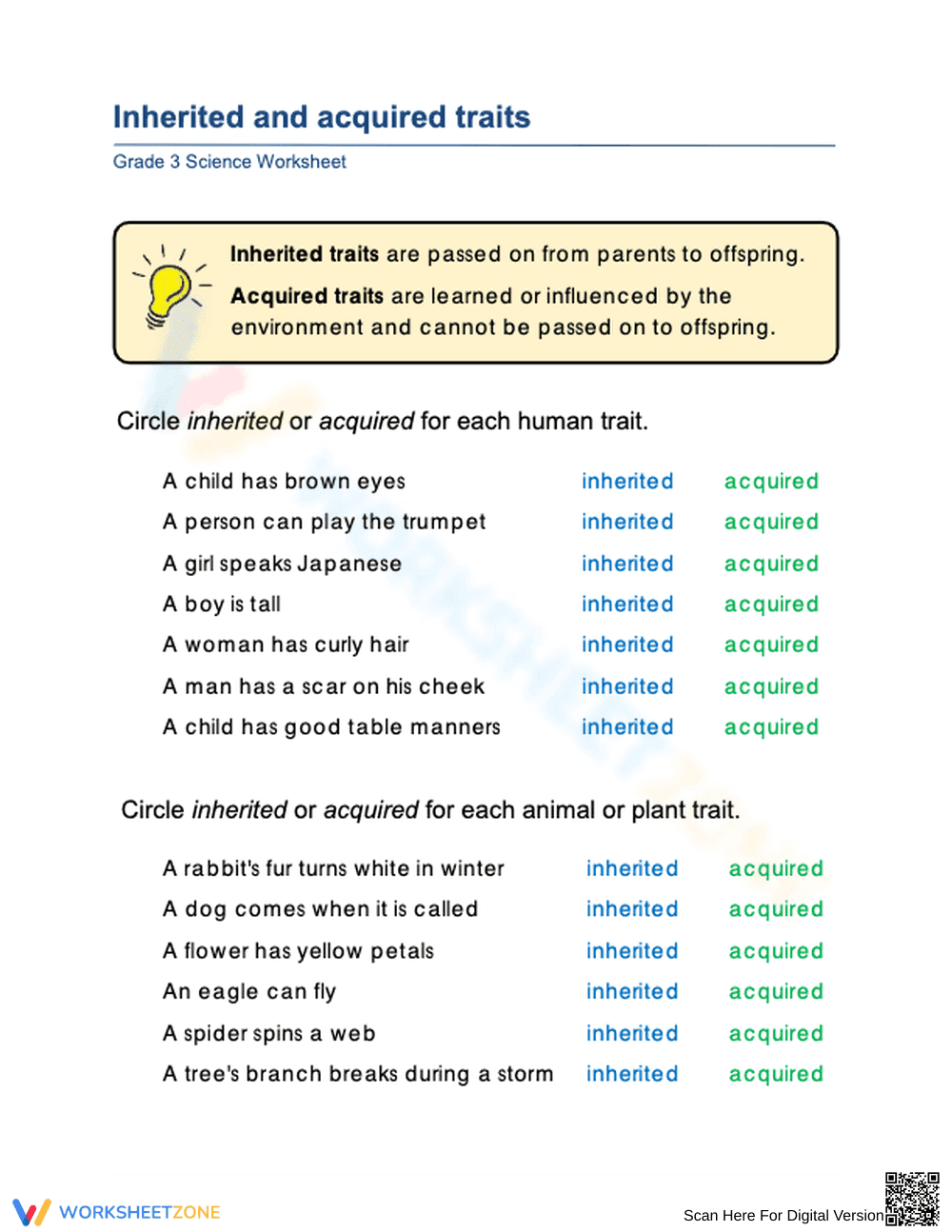

Grade 1 Inherited Traits — Printable No-Prep Worksheet
Paste this activity's link or code into your existing LMS (Google Classroom, Canvas, Teams, Schoology, Moodle, etc.).
Students can open and work on the activity right away, with no student login required.
You'll still be able to track student progress and results from your teacher account.
This Grade 1 science worksheet helps students differentiate between traits passed from parents and those learned from the environment. By classifying various human, animal, and plant characteristics, young learners build a foundational understanding of biological inheritance and environmental influence.
At a Glance
- Grade: 1 · Subject: Science
- Standard:
1-LS3-1— Identify similarities and differences between parents and offspring- Skill Focus: Inherited and Acquired Traits
- Format: 2 pages · 13 problems · Answer key included · PDF
- Best For: Independent practice and review
- Time: 10–15 minutes
This resource includes a one-page student worksheet and a complete answer key. The student page begins with clear, student-friendly definitions of both inherited and acquired traits to support independent work. Below the definitions, students will find 13 classification tasks divided into two sections: seven human traits and six animal or plant traits.
Zero-Prep Workflow
- Print (1 minute): Simply print the single-page PDF for each student. The built-in definitions mean no extra anchor charts are required.
- Distribute (1 minute): Hand out the worksheets as a quick independent activity or homework assignment.
- Review (3 minutes): Use the included answer key to quickly grade submissions or guide a whole-class review.
Total teacher prep time is under two minutes, making this an ideal addition to any emergency substitute teacher plan.
Standards Alignment
Aligned to primary standard 1-LS3-1: Make observations to construct an evidence-based account that young plants and animals are like, but not exactly like, their parents. By categorizing traits as inherited or acquired, students gather evidence of biological patterns. Both standard codes can be copied directly into lesson plans, IEP goals, or district curriculum mapping tools.
How to Use It
Use this worksheet as a formative assessment immediately following a whole-class lesson on life cycles or genetics. Alternatively, assign it as a paired activity where students must discuss and justify their choices before circling the correct term. During the activity, listen to student conversations to ensure they understand the difference between physical traits (like brown eyes) and learned behaviors (like playing the trumpet). Expected completion time is 10 to 15 minutes.
Who It's For
This resource is designed for first-grade students but works well for second graders needing a quick review of life science fundamentals. The straightforward sentence structure and clear formatting make it highly accessible for English Language Learners. It pairs perfectly with introductory lessons on plant and animal adaptations.
Mastering the distinction between inherited and acquired traits is a critical step in early elementary science education that builds a foundation for future genetic studies. Aligned with 1-LS3-1, this activity helps students identify similarities and differences between parents and offspring through guided categorization. According to a ScienceDirect TpT Analysis, providing explicit definitions alongside immediate classification practice significantly improves the retention of domain-specific vocabulary in young learners. By evaluating highly familiar examples—such as a dog coming when called, a person playing the trumpet, or a flower having yellow petals—students can successfully anchor abstract biological concepts to observable, everyday phenomena. This targeted practice not only reinforces core life science principles but also encourages critical thinking as students debate whether a characteristic is a product of nature or the environment. The clear, distraction-free format supports cognitive focus, ensuring that all learners can confidently master these essential scientific classifications.


