


























Views
Downloads
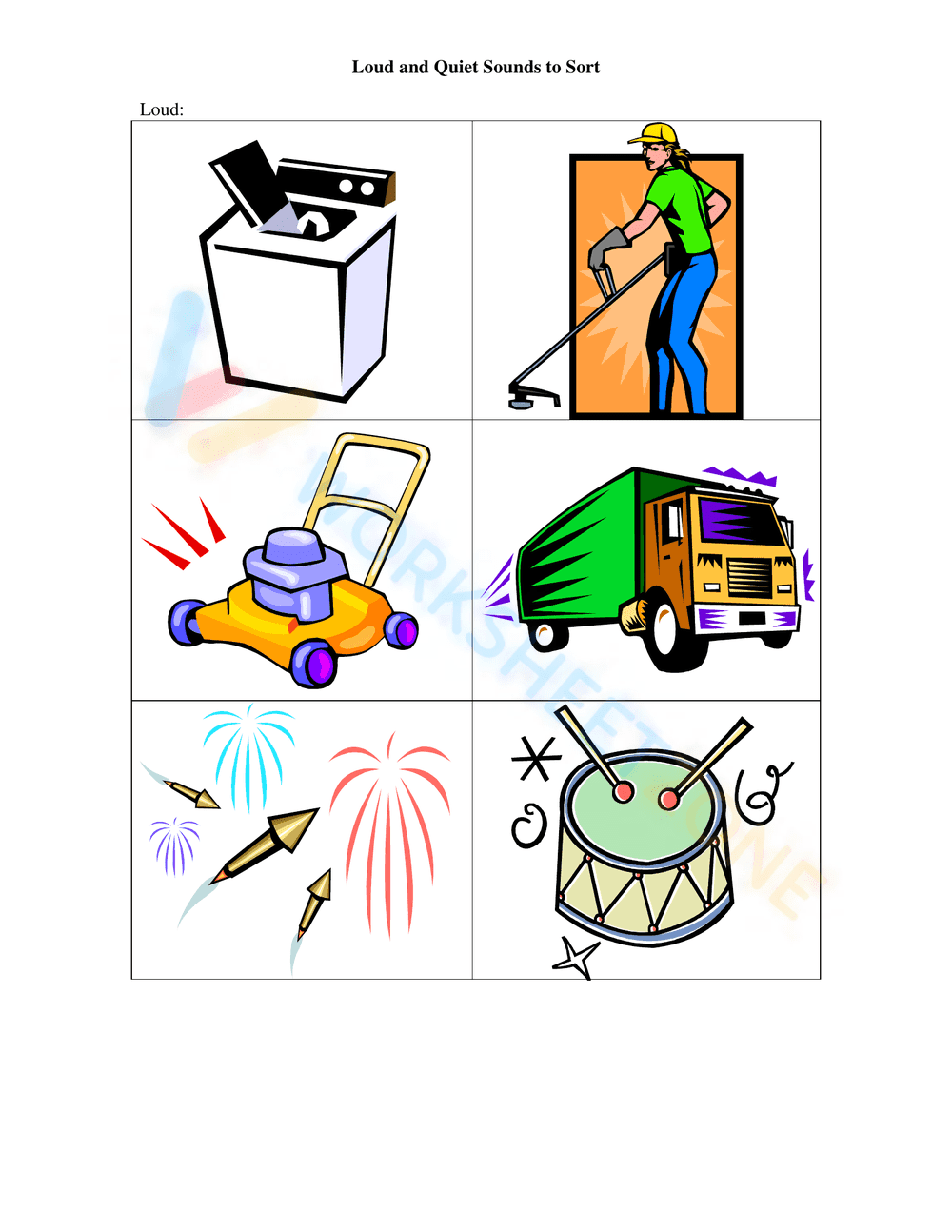


Loud and Quiet Sounds Sort | Printable Grade 1 Science
Paste this activity's link or code into your existing LMS (Google Classroom, Canvas, Teams, Schoology, Moodle, etc.).
Students can open and work on the activity right away, with no student login required.
You'll still be able to track student progress and results from your teacher account.
This printable loud and quiet sounds sorting activity helps first-grade students classify different everyday noises based on their volume. By evaluating familiar scenarios like a ringing telephone or a sleeping child, young learners develop foundational physical science skills and build a stronger understanding of sound energy in their daily environment.
At a Glance
- Grade: 1 · Subject: Science
- Standard:
1-PS4-1— Observe and classify different types of sounds- Skill Focus: Sorting loud and quiet sounds
- Format: 3 pages · 16 problems · PDF
- Best For: Independent practice or science centers
- Time: 15–20 minutes
This three-page resource features 16 visual sorting cards depicting common objects. Students find clear illustrations of loud items, such as a lawnmower and fireworks, alongside quiet scenarios, like reading or whispering. The straightforward layout allows students to easily cut, sort, and paste the images into the correct categories, making it an engaging hands-on activity.
- Guided practice: Begin by reviewing the first few images together as a class, discussing why a weed whacker makes a loud noise while watering a plant is quiet.
- Supported practice: Have students work in pairs to sort the remaining cards, encouraging them to explain their reasoning to their partner before finalizing their choices.
- Independent practice: Students independently categorize the final set of images, demonstrating their individual grasp of volume differences.
This gradual-release approach ensures students confidently transition from the "I Do" phase to the "You Do" phase of learning.
This worksheet aligns with 1-PS4-1, which asks students to plan and conduct investigations to provide evidence that vibrating materials can make sound. While this specific activity focuses on the observable properties of those sounds (volume), it serves as a crucial building block for understanding sound energy. Both standard codes can be copied directly into lesson plans, IEP goals, or district curriculum mapping tools.
Integrate this sorting activity into your science centers during a unit on sound energy. It works well as a formative assessment after direct instruction on volume. As students sort the cards, listen to their peer discussions; if a student struggles to classify the dripping faucet, it provides an immediate opportunity to review. Expect this activity to take 15 to 20 minutes.
This resource is designed primarily for first-grade general education students, though it is highly effective for kindergarteners needing enrichment or second graders requiring review. The heavy reliance on visual cues makes it an excellent tool for English Language Learners (ELLs) and students with special education needs who benefit from reduced text. Pair this worksheet with a read-aloud book about the five senses or an interactive classroom sound walk.
Developing early classification skills in physical science is essential for long-term academic success. When students practice sorting loud and quiet sounds, they are actively engaging with the foundational concepts of 1-PS4-1 to observe and classify different types of sounds. According to a recent ScienceDirect TpT Analysis, hands-on sorting activities that utilize clear visual supports significantly improve retention of abstract science concepts in early childhood education. By connecting familiar visual stimuli—like a loud firework or a quiet whisper—to scientific vocabulary, young learners build stronger cognitive frameworks for future physics and energy units. This structured approach to categorizing sensory input not only meets core science standards but also supports cross-curricular vocabulary development, ensuring students are well-prepared for more complex scientific inquiries and investigations in subsequent grade levels.


