




























Views
Downloads

Essential Healthy Foods Worksheet | Kindergarten Science

Paste this activity's link or code into your existing LMS (Google Classroom, Canvas, Teams, Schoology, Moodle, etc.).
Students can open and work on the activity right away, with no student login required.
You'll still be able to track student progress and results from your teacher account.
Teaching young children to make informed nutritional choices is a vital part of early science and health education. This Essential Healthy Foods Worksheet helps students distinguish between nutrient-dense options and occasional treats. By evaluating a variety of familiar items, learners build the foundational knowledge required to understand how food choices impact physical well-being and growth.
At a Glance
- Grade: Kindergarten · Subject: Science
- Standard:
K-LS1-1— Use observations to describe patterns of what humans need to survive- Skill Focus: Nutritional Classification
- Format: 1 page · 12 problems · Answer key included · PDF
- Best For: Introduction to healthy eating habits
- Time: 10–15 minutes
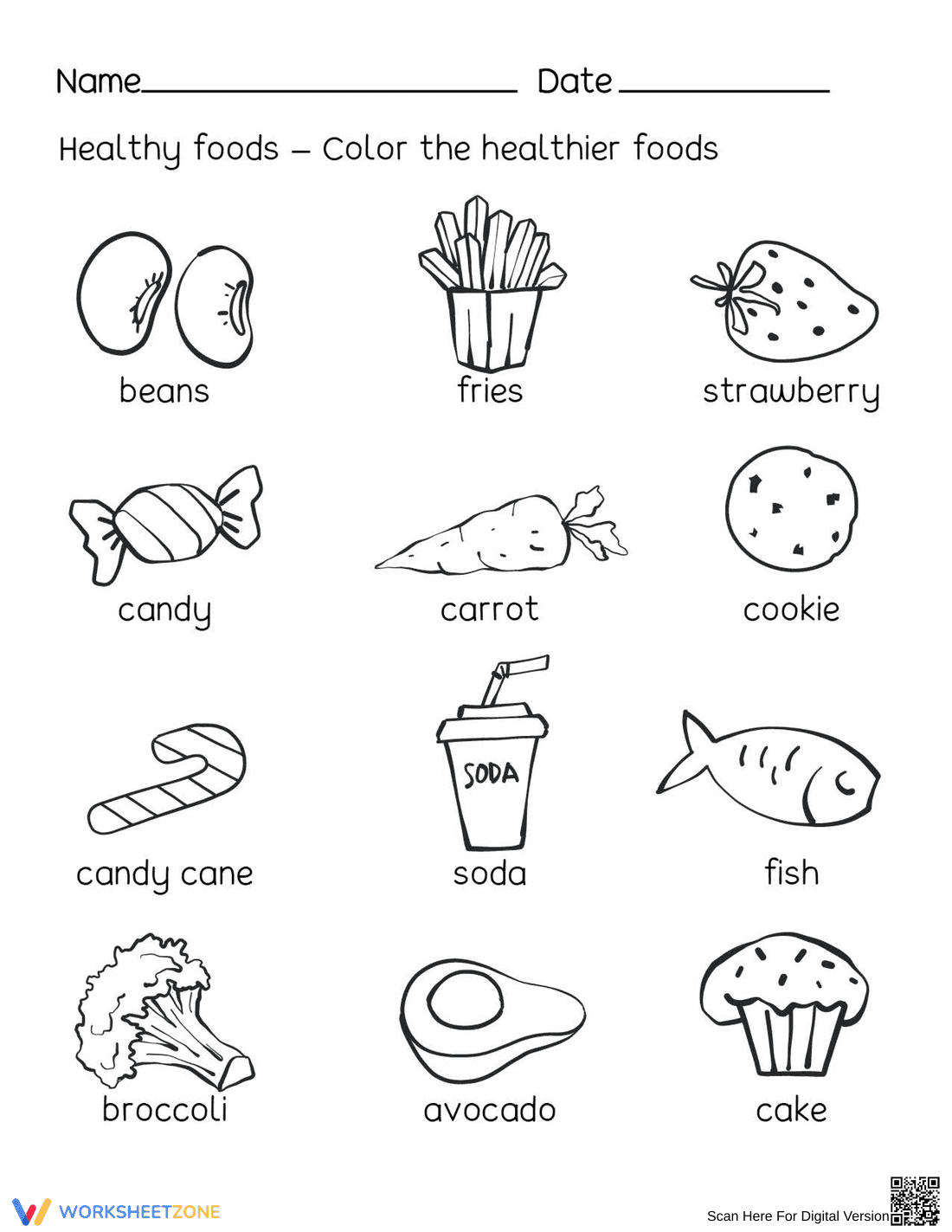
This single-page PDF features 12 high-quality illustrations of various food and drink items, including proteins, vegetables, fruits, and snacks. The clear, bold outlines are perfect for coloring, while the printed labels beneath each image support early literacy and vocabulary development. A comprehensive answer key is provided to ensure quick and accurate student feedback on every choice.
This resource is designed for a fast-paced classroom environment. The workflow involves three simple steps: Print (30 seconds), Distribute (1 minute), and Review (1 minute). The total teacher preparation time is under two minutes. Students can complete the task independently, making it an ideal choice for emergency sub plans, morning work, or quick transitions between scheduled lessons.
The primary alignment for this activity is `K-LS1-1`: Use observations to describe patterns of what plants and animals (including humans) need to survive. It focuses specifically on the human requirement for healthy food to maintain life and health. This standard code can be copied directly into lesson plans, IEP goals, or district curriculum mapping tools to demonstrate compliance with national science frameworks.
Use this worksheet as a formative assessment after a direct instruction lesson on food groups. Observe students as they color to identify those who may struggle with the concept of "sometimes" foods versus "everyday" foods. Alternatively, it serves as an excellent quiet-time activity following a classroom discussion about the importance of balanced meals and the role of nutrients in energy levels.
This activity is perfectly suited for Preschool, Kindergarten, and Grade 1 students who are developing their sorting and classification skills. It is highly beneficial for tactile learners who enjoy coloring while processing new information. Pair this resource with a classroom anchor chart or a read-aloud book about nutrition for a complete and cohesive learning experience during your health unit.
Early childhood nutritional education is a critical component of biological science and personal health curriculum. This resource aligns with `K-LS1-1`, which requires students to use observations to describe patterns of what humans need to survive, specifically focusing on the distinction between nutrient-dense foods and high-sugar alternatives. By engaging in the classification of twelve distinct food items—ranging from proteins like fish to leafy vegetables like broccoli—students develop the foundational observational skills necessary for scientific inquiry. According to a ScienceDirect TpT Analysis, high-engagement visual sorting tasks significantly improve retention of health concepts in primary learners compared to passive instruction. The worksheet provides a structured environment for students to apply their understanding of "healthier" choices through a familiar coloring medium. This alignment ensures that young learners are not only practicing fine motor skills but also building a conceptual framework for wellness that supports long-term academic and personal success in health-related domains.


