


























Views
Downloads

Grade 1 Parts of the Face — Printable No-Prep Worksheet
Paste this activity's link or code into your existing LMS (Google Classroom, Canvas, Teams, Schoology, Moodle, etc.).
Students can open and work on the activity right away, with no student login required.
You'll still be able to track student progress and results from your teacher account.
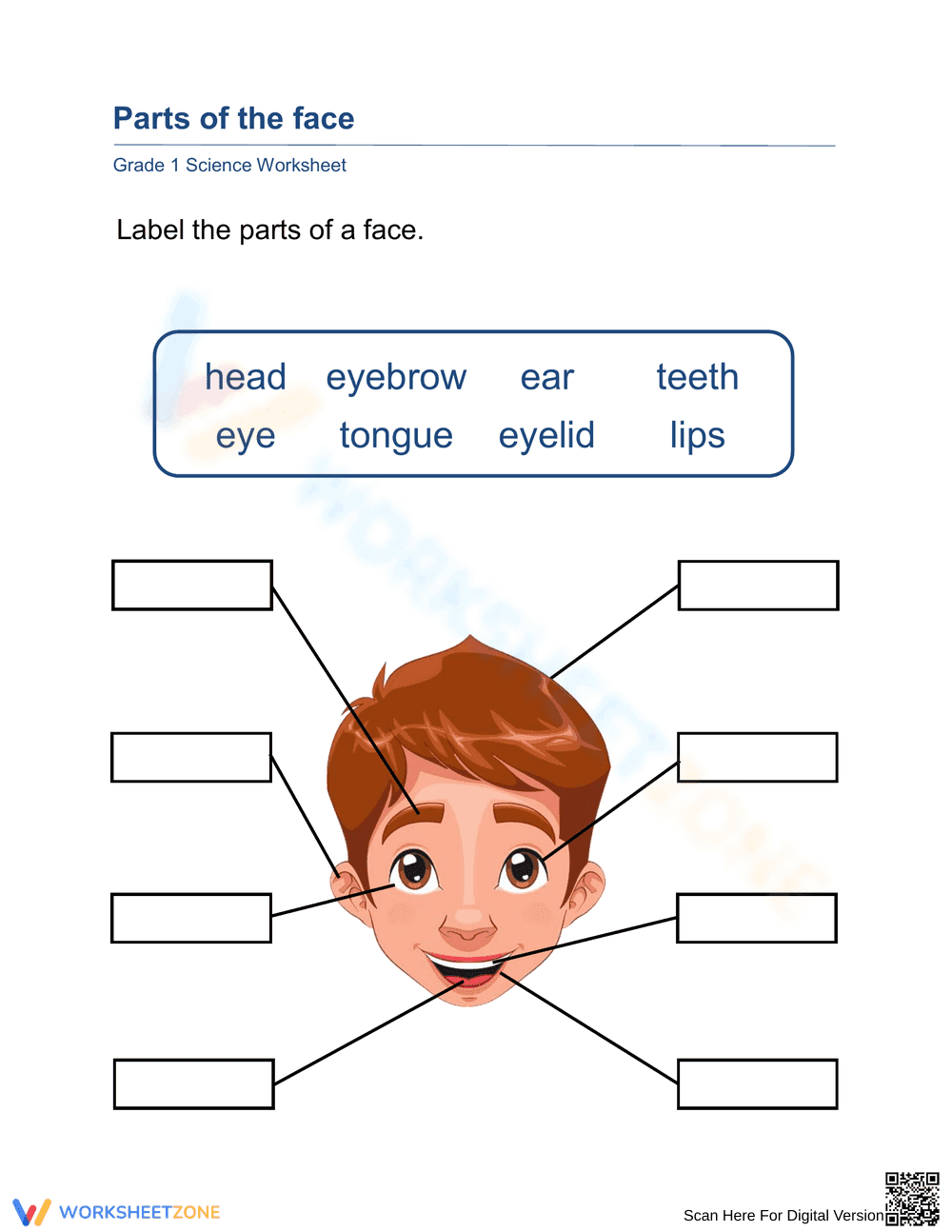
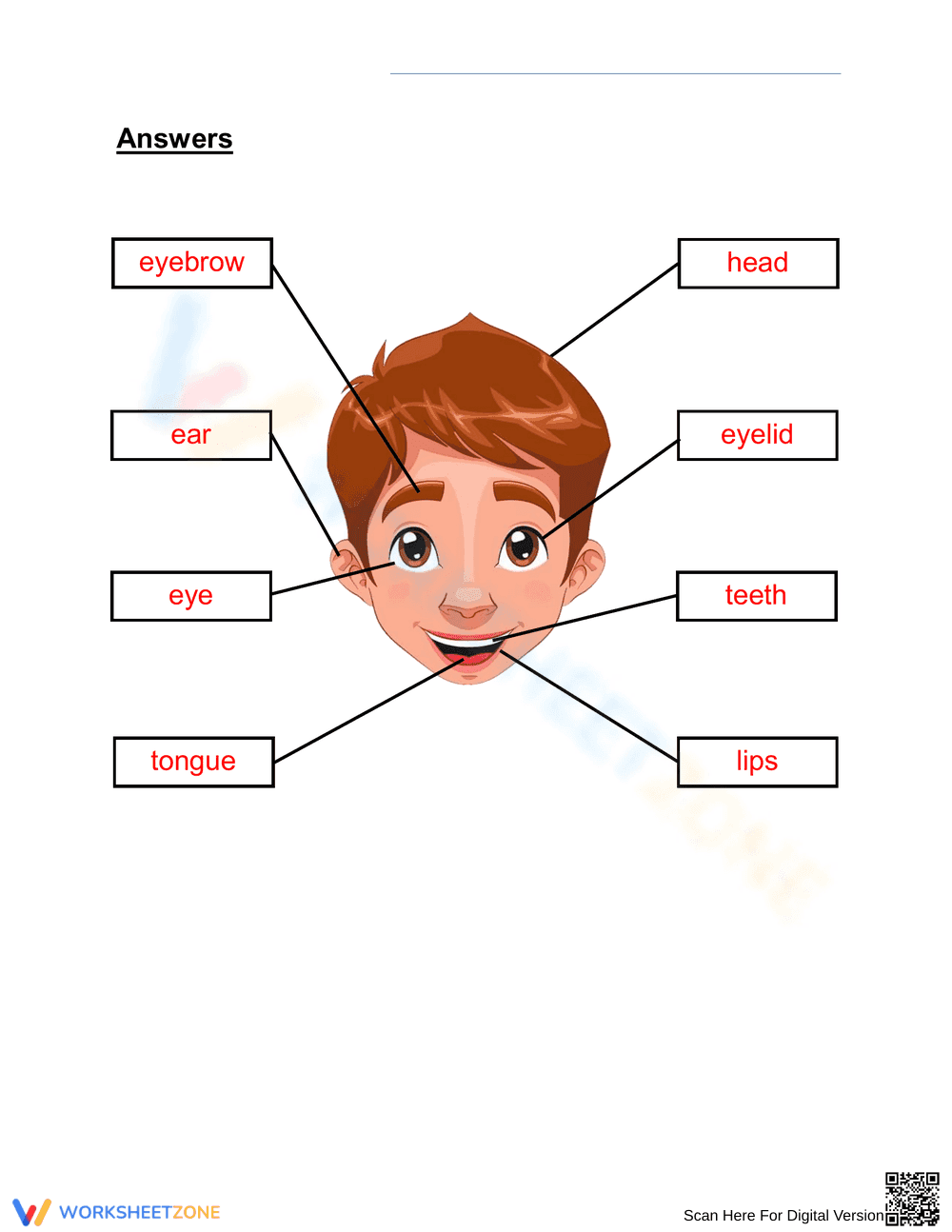
This Grade 1 science worksheet helps students master anatomical vocabulary by labeling eight distinct parts of the human face. By identifying features like the eyelid and tongue, learners develop foundational biological awareness and fine motor skills through guided writing. It provides a clear, visual entry point into the study of human body systems and structure.
At a Glance
At a Glance
- Grade: 1 · Subject: Science
- Standard:
1-LS1-1— Identify and describe how external parts help organisms survive, grow, and meet needs- Skill Focus: Facial anatomy vocabulary and identification
- Format: 2 high-quality pages · 8 problems · Answer key included · PDF
- Best For: No-prep primary science centers, independent practice, or sub plans
- Time: 10–15 minutes
What's Inside
The package includes a high-quality labeling worksheet featuring a clear, child-friendly illustration of a boy's face and an organized word bank. Students use eight precise lines to match terms like "eyebrow," "eyelid," and "tongue" to the correct anatomical locations. A complete answer key is provided on the second page for immediate feedback or teacher-led review sessions, ensuring accuracy in every lesson.
Zero-Prep Workflow
Teachers can implement this resource in three easy steps: Print the single-page worksheet (15 seconds), distribute it to students as a bell-ringer or science center activity (30 seconds), and review the answers using the provided key (1 minute). Total teacher preparation time is under two minutes, making it an ideal choice for emergency sub plans or quick transitions between instructional blocks.
Standards Alignment
Aligned to 1-LS1-1, which focuses on how external parts of organisms function to meet their survival needs. This worksheet specifically addresses the "Structure and Function" disciplinary core idea by requiring students to recognize and name specific human features. Both standard codes can be copied directly into lesson plans, IEP goals, or district curriculum mapping tools for seamless documentation.
How to Use It
Assign this during the "Explain" phase of a 5E lesson to consolidate vocabulary after a direct instruction session on the human body or the five senses. For formative assessment, observe students as they distinguish between similar features like the eye and eyelid; this provides an immediate window into their anatomical precision and reading comprehension during the independent work period.
Who It's For
This resource is designed for Grade 1 students, English Language Learners (ELLs) requiring visual scaffolds, and primary learners developing spelling proficiency. It pairs naturally with a classroom "All About Me" unit or a science passage discussing how humans interact with their environment using their senses and specific facial features like the lips and ears.
According to RAND AIRS 2024, the use of visual labeling tasks in early childhood science significantly enhances the retention of technical vocabulary and the ability to categorize structural components. This worksheet targets the 1-LS1-1 standard by focusing on the plain-English skill of identifying external parts of the human body. By providing a structured word bank alongside clear diagrammatic lines, the resource minimizes cognitive load while maximizing student engagement with anatomical concepts. Research from NAEP indicates that learners who successfully master foundational labeling tasks in Grade 1 are better prepared for more complex systems-thinking in upper elementary life sciences. This tool serves as a bridge between simple observation and the formal scientific description of organisms, ensuring that every student can access the curriculum through evidence-based, classroom-ready materials that support long-term academic growth.


