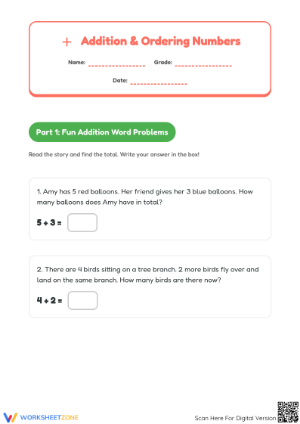
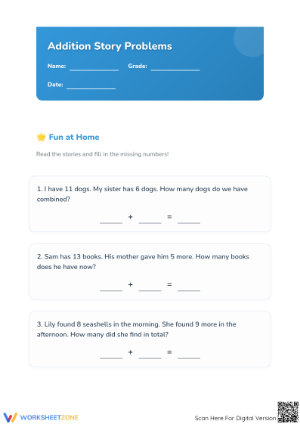
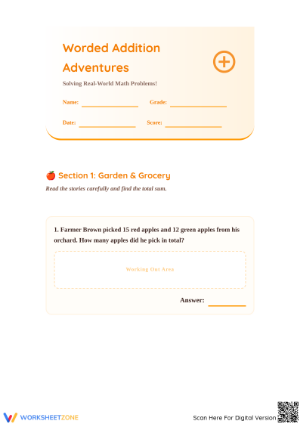
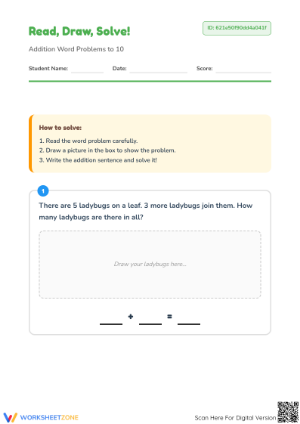
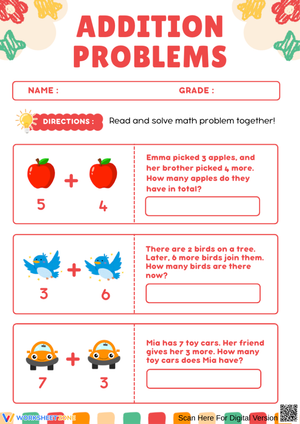
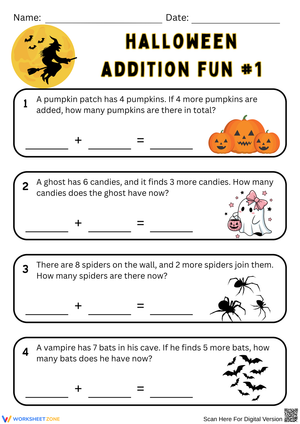
Addition word problem worksheets for 1st grade give teachers a direct route between math fact fluency and the reasoning that shows whether a child actually understands what addition does — not just which answer to retrieve. These worksheets ask students to read a short story, decide what is happening, and represent the situation through a drawing, a ten frame, or a written equation before arriving at a number.
What Each Worksheet Asks Students to Do
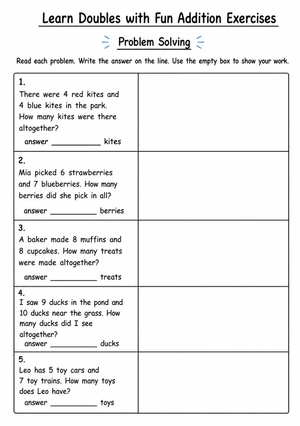
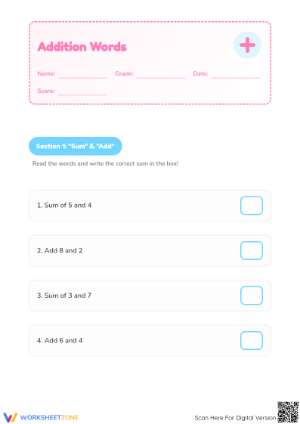
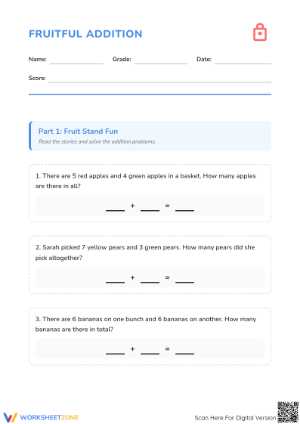
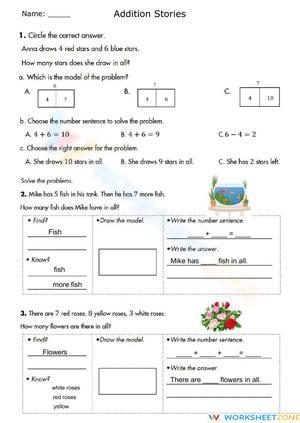
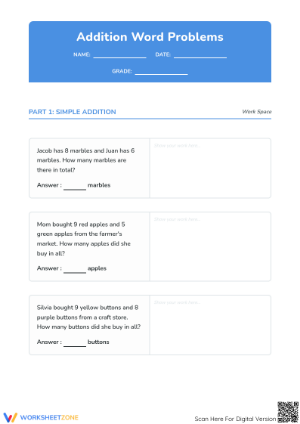
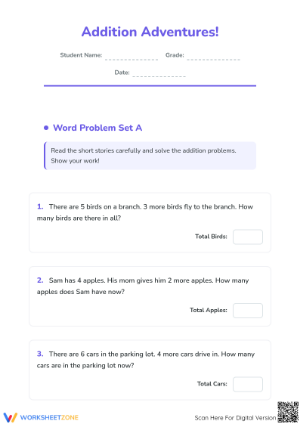
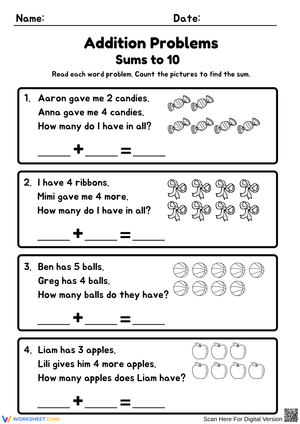
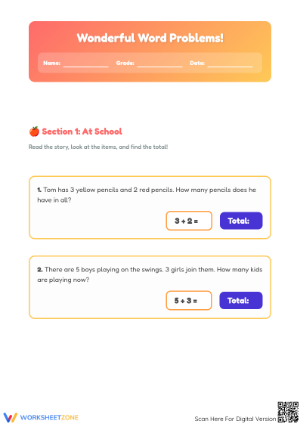
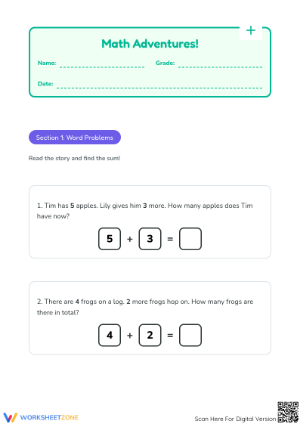
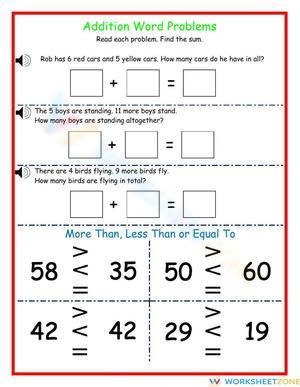
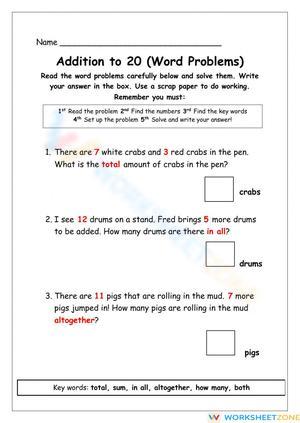
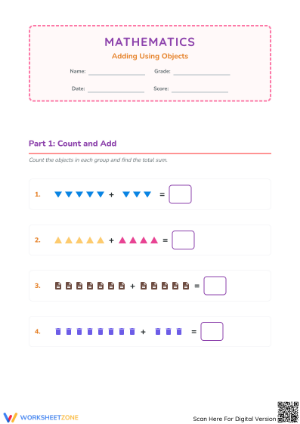
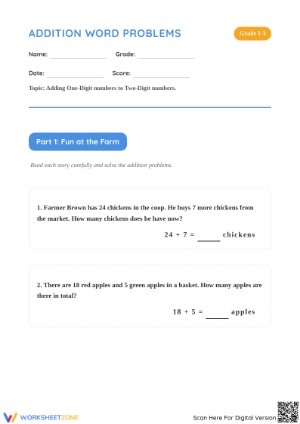
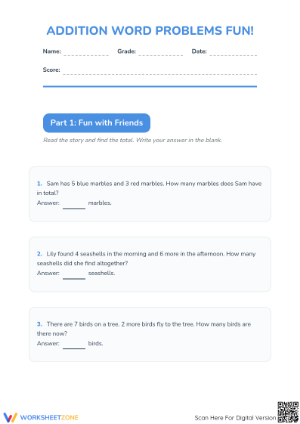
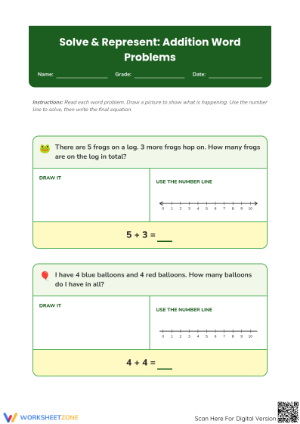
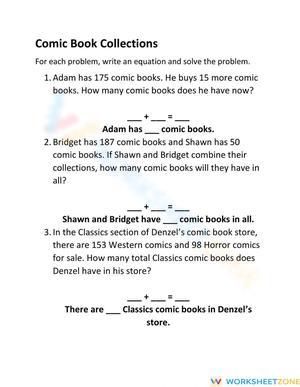
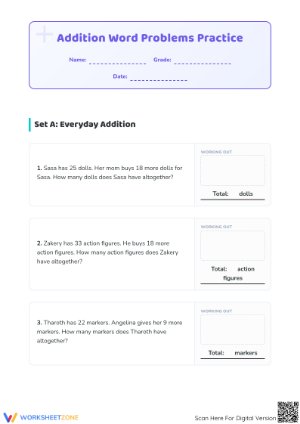
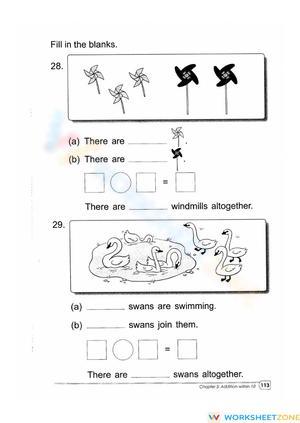
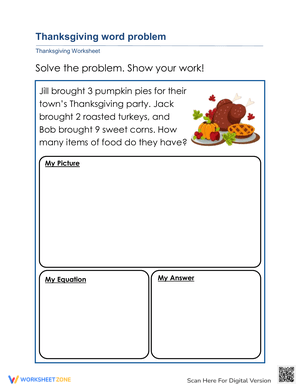
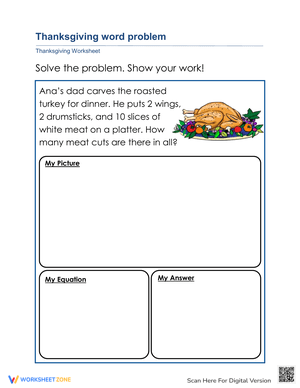
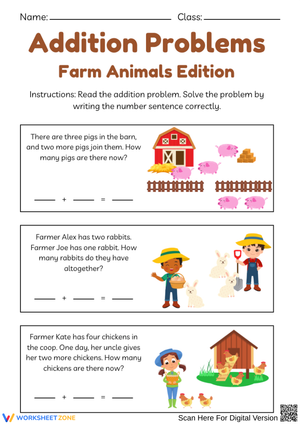
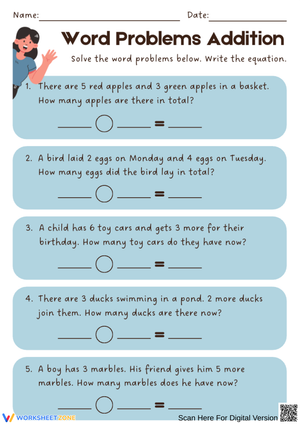
The core task is translating language into a mathematical action. Students read a sentence or two, identify the quantities being joined, and record both a visual model and a written equation. Each worksheet focuses on one-step joining situations — two groups coming together, a starting amount increasing, or two parts making a whole. Problem structures draw from joining and part-part-whole categories because those map directly to the addition equation form students are already learning to write.
Across the set, number ranges shift from sums within 10 to sums within 20. Early worksheets keep numbers small and sentences short — three to five words of actual math content — so reading load stays low and student thinking goes toward the operation, not decoding. Later worksheets present the same familiar problem structures but push into the teens, asking students to apply counting-on or ten-frame strategies they have already practiced in isolation. The best addition word problem worksheets for 1st grade make that progression visible in the page design itself: more white space and picture cues early, cleaner equation-focused layouts later.
Why One-Step Story Problems Belong in Grade 1 — and Why Format Matters
First graders are still working out that numbers represent quantities that can be acted upon. That is not a reading problem or a motivation problem — it is a developmental one. The word problem format forces the connective step: students have to decide what the story is asking before they can write anything down. Repeated exposure to that decision-making, in a format consistent enough that students recognize the routine, builds the flexible thinking that resurfaces in second-grade multi-step problems and beyond.
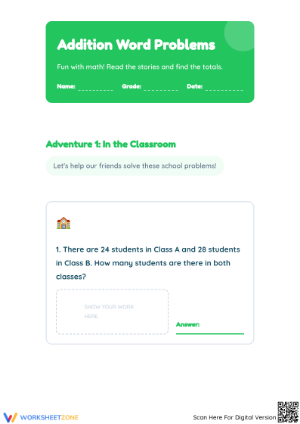
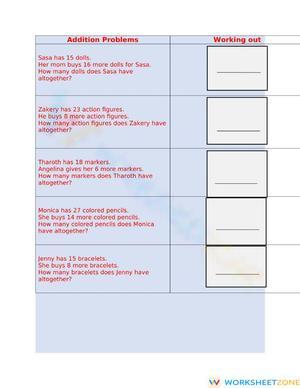
Page design is part of the instruction at this age. Large print, one problem per problem block, and dedicated space for drawing are not cosmetic choices. Cognitive load research is clear that novice learners perform better when irrelevant visual complexity is removed. A clean worksheet with one story, a blank box for a picture, and a line for the equation asks students to do exactly the work that matters — and nothing else.
Mistakes Students Make That These Worksheets Help You Catch
The most predictable error in first-grade word problems is solving by the numbers rather than by the situation. A student who sees "3" and "5" in a story will write 3 + 5 = 8 without checking whether that matches what actually happened. This error is nearly invisible when worksheets include only straightforward joining stories, but it surfaces immediately when you include a problem like "Maya had 7 stickers. She gave 2 away." Students skimming for numbers and assuming addition write 7 + 2 = 9. Including a deliberate mix of problem situations — even across addition-focused worksheets — makes the read-first habit visible before a test does.
A second recurring pattern: students draw an accurate picture but write an equation that does not match it. They will draw four apples and three more, count seven correctly, and still write 4 + 2 = 7 — because the drawing was right but the equation was reconstructed from memory using the wrong second addend. Worksheets that require both a model and a written equation in adjacent spaces make that discrepancy visible without any follow-up questioning. The mismatch sits right there on the page.
Building These Worksheets Into Your Math Block
The 10 minutes after the mini-lesson and before independent practice is where these worksheets earn their place. Use one problem as a shared example during the lesson — project it, read it aloud, and model underlining the action word before writing the equation. Then send students to their seats with the full worksheet. That transition is faster when the format matches exactly what you just modeled together.
Addition word problem worksheets for 1st grade fit naturally into small-group time as well. A group of three or four students can work through two problems together, each student drawing the model independently before comparing. That structure surfaces disagreements — "I drew 5 and 3 but she drew 3 and 5" — that rarely come up during silent seatwork. You hear the reasoning in real time without scheduling a separate conference.
For centers, slide individual worksheets into dry-erase pockets. Students solve with a dry-erase marker, you check, they wipe it clean — one worksheet stays usable across a full week without printing a new copy each day. For sub plans, two worksheets with a familiar problem structure run without explanation because students already know the routine.
Differentiating These Worksheets Across the Classroom
Students who are still making sense of one-to-one correspondence need worksheets where numbers stay at or below 5 and a picture is already partially drawn — they extend the image rather than build it from scratch. That partial image structure reduces the blank-page freeze that slows some early learners before they have even read the problem.
Students with solid fluency within 10 are ready for within-20 problems and an added challenge: after solving, write a related subtraction equation. That extension does not require a different worksheet — it is a written instruction you add to the top of the page with a pen. The same worksheet meets three different learners when you think about what each student needs to produce, not just what they read.
For students in intervention, reading the problem aloud and acting it out with physical counters before touching the paper is the right sequence. The worksheet then functions as a recording tool, not the site of the thinking. Separating manipulation from recording — counters for reasoning, paper for notation — is an important distinction for students who conflate "I can't fill in the paper" with "I don't understand the math."
Standard Alignment
These worksheets address CCSS 1.OA.A.1, which requires first graders to use addition within 20 to solve word problems involving situations of adding to, putting together, and finding an unknown whole — using objects, drawings, and equations. That standard sits at the center of the Grade 1 Operations and Algebraic Thinking domain because it is the first time students are formally expected to connect a written expression to a real-world situation. Teachers typically begin 1.OA.A.1 work in the first quarter with sums within 10, then revisit the standard across the year as students extend to 20 and shift from drawing-first to equation-first strategies.
Frequently Asked Questions
Do these worksheets work for students who cannot yet read the problems independently?
Yes, with one adjustment. Read the problem aloud while the student follows along, then step back and let them handle the math. The reading barrier is real in Grade 1, but it does not have to keep students from reasoning through the operation. Once the language is processed, the drawing and equation work is fully within reach.
How many problems per worksheet is appropriate for first graders?
Two to four problems per worksheet matches typical Grade 1 attention spans for independent math work. More than four one-step word problems on a single worksheet tends to produce rushed answers on the later items — students begin pacing themselves to finish rather than thinking carefully about each story.
When in the year should word problem practice begin?
Most teachers introduce simple joining problems in the second month of first grade, after students have had several weeks of oral number sense work and can reliably count forward from a given number. Starting before students understand what it means to combine two quantities produces rote copying behavior rather than actual reasoning about the problem situation.
How do these worksheets work for progress monitoring?
Effectively, particularly when a worksheet includes both within-10 and within-20 problems and requires students to show a model alongside an equation. A quick scan of whether the drawing matches the equation — and whether the equation matches the story — gives three data points per problem without a formal test. Many teachers pull a short set at the end of a unit cycle as a formative snapshot before deciding whether to move forward or reteach.
What is the best way to store and reuse printed copies?
Dry-erase sleeves handle center copies well — one printed copy per sleeve, reusable all week. For intervention binders and homework folders, addition word problem worksheets for 1st grade print at standard letter size and store flat without trimming. A tabbed binder sorted by sum range — within 10 in one section, within 20 in another — puts the right level in your hand the moment you need it.













 Interactive Worksheet Maker
 Quiz Maker
 Word Search Maker
 Crossword Puzzle Maker
 Word Scramble Generator
 Sentence Scramble Generator
 Handwriting Worksheet Generator
 Name Tracing Generator
 Fill In The Blank Generator