


























Views
Downloads

Printable Addition Word Problems Worksheet | Grade 1-2
Paste this activity's link or code into your existing LMS (Google Classroom, Canvas, Teams, Schoology, Moodle, etc.).
Students can open and work on the activity right away, with no student login required.
You'll still be able to track student progress and results from your teacher account.
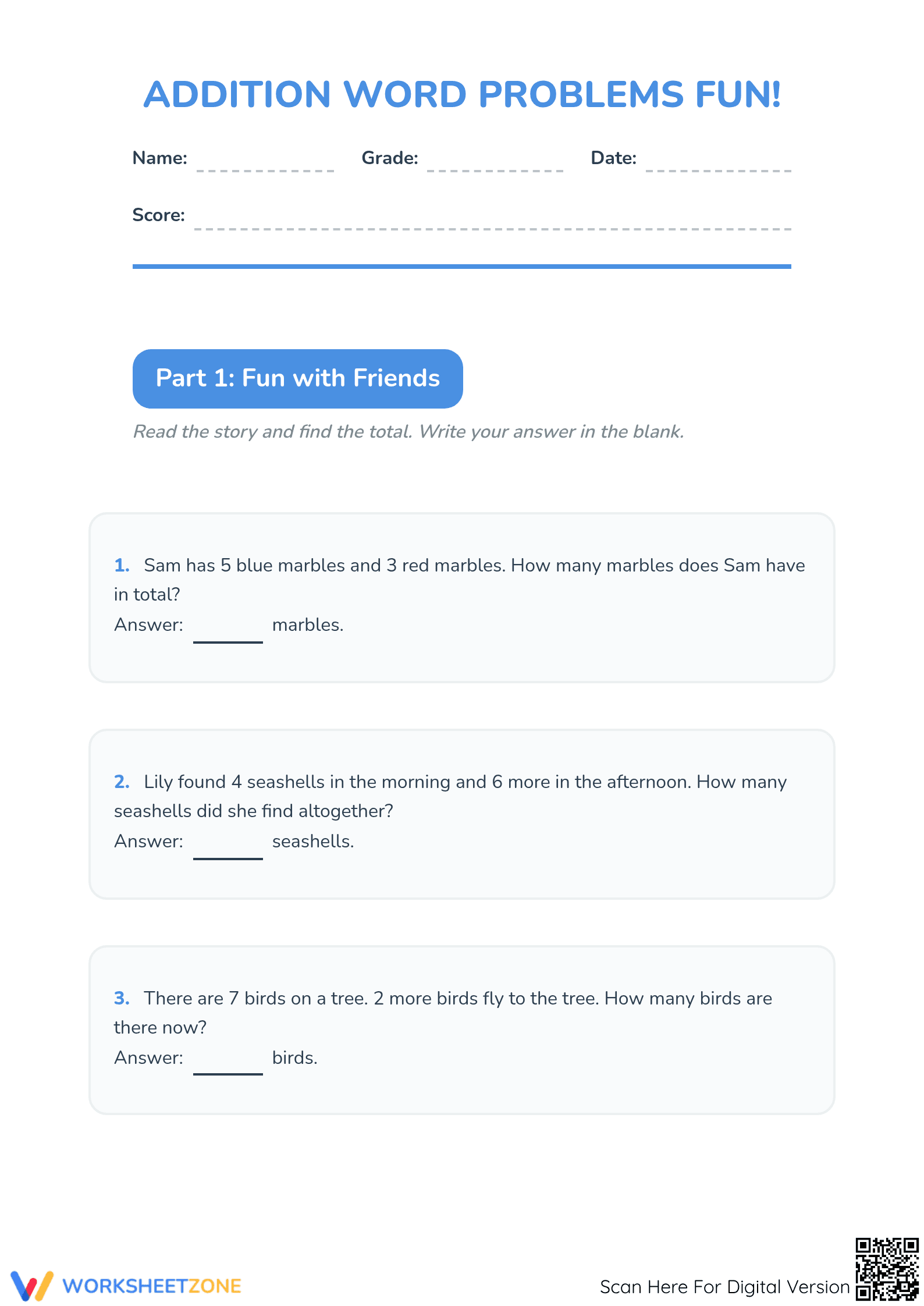
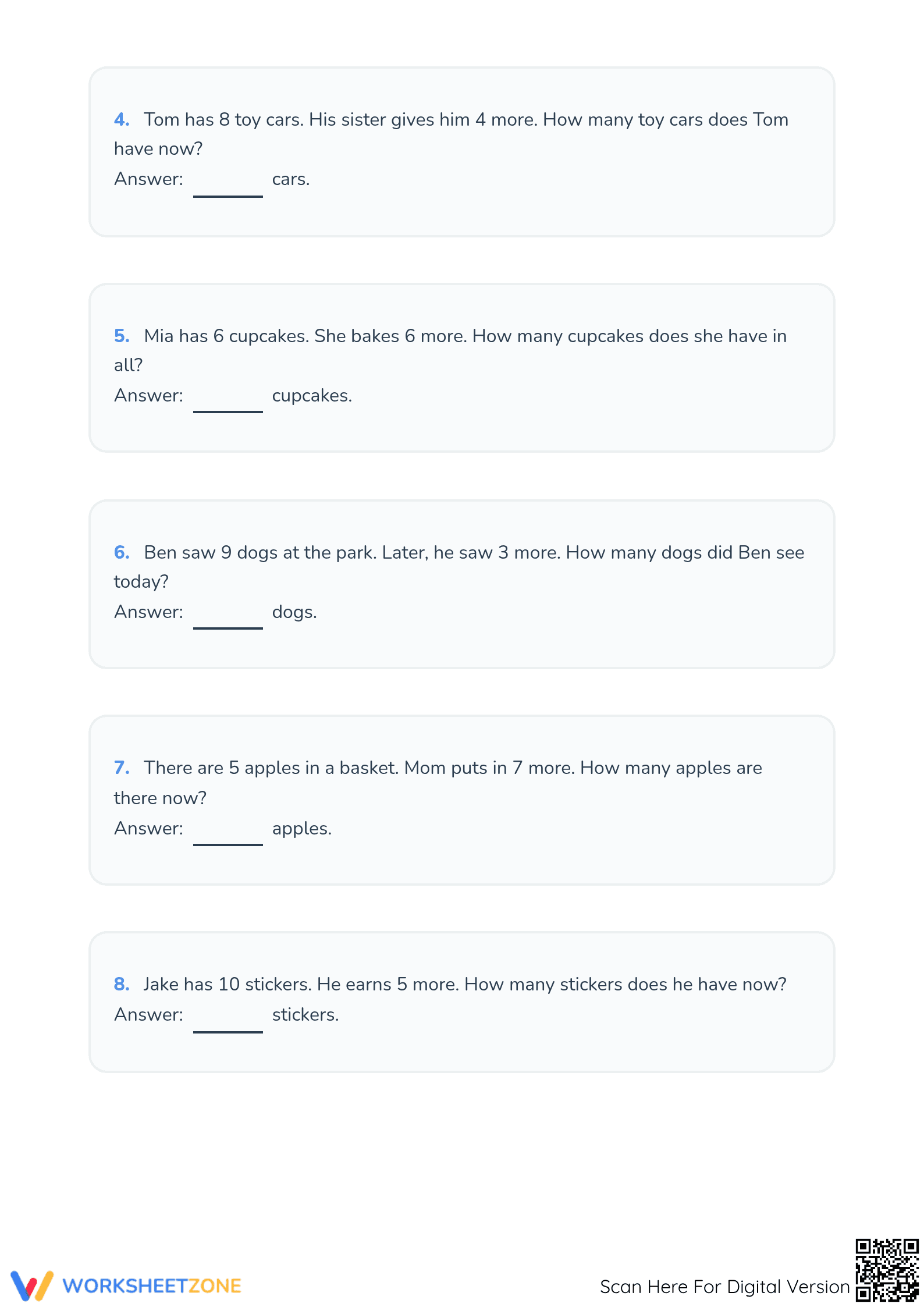
Solve real-world addition scenarios with this comprehensive Grade 1 and Grade 2 math resource. This worksheet guides students through 22 unique word problems, helping them translate narrative stories into mathematical equations. By practicing these exercises, learners develop the essential ability to identify "altogether" and "in total" contexts, ensuring mastery of foundational arithmetic concepts.
At a Glance
- Grade: Grade 1-2 · Subject: Math
- Standard:
CCSS.MATH.CONTENT.1.OA.A.1— Use addition within 20 to solve one-step word problems involving situations of adding to- Skill Focus: Single-step addition word problems
- Format: 5 pages · 22 problems · Answer key included · PDF
- Best For: Independent practice and formative assessment
- Time: 25–35 minutes
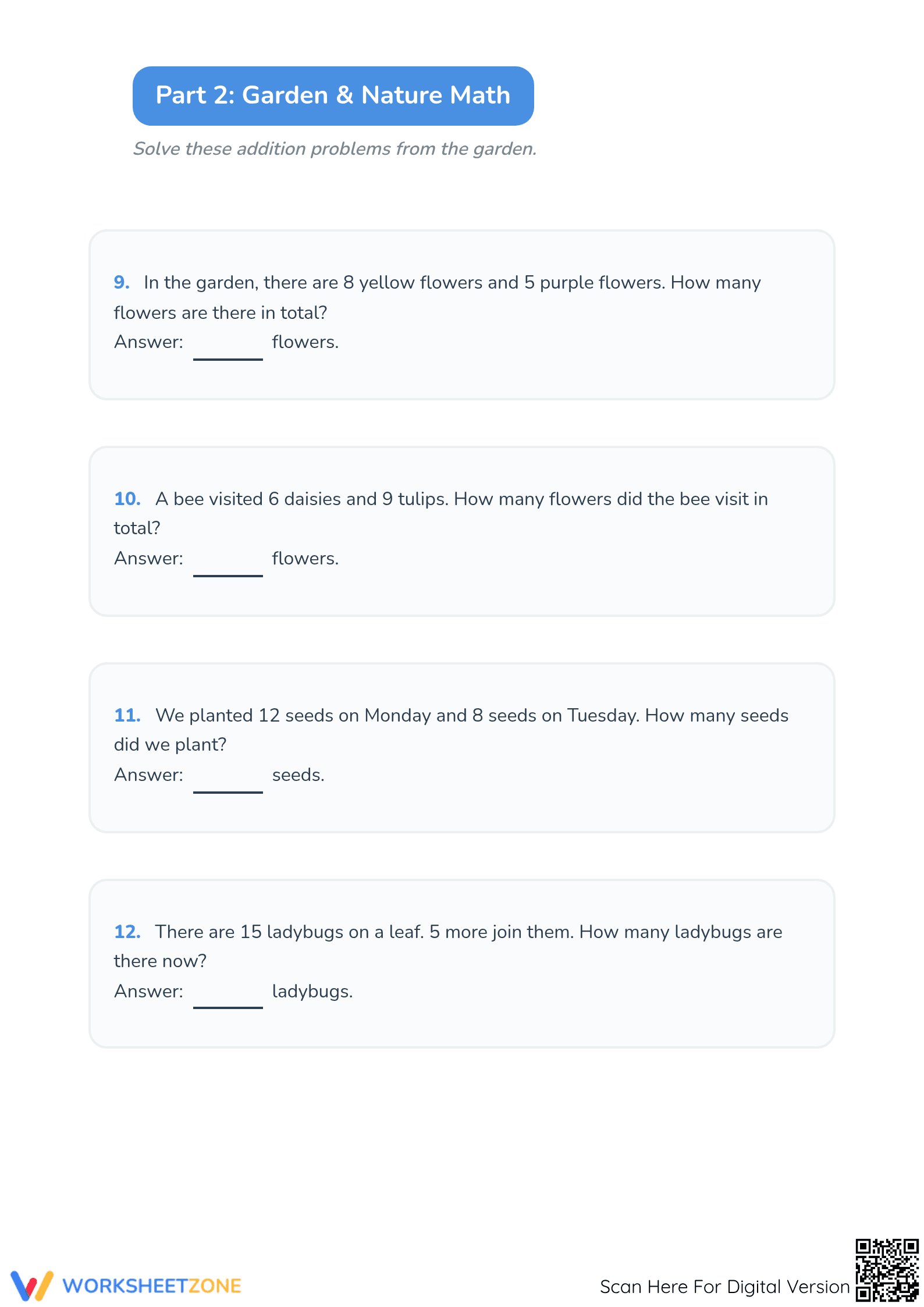
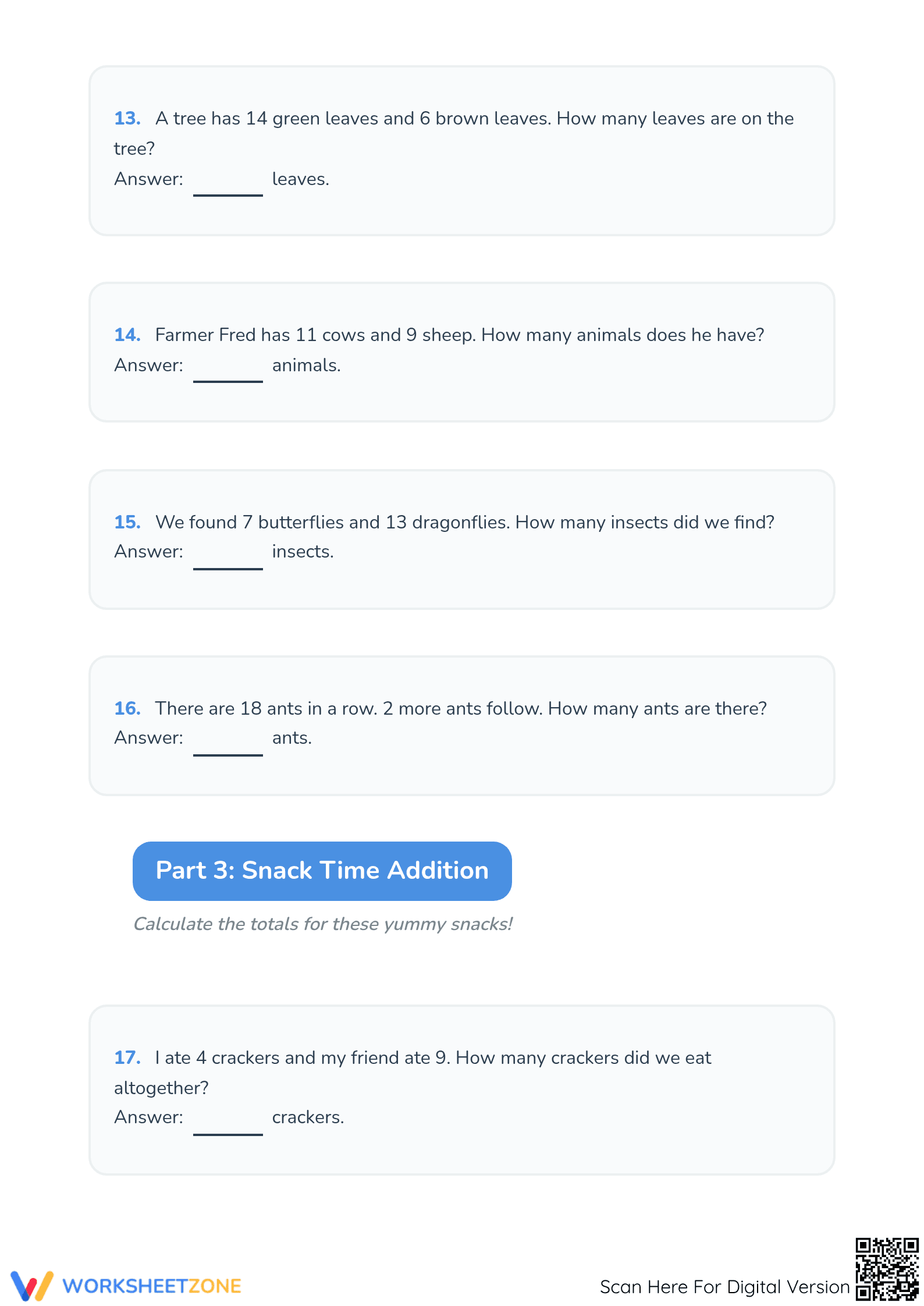
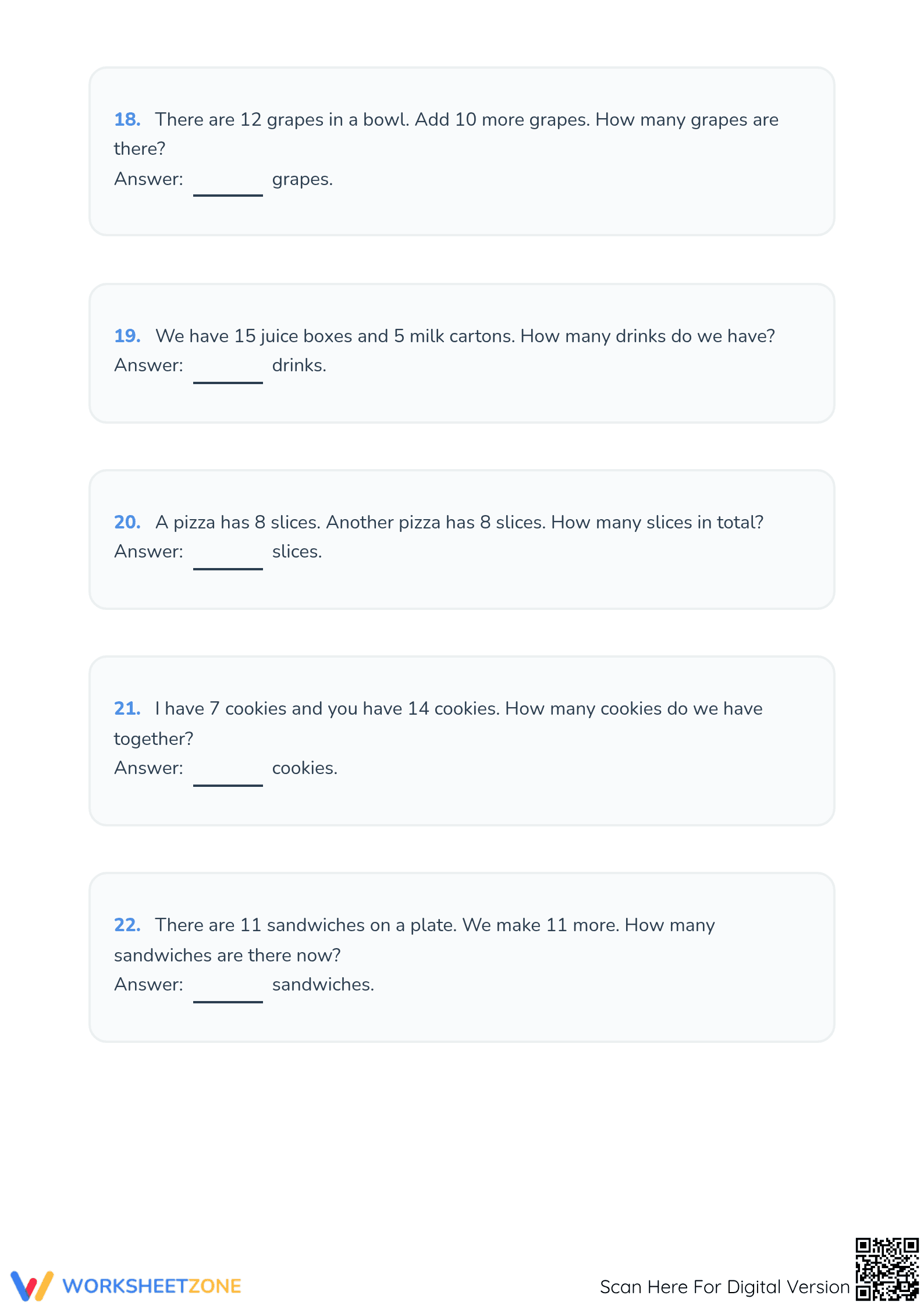
This extensive five-page PDF features 22 addition word problems divided into three thematic sections: Friends, Nature, and Snacks. Each problem includes a story prompt and a dedicated answer line, providing space for students to write responses. A comprehensive answer key is provided to facilitate quick grading and immediate student feedback during classroom activities or homework review sessions.
Skill Progression
- Guided practice: The first eight problems use simple scenarios like marbles to build confidence with sums within 15 using single-digit addends.
- Supported practice: The middle section transitions to nature-themed problems, introducing 12 as an addend and pushing sums toward 20 with increased narrative complexity.
- Independent practice: The final section challenges students with double-digit addends and sums reaching up to 25, requiring higher-order thinking and fluent computation skills.
This structure follows the gradual-release model, moving students from familiar contexts to more complex addition tasks while maintaining consistent scaffolding throughout the multi-page packet to ensure student success.
Standards Alignment
This resource is meticulously aligned with CCSS.MATH.CONTENT.1.OA.A.1, which requires students to use addition within 20 to solve word problems involving situations of adding to, taking from, putting together, and taking apart. It also supports Grade 2 readiness by introducing sums slightly beyond 20. This standard code can be copied directly into lesson plans, IEP goals, or district curriculum mapping tools.
How to Use It
Use this worksheet as a summative assessment after a unit on addition or as a rotation in a math center. During instruction, observe how students identify keywords like "more" or "plus" to determine the correct operation. For students requiring extra support, suggest using manipulatives or drawing pictures for each scenario. The expected completion time for the full set of 22 problems is approximately 30 minutes.
Who It's For
This material is designed for Grade 1 and Grade 2 students working on addition fluency and reading comprehension. It is particularly effective for learners who struggle to bridge the gap between abstract numbers and real-world application. Pair this worksheet with a shared reading of a math-themed picture book or a set of physical counters to enhance tactile learning and engagement.
Educational research emphasizes the importance of contextualizing math to improve retention and application. According to Fisher & Frey (2014), the gradual release of responsibility—moving from teacher-led modeling to independent application—is crucial for mastering complex tasks like word problem decoding. This worksheet implements that framework by increasing problem complexity across 22 tasks. By requiring students to interpret the standard code CCSS.MATH.CONTENT.1.OA.A.1 through three distinct thematic lenses, the resource ensures that the plain-English skill of solving addition stories becomes second nature. Students who engage with these diverse scenarios are better prepared for the multi-step demands of higher-grade mathematics. This structured approach provides the necessary repetition to move addition facts from short-term memory to long-term fluency, which remains a key indicator of future success in algebraic thinking and complex problem-solving across all primary grade levels.


