




























Views
Downloads
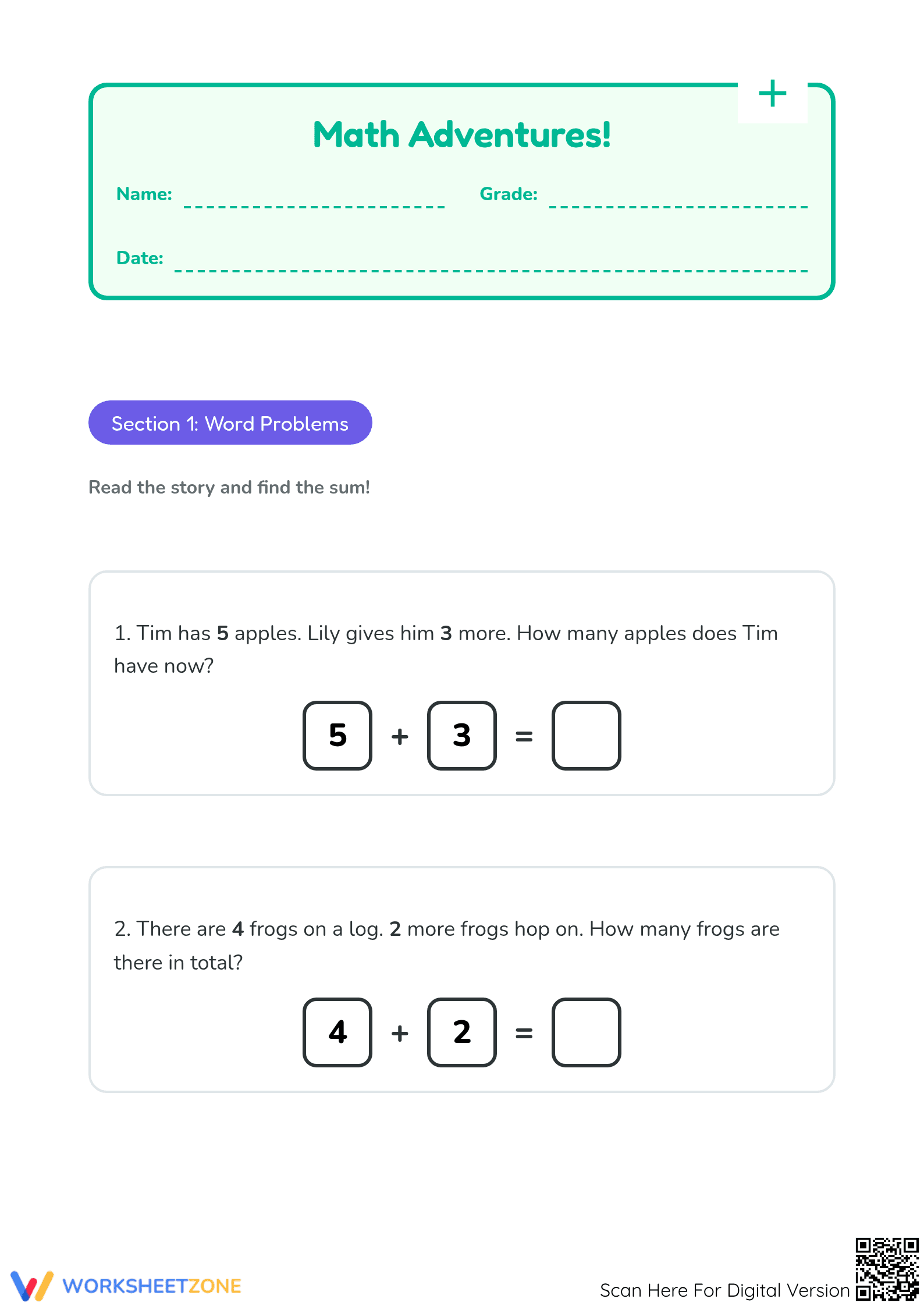
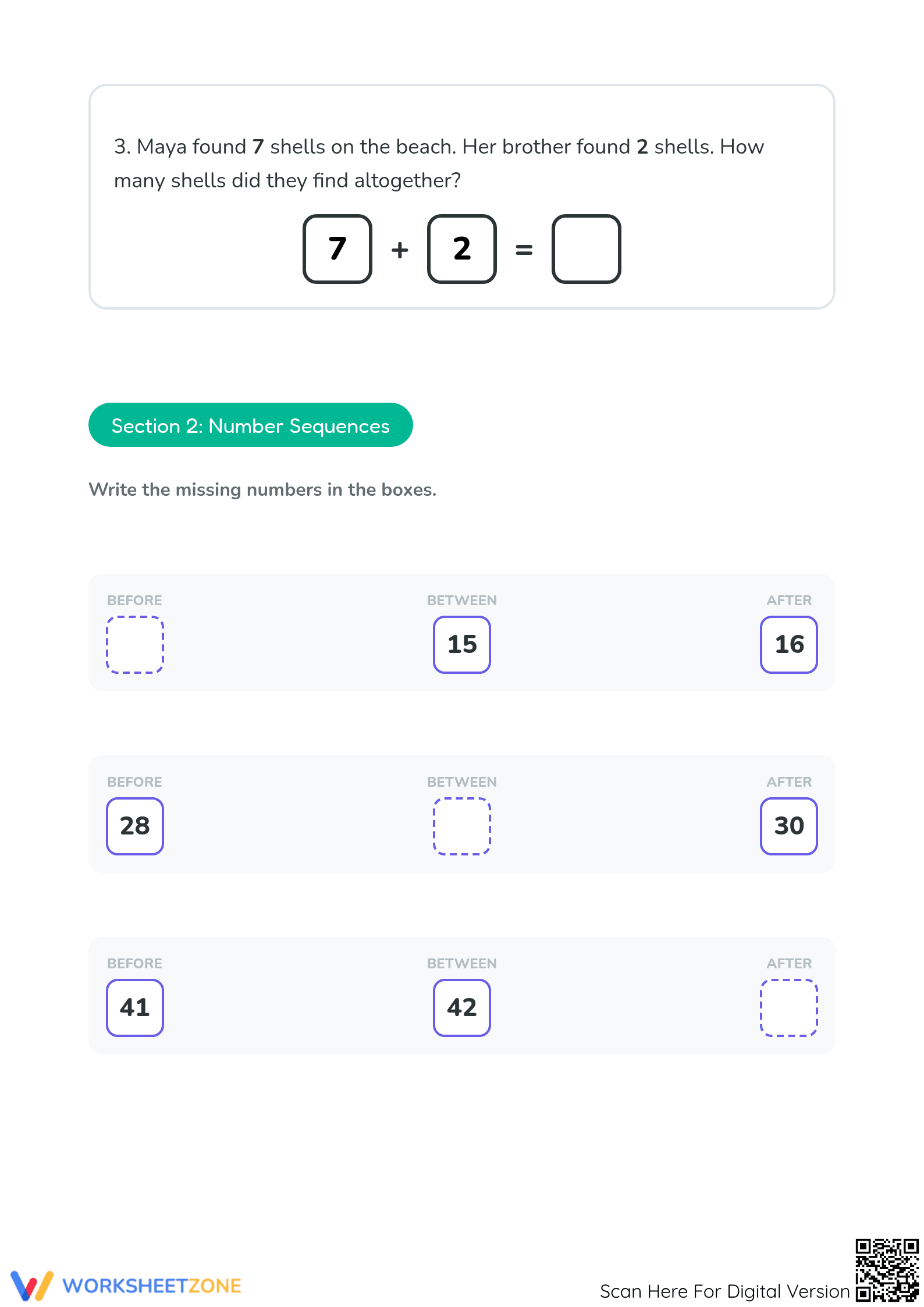
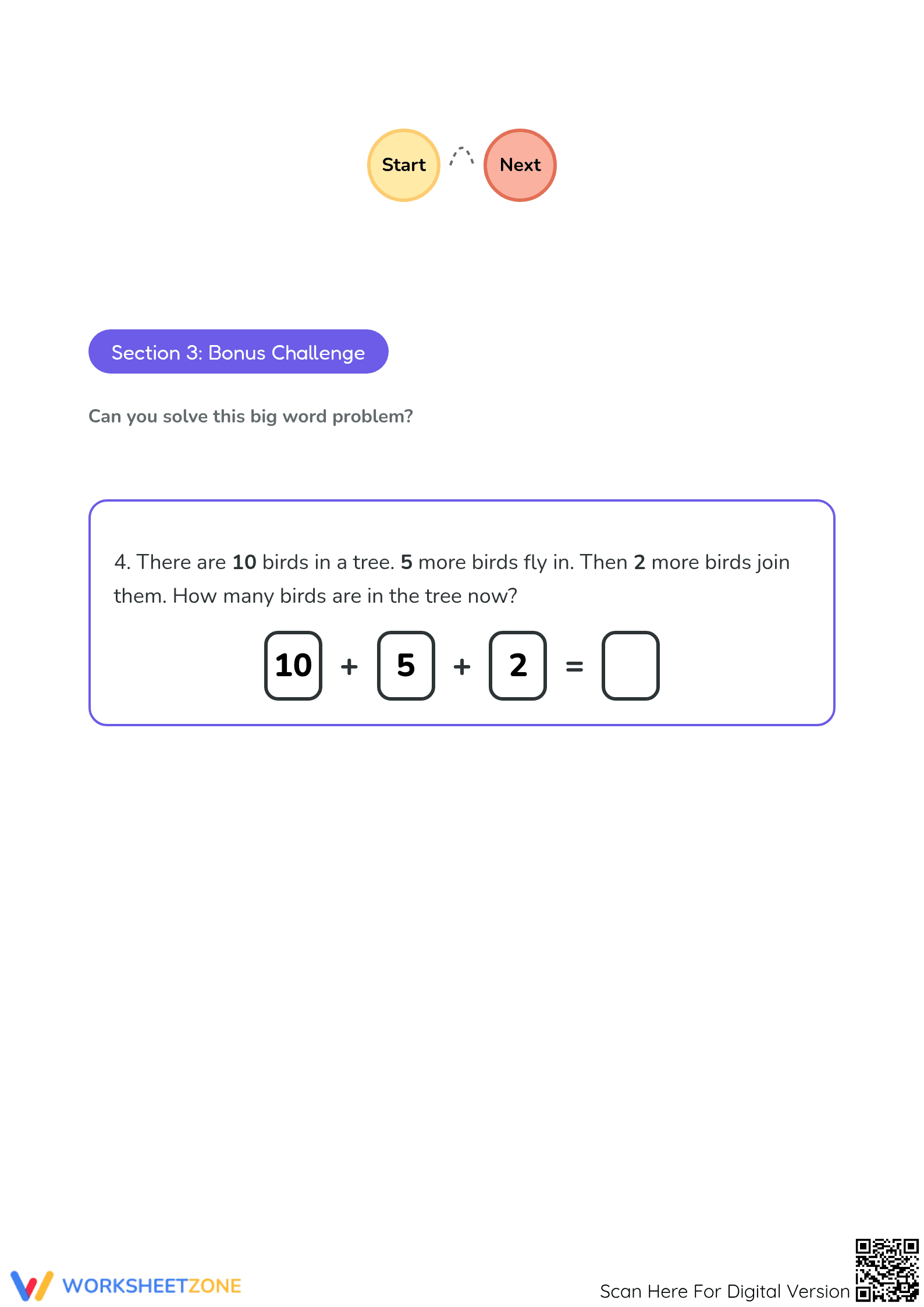

Printable Addition Word Problems & Number Sequences Grade 1

Paste this activity's link or code into your existing LMS (Google Classroom, Canvas, Teams, Schoology, Moodle, etc.).
Students can open and work on the activity right away, with no student login required.
You'll still be able to track student progress and results from your teacher account.
This Grade 1 math worksheet helps students master addition word problems and number sequencing through clear, structured practice. By solving real-world stories and identifying numbers that come before, between, or after, learners build a strong foundation for mathematical fluency. This resource ensures students can translate written scenarios into equations while strengthening their mental number line.
At a Glance
- Grade: 1 · Subject: Math
- Standard:
CCSS.MATH.CONTENT.1.OA.A.1— Use addition within 20 to solve word problems involving situations of adding to- Skill Focus: Word Problems & Number Sequences
- Format: 3 pages · 7 problems · Answer key included · PDF
- Best For: Independent practice and formative assessment
- Time: 15–20 minutes
The PDF contains three distinct sections across three printable pages. Section 1 features three single-step addition word problems with visual equation boxes to guide students. Section 2 focuses on number sequences, requiring students to fill in the missing "before," "between," or "after" numbers. The final page presents a "Bonus Challenge" with a three-addend word problem to stretch student thinking. A complete answer key is provided for quick grading.
Zero-Prep Workflow
This resource is designed for immediate classroom deployment with zero teacher preparation. You can print the 3-page set in under 30 seconds, distribute it to your class in less than a minute, and use the included answer key to review results in under one minute. This makes it an ideal choice for last-minute substitute plans, morning work, or quick "exit ticket" assessments.
Standards Alignment
The primary alignment is CCSS.MATH.CONTENT.1.OA.A.1, which requires students to use addition and subtraction within 20 to solve word problems involving situations of adding to, taking from, putting together, taking apart, and comparing. It also supports basic number sense and sequencing skills necessary for Grade 1 success. Both standard codes can be copied directly into lesson plans, IEP goals, or district curriculum mapping tools.
How to Use It
Use this worksheet during the independent practice portion of a lesson on addition strategies. It is particularly effective after a group modeling session where students learn to identify keywords like "more" or "altogether." As a formative assessment tip, observe whether students are drawing pictures to represent the story or using fingers to count on, which helps identify their current level of abstract reasoning.
Who It's For
This worksheet is perfect for first-grade students or Kindergarten learners ready for an extension. It provides excellent support for English Language Learners (ELLs) through simple sentence structures and clear visual cues. It pairs naturally with an interactive number line or a set of counting manipulatives to help students bridge the gap between concrete and abstract mathematics.
According to the RAND AIRS 2024 report, high-quality math instructional materials that integrate both computational practice and word problem application significantly improve student retention of core arithmetic concepts. This worksheet aligns with those findings by forcing students to identify the mathematical operation within a narrative context, a key indicator of long-term proficiency. By mastering CCSS.MATH.CONTENT.1.OA.A.1 through these 7 targeted tasks, students develop the literacy-math bridge required for higher-order problem solving in later elementary grades. The inclusion of number sequencing exercises further reinforces the mental number line, which research suggests is a foundational predictor of future algebraic success. Teachers can confidently implement this resource knowing it adheres to evidence-based practices for early childhood numeracy development, providing a reliable tool for both direct instruction and independent skill reinforcement in any standard-aligned classroom environment.


