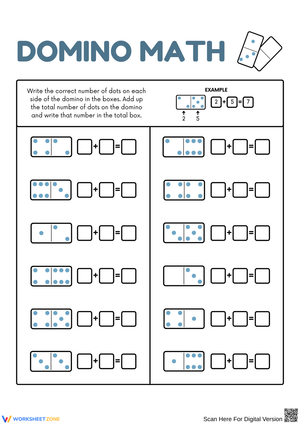
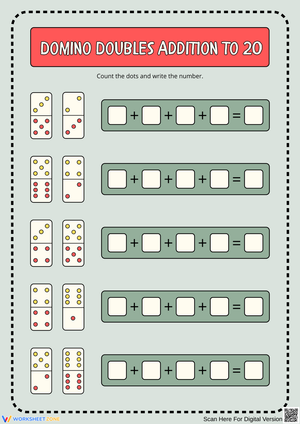
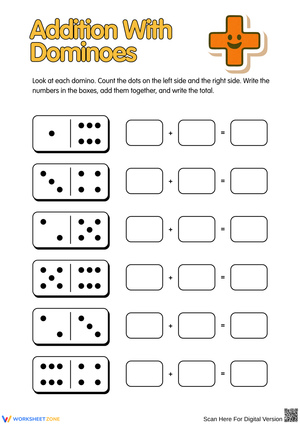
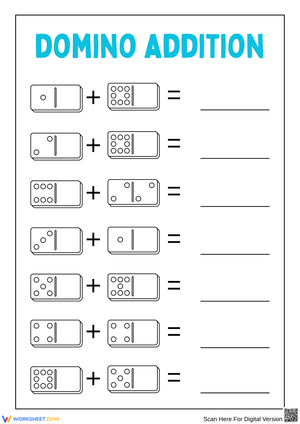
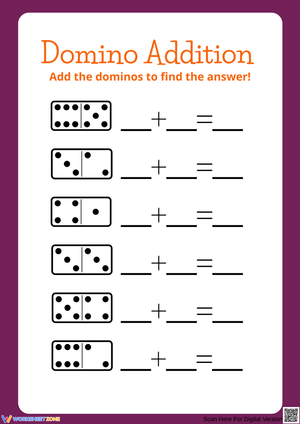
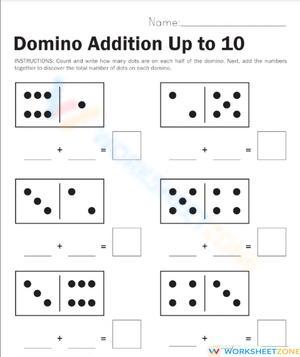
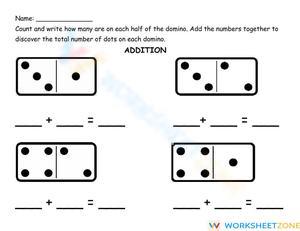
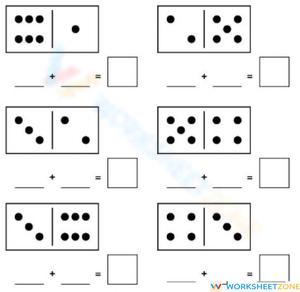
1st grade addition with dominoes printable worksheets give teachers a concrete bridge between dot patterns and written equations — a format first graders tend to pick up faster than number lines or ten frames because the two-part domino tile maps directly onto the part-part-whole relationship they're building all year. Each worksheet in the set pairs a printed domino image with space to record both addends and the sum, keeping the visual and the symbolic representation side by side where students can move their eyes between them.
What the Dot Patterns Do for Number Sense
The reason dominoes work so well at this age comes down to subitizing — the ability to recognize a small quantity without counting dot by dot. Standard domino arrangements use fixed spatial configurations: three dots in a diagonal, five dots in an X-plus-center layout. First graders who encounter these patterns repeatedly stop counting and start recognizing, which reduces the mental effort required to identify each addend. That freed-up attention goes directly toward the addition step.
This is not a trivial shift. When a student still has to count every dot on both halves of a tile before adding, the equation is almost secondary — they're already near capacity just parsing the visual. Once subitizing clicks in, the equation becomes the main cognitive event. These worksheets use the same standard dot configurations found on physical domino tiles, so students who have handled real dominoes during hands-on lessons recognize the patterns immediately and move into written practice without a separate adjustment period.
Skills Covered in the Set
The worksheets target a focused cluster of early addition skills rather than scattering across unrelated concepts. Across the set, students:
- Count dot arrays on each half of a printed tile and record the two addends
- Write the complete addition equation — both addends and the sum — in a consistent format
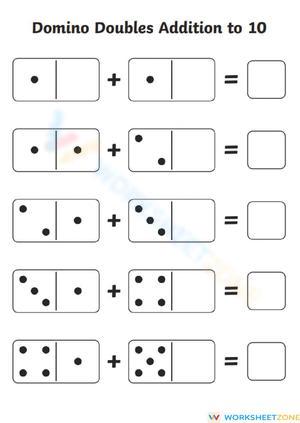
- Recognize doubles (tiles like 3-3 or 5-5) and use those as anchor facts for nearby sums
- Practice the count-on strategy by starting from the larger addend rather than always starting from one
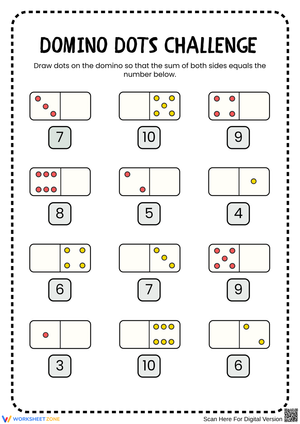
- Fill in blank domino templates by drawing their own dot arrangements to reach a given total
That last task shifts the cognitive demand considerably. A student who writes 4 + 3 = 7 without hesitation may still pause when asked to show three different ways to fill a domino that totals 7. That gap — between reading a given equation and generating the parts yourself — is worth surfacing in first grade rather than discovering later during fact fluency assessment.
Standard Alignment
These worksheets address CCSS.MATH.CONTENT.1.OA.C.6, which calls for adding and subtracting within 20 and demonstrating fluency for addition within 10. Standard domino sets top out at sums of 12 (a 6-6 tile), so the range maps cleanly onto this standard. More importantly, the standard expects strategy use — counting on, using doubles, decomposing numbers — not rote recall. Domino images support that intent because students can see the four dots and the five dots before they write the equation. The "why" behind 4 + 5 = 9 stays visible rather than disappearing into a bare number sentence.
Mistakes Students Make That These Worksheets Help You Catch
The most predictable error isn't miscounting — it's treating addend order as meaningful. A student who records a tile with 2 dots on the left and 5 on the right as "2 + 5 = 7" will sometimes look at the mirrored tile — 5 on the left, 2 on the right — and believe it's a different problem with a different answer. These worksheets surface that confusion quickly. Pairing two tiles that show the same numbers in reversed positions and asking whether the sums match is one of the most direct ways to address commutativity at this age, because the visual makes the comparison concrete rather than abstract.
A second error appears specifically with tiles that have zero dots on one side. Students who have learned to subitize standard 1-through-6 patterns often freeze when confronted with a blank half — they recognize 5 immediately, but the empty side throws them. Some write nothing in the addend box; some write 1. The concept that a blank side means adding zero is not as automatic as it sounds to adults. Several worksheets in the set include zero-half tiles specifically because that gap tends to be invisible until it shows up in a fact fluency check.
How to Build These Worksheets Into Your Lesson Plans
These worksheets fit three different points in the math block without modification. As a warm-up, one worksheet runs six to eight minutes and anchors students in numerical thinking before direct instruction begins. During math centers, 1st grade addition with dominoes printable worksheets pair naturally with a bowl of physical tiles — students build the equation with real dominoes first, then record it on the worksheet, which moves them from concrete to representational without requiring any additional materials. The physical tile becomes a self-check: if the student's written equation doesn't match what's in front of them, they know something went wrong before the teacher gets there.
For small-group sessions, the blank template tasks are especially productive. A teacher working with four students can ask everyone to fill in a domino that totals 6, then compare results. The conversation that follows — "I did 4 and 2, she did 5 and 1, he did 3 and 3" — builds the flexible number thinking that fluency assessments measure. That discussion is difficult to generate from a standard fill-in equation, but the open domino frame makes it completely natural because the visual invites multiple answers.
Adjusting the Set for Different Levels of Readiness
For students still building foundational counting skills, restricting work to tiles with sums of 5 or less is the right starting point. These students still count each dot individually, and smaller quantities keep the counting manageable while the subitizing habit develops. A student practicing 1st grade addition with dominoes printable worksheets at this entry level benefits most from worksheets where one side of the tile always shows one or two dots — quantities that are already automatic for most first graders — so the variable is only on the other side.
Students who have internalized basic sums need a different kind of challenge: doubles-plus-one reasoning. Once a student knows 4 + 4 = 8 without counting, a 4-5 tile becomes a reasoning prompt rather than a counting exercise. They see the 4 and the 5, recall the doubles fact, and add one more. Teachers can push this group toward the blank-template tasks and ask them to find every possible pair of addends that reaches a given sum — essentially working through all combinations systematically, which is a more demanding algebraic thinking task than any pre-filled worksheet provides on its own.
Frequently Asked Questions
Do students need physical dominoes to use these worksheets?
No, but pairing the printed worksheets with real tiles during initial instruction accelerates understanding. The domino images are clear enough for independent work once students have handled physical tiles a few times and recognize the standard dot configurations without needing to count from scratch each time.
How do these worksheets address the commutative property?
The visual format makes commutativity observable in a way that a bare number sentence does not. When students compare a 3-5 tile and a 5-3 tile and find the same sum, they're seeing the commutative property rather than accepting it as a rule they were told. Several worksheets in the set include pairs of tiles with reversed dot arrangements specifically to prompt that comparison and the discussion that follows.
What's the best way to introduce blank domino templates to a class that hasn't seen them before?
Model the task whole-group before sending students to work independently. Put a target sum on the board — 7 works well — draw a blank domino frame, and fill it in together while talking through the choice. Then ask students to find a second way to reach 7 on a new frame. Most classes need one full shared example before they can approach decomposition tasks on their own with confidence.
Are these worksheets appropriate for take-home practice?
Yes. The domino image is self-explanatory for most families, and the task — count the dots, write the numbers, find the sum — needs no additional explanation from a parent who wasn't in the lesson. Using 1st grade addition with dominoes printable worksheets as homework also gives families a clear picture of the part-part-whole model the class is working on, which helps at-home conversations stay aligned with the strategies students are using in the classroom.













 Interactive Worksheet Maker
 Quiz Maker
 Word Search Maker
 Crossword Puzzle Maker
 Word Scramble Generator
 Sentence Scramble Generator
 Handwriting Worksheet Generator
 Name Tracing Generator
 Fill In The Blank Generator