




























Views
Downloads
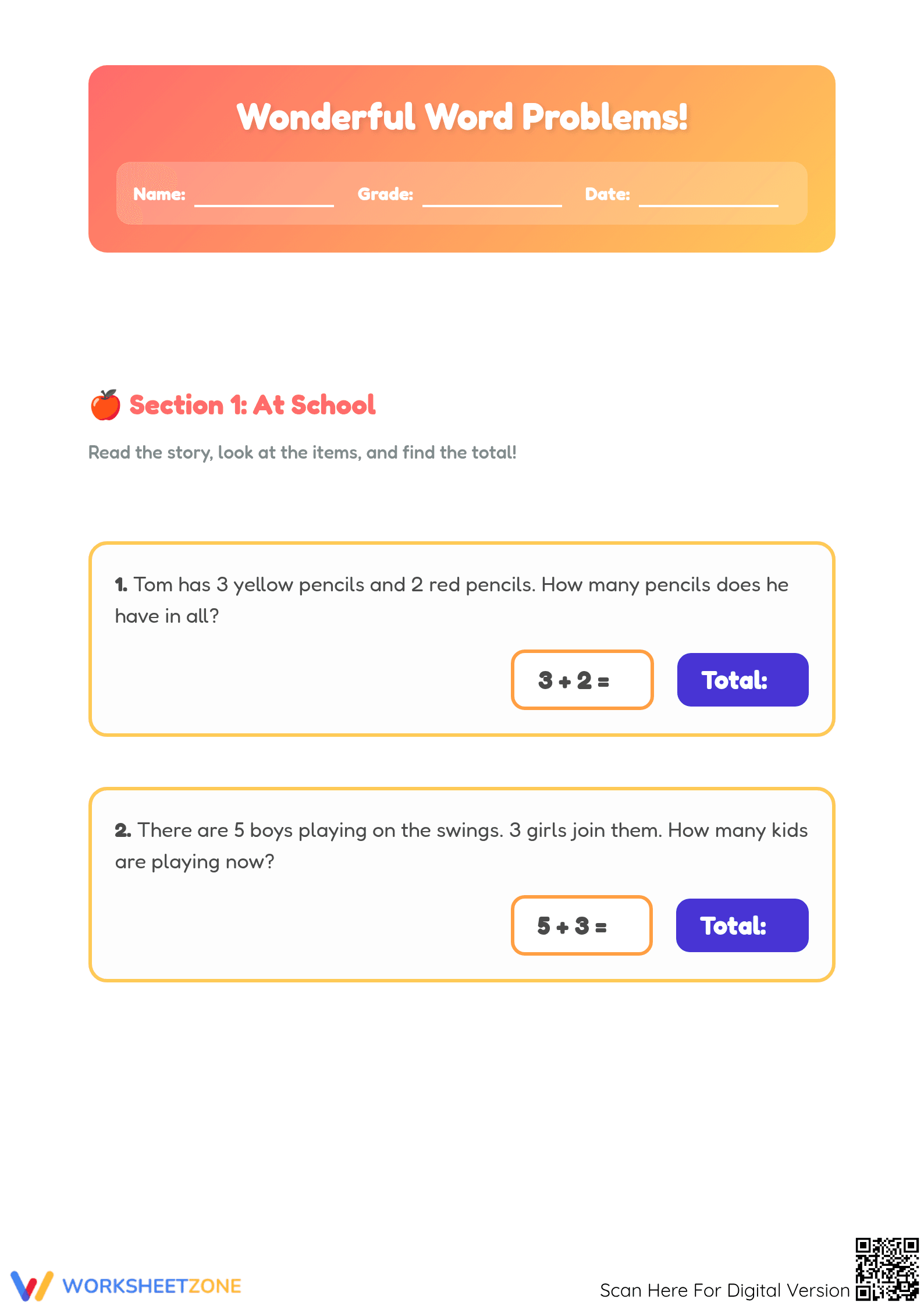


Printable Addition Word Problems Worksheet | Grade 1 Math

Paste this activity's link or code into your existing LMS (Google Classroom, Canvas, Teams, Schoology, Moodle, etc.).
Students can open and work on the activity right away, with no student login required.
You'll still be able to track student progress and results from your teacher account.
This worksheet provides essential practice for first-graders learning to solve addition word problems. Across 13 scenarios, learners translate real-world situations into mathematical equations and find the sum. It’s a foundational tool for building both reading comprehension and operational fluency in early math, focusing on sums within 20.
At a Glance
- Grade: 1 · Subject: Math
- Standard:
CCSS.MATH.CONTENT.1.OA.A.1— Use addition to solve word problems with results within 20.- Skill Focus: Addition Word Problems
- Format: 4 pages · 13 problems · Answer key included · PDF
- Best For: Independent practice, homework, or formative assessment.
- Time: 15–25 minutes
What's Inside
This four-page resource contains 13 unique addition word problems organized into themes. Each problem provides a clear workspace for students to write the corresponding addition equation before solving. A complete, separate answer key is provided for quick grading.
A Structured Path to Fluency
The worksheet follows a gradual-release model to build student confidence in solving word problems.
- Guided Practice: Initial problems feature simple, single-digit addition, allowing teachers to model how to identify key numbers and actions in a story.
- Supported Practice: As students progress, problems introduce slightly larger numbers, encouraging them to apply the modeled strategy with decreasing support.
- Independent Practice: By the final section, students should be able to tackle the problems independently, showing their ability to deconstruct a word problem and solve it. This structure ensures a solid foundation.
Standards-Aligned for Your Classroom
This worksheet is directly aligned with the Common Core State Standard for first-grade mathematics: CCSS.MATH.CONTENT.1.OA.A.1, which requires students to "Use addition and subtraction within 20 to solve word problems involving situations of adding to, taking from, putting together, taking apart, and comparing, with unknowns in all positions." The tasks exclusively target the "adding to" and "putting together" aspects of this standard. Both standard codes can be copied directly into lesson plans, IEP goals, or district curriculum mapping tools.
Flexible for Any Lesson Plan
Use this resource as independent practice after a direct instruction lesson on word problems, or as homework to reinforce learning. For formative assessment, observe students as they work. Note which ones easily pull numbers from the text versus those who need to re-read. Most students will complete the worksheet in 15 to 25 minutes.
Designed for Early Learners
This worksheet is ideal for first-grade students but can also be used for advanced kindergarteners or as a review for second graders at the beginning of the year. For students needing support, provide physical counters or a number line. To extend the activity, pair it with an anchor chart that breaks down the steps for solving a word problem (Read, Circle Numbers, Underline Question, Solve).
Effective problem-solving instruction is a cornerstone of early mathematics education. This worksheet supports that goal by providing practice aligned with CCSS.MATH.CONTENT.1.OA.A.1. It requires students to apply addition within concrete scenarios, a practice supported by research. The RAND AIRS 2024 report on foundational math skills notes that repeated exposure to varied problem contexts is crucial for developing flexible thinking. The 13 problems in this set give students the opportunity to move beyond simple calculation and engage with the narrative structure of mathematics. By translating stories into equations, students build a durable conceptual understanding, a key predictor of future success in more complex mathematical domains. This resource provides a practical tool for building that bridge from concrete to abstract.


