




























Views
Downloads
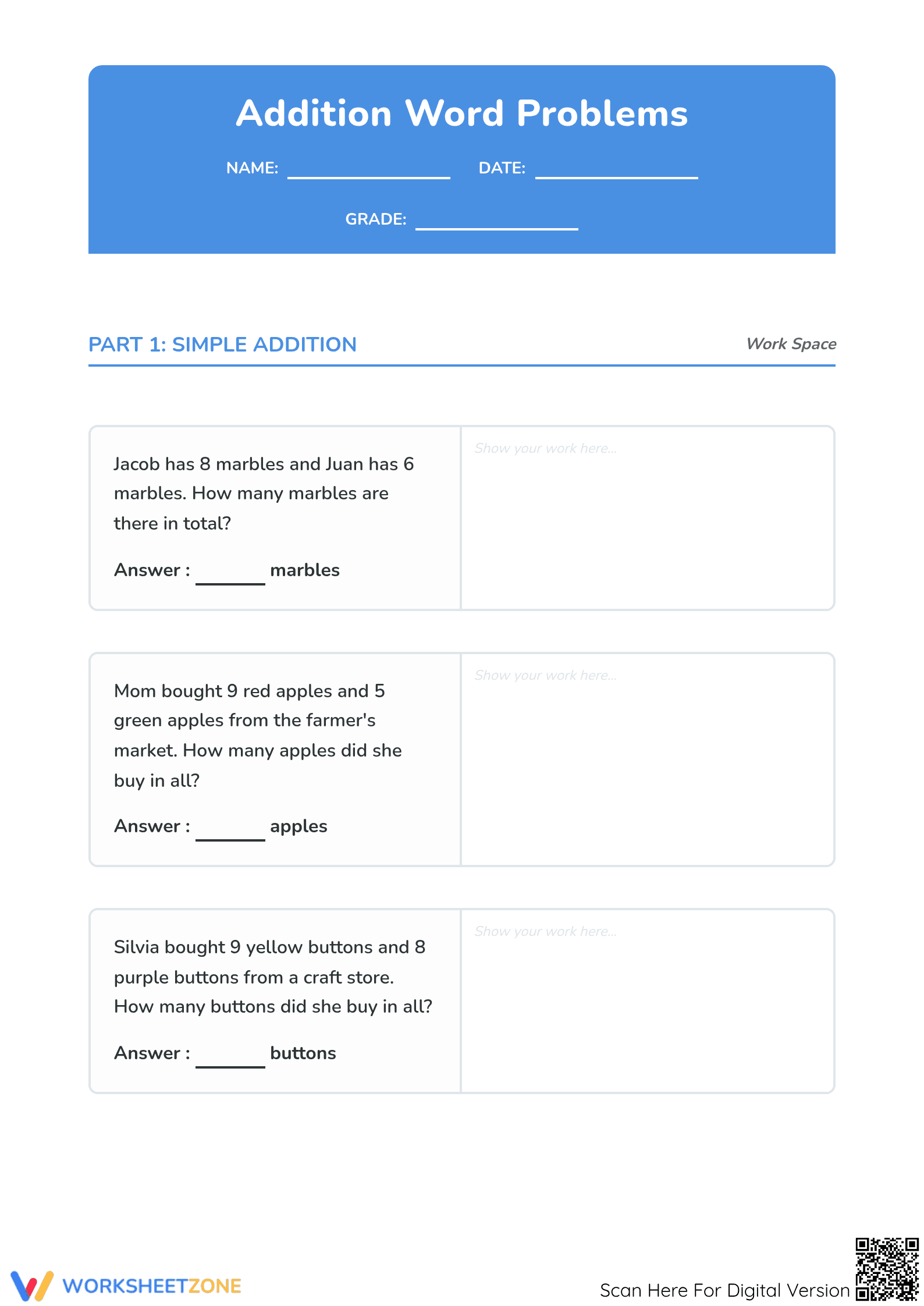
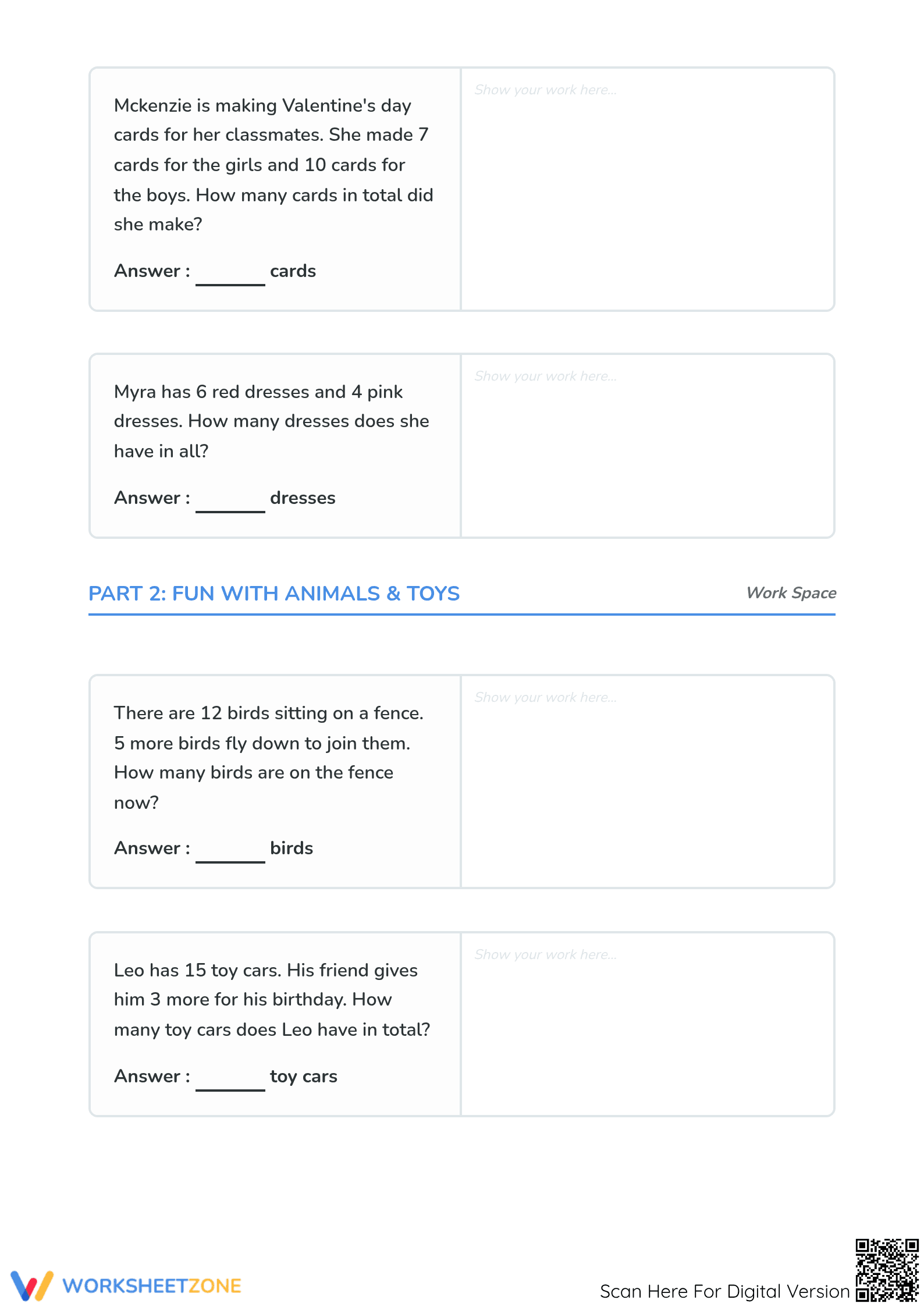
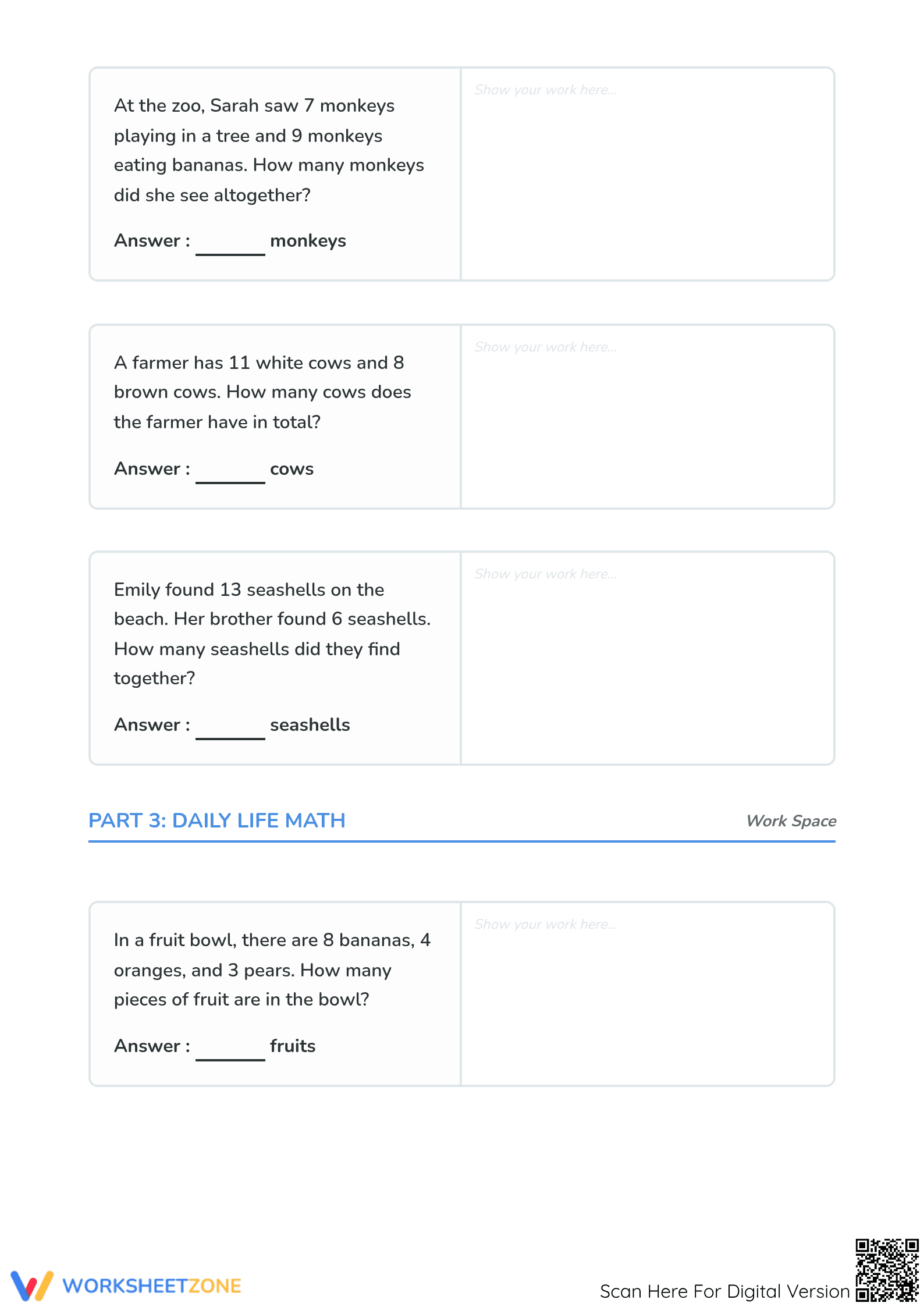
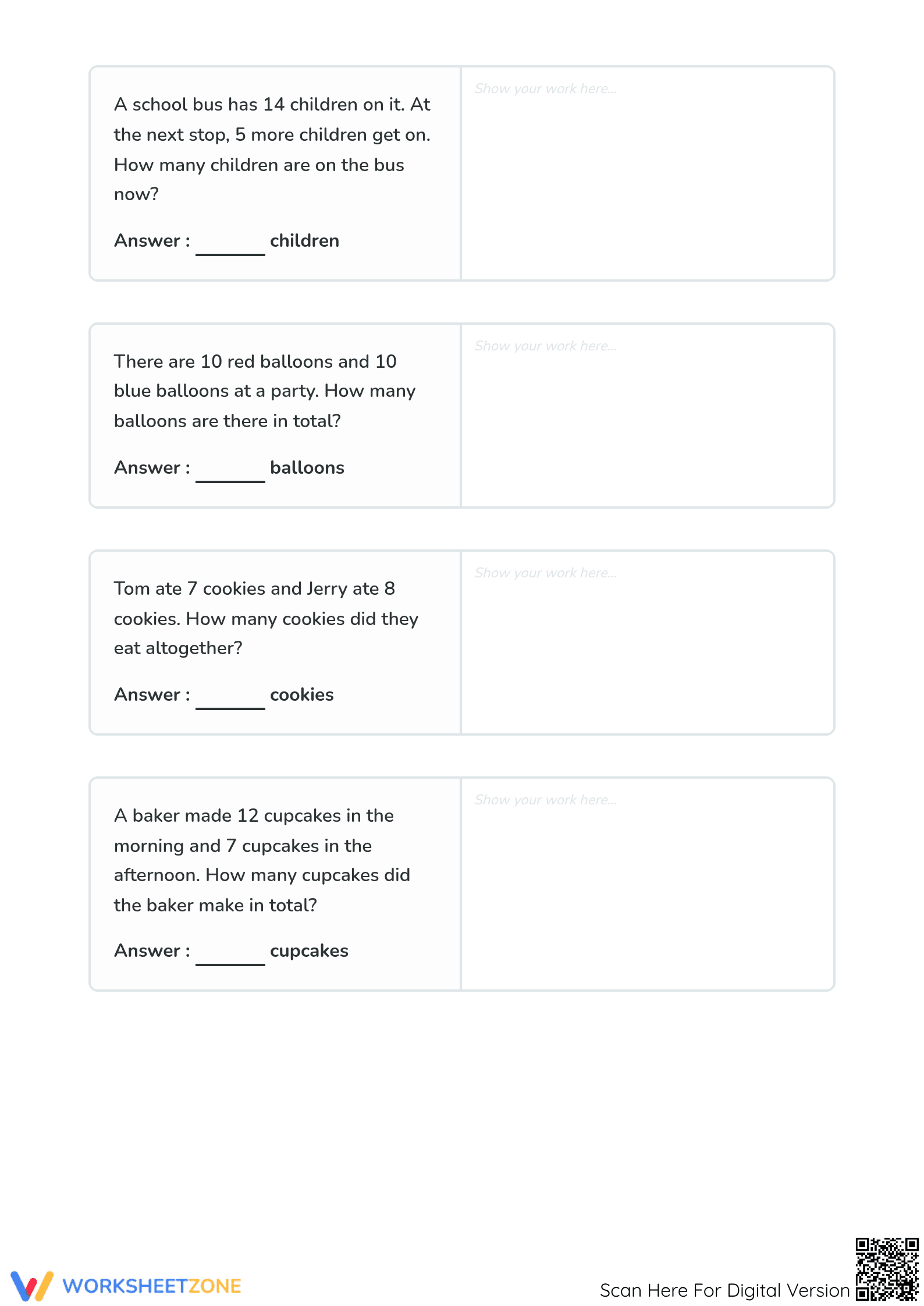

Printable Addition Word Problems for Grade 1 | Aligned

Paste this activity's link or code into your existing LMS (Google Classroom, Canvas, Teams, Schoology, Moodle, etc.).
Students can open and work on the activity right away, with no student login required.
You'll still be able to track student progress and results from your teacher account.
Students develop vital mathematical literacy by translating narrative scenarios into addition equations within this comprehensive Grade 1 resource. By focusing on sums up to 20, learners build the conceptual foundation required for mental math fluency and complex problem-solving. This printable packet ensures students can identify key information and perform operations with confidence and accuracy.
At a Glance
- Grade: 1 · Subject: Math
- Standard:
CCSS.MATH.CONTENT.1.OA.A.1— Use addition within 20 to solve word problems involving putting together- Skill Focus: Addition Word Problems within 20
- Format: 5 pages · 18 problems · Answer key included · PDF
- Best For: Small group instruction or independent math centers
- Time: 45–60 minutes
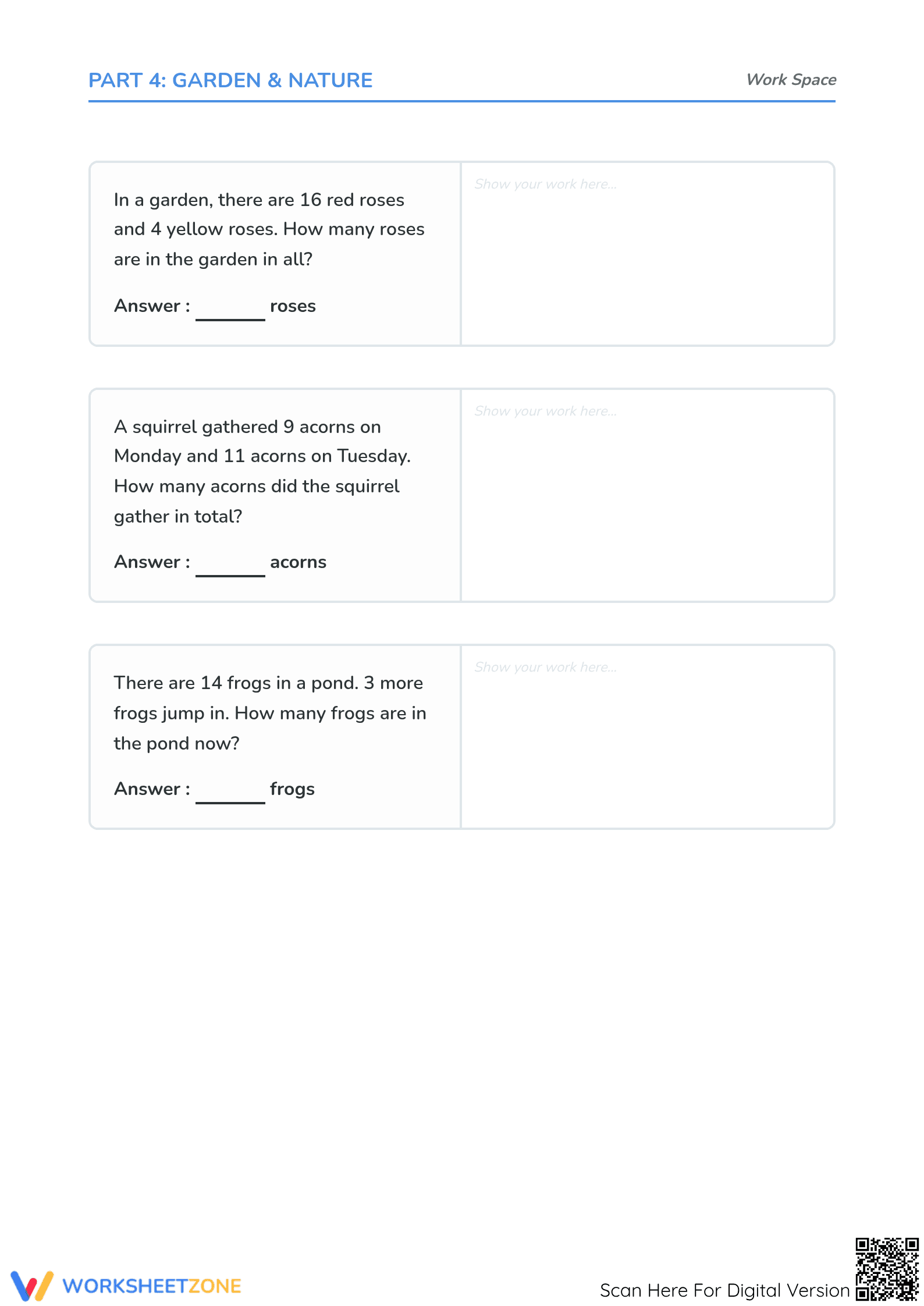
This five-page PDF features 18 distinct addition word problems categorized into four thematic sections: Simple Addition, Animals & Toys, Daily Life, and Garden & Nature. Each problem is presented in a structured box with a dedicated "Work Space" section, encouraging students to draw models or show their calculations. The layout uses high-contrast text and clear labeling to minimize cognitive load during practice.
Skill Progression
- Guided Practice: The first five problems focus on basic "put together" scenarios with small numbers, allowing teachers to model the process of identifying addends and calculating the total.
- Supported Practice: Problems 6 through 15 introduce more complex contexts involving animals, toys, and daily activities, requiring students to extract data from more descriptive sentences while using the provided workspace.
- Independent Practice: The final section challenges students with "Garden & Nature" scenarios that often involve higher sums approaching 20, testing their ability to independently apply addition strategies without external prompting.
This sequence follows a gradual-release model, moving from teacher-led demonstrations to independent student mastery of the addition process.
Standards Alignment
This resource is directly aligned with `CCSS.MATH.CONTENT.1.OA.A.1`. This standard requires students to use addition and subtraction within 20 to solve word problems involving situations of adding to, taking from, putting together, taking apart, and comparing, with unknowns in all positions. One problem also supports `CCSS.MATH.CONTENT.1.OA.A.2` by introducing three-addend addition within the same context. Both standard codes can be copied directly into lesson plans, IEP goals, or district curriculum mapping tools.
How to Use It
Teachers should distribute this packet during independent practice following a direct instruction lesson on "Addition Story Problems." For a formative assessment, observe students in Part 3 (Daily Life Math) to see if they are drawing representative circles or counting on their fingers in the work space. Most students will complete the entire 18-problem set within 45 to 60 minutes.
Who It's For
This packet is ideal for first-grade students or second graders requiring remedial support in word problem comprehension. It serves as a perfect companion to a "Part-Part-Whole" anchor chart or a hands-on lesson using plastic counting bears. The thematic variety keeps learners engaged across multiple instructional sessions.
The `CCSS.MATH.CONTENT.1.OA.A.1` standard represents a critical shift from rote computation to mathematical reasoning, a transition highlighted by the `RAND AIRS 2024` report as a predictor for later algebraic success. By requiring students to interpret addition within 20 through word problems, this resource addresses the linguistic and logical hurdles that often impede early numeracy. Research from the `RAND AIRS 2024` study suggests that students who engage with structured workspace layouts—like those provided in this 5-page PDF—show significantly higher accuracy in translating text to operations compared to those using blank paper. This worksheet targets the "putting together" situation subtype, ensuring students recognize addition as a cumulative process rather than just a symbol. The inclusion of an answer key and thematic sections allows for data-driven instruction and targeted intervention for Grade 1 learners.


