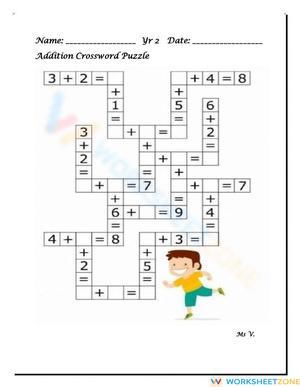
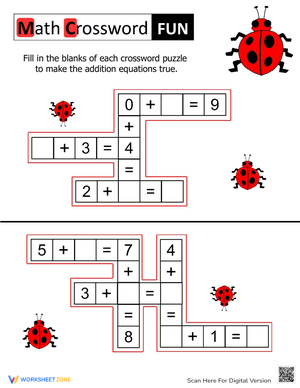
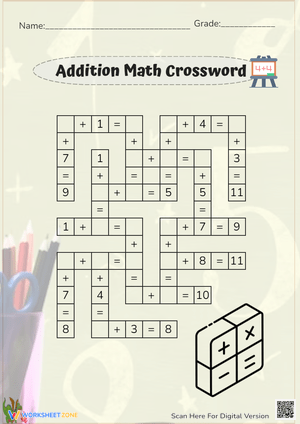
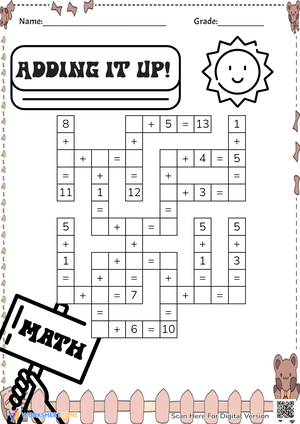
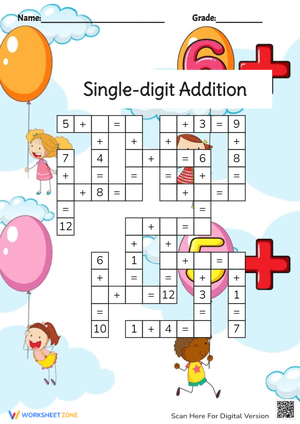
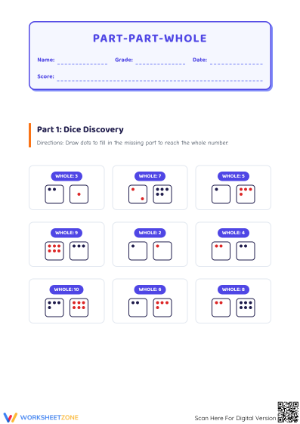
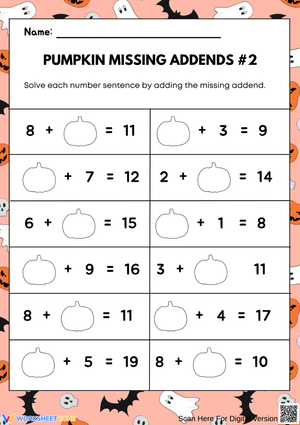
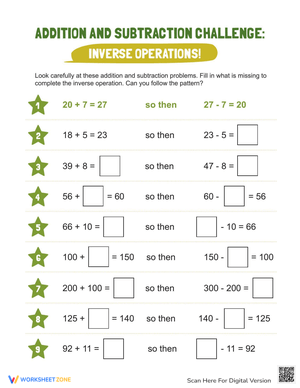
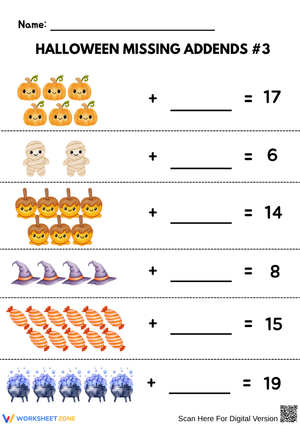
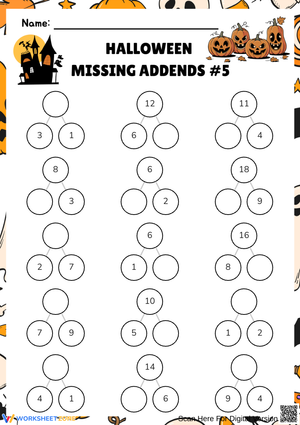
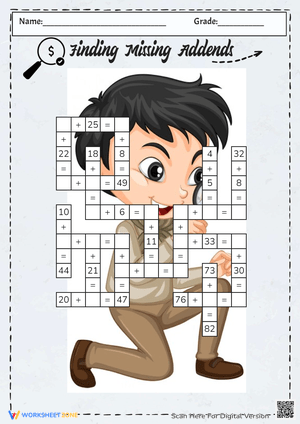
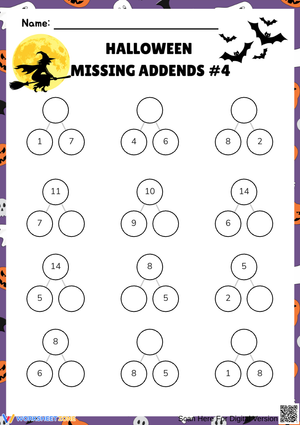
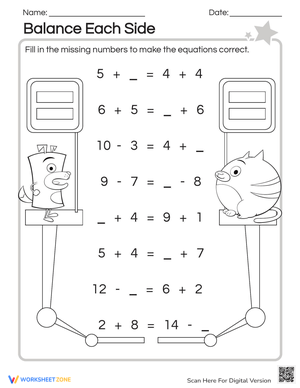
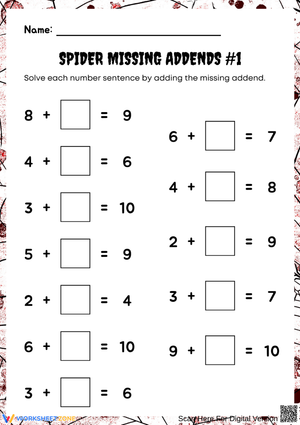
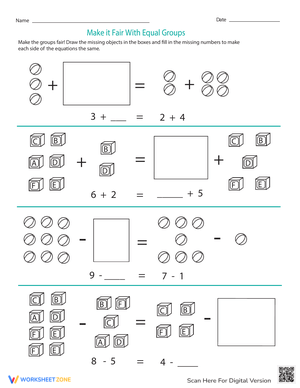
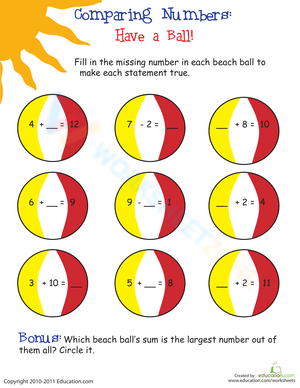
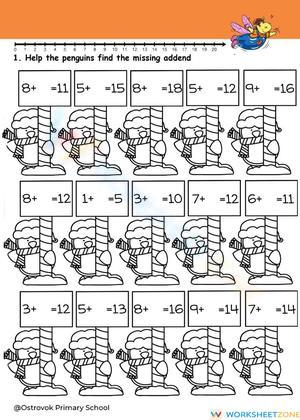
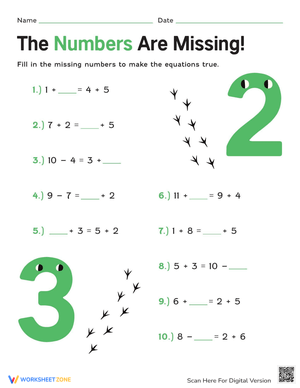
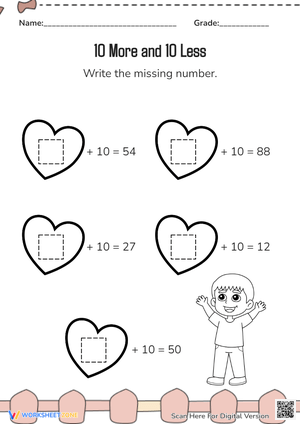
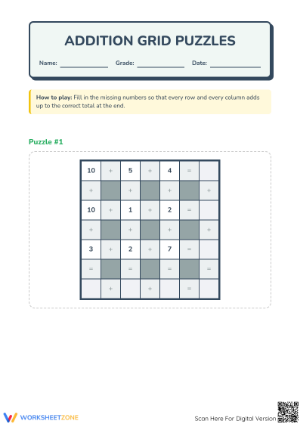
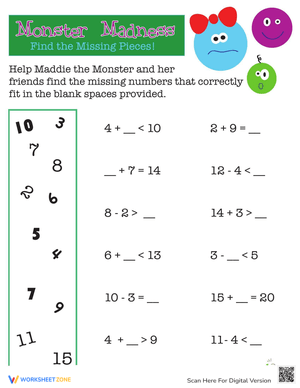
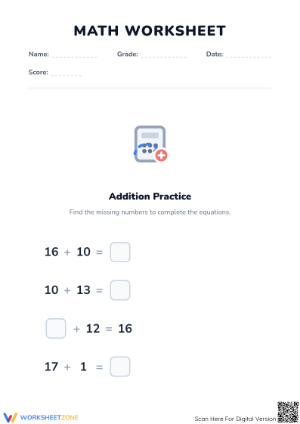
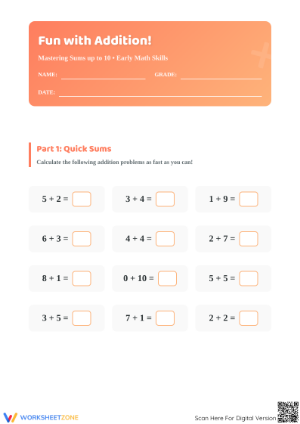
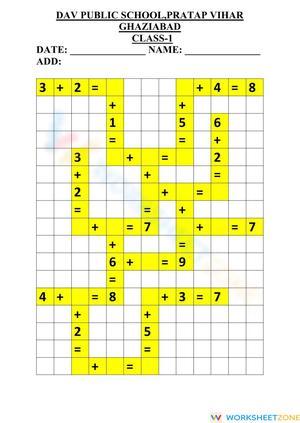
These 1st grade missing addends printable worksheets give teachers a ready-to-use set of practice pages that move students from concrete reasoning about quantity to fluent, independent equation work — organized by difficulty so the right page for any learner is easy to find. Each worksheet stands alone, so teachers can pull one for morning work, intervention, or a quick formative check without committing to a fixed sequence. The set spans sums within 10 through sums within 20, matching the progression most Grade 1 classrooms follow from October through late spring.
Skills These Worksheets Build
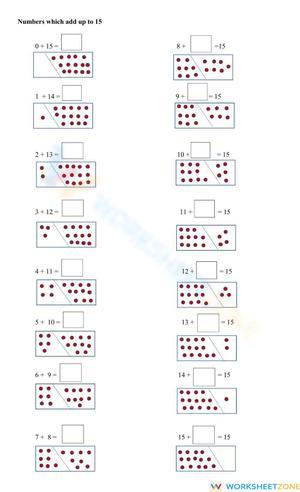
The core task on every worksheet is identical: find the number that makes the equation true. The formats shift across the set to prevent students from solving by template recognition rather than actual reasoning.
- Equations within 10 — horizontal and vertical layouts, with the blank appearing in both addend positions, not exclusively the second
- Equations within 20 — for students ready to count on or use known fact relationships rather than one-by-one counting
- Number bond pages — show the whole and one part; students name the missing piece, which bridges visual thinking and symbolic work
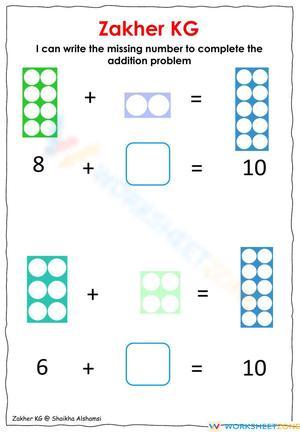
- Ten-frame pages — filled squares represent the known addend; open squares reveal the unknown; students record the completed equation below
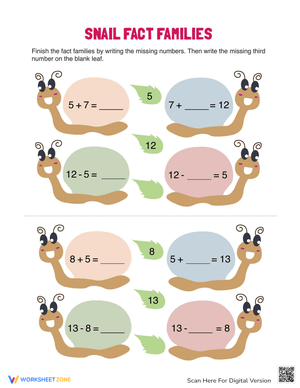
- Fact family practice — connects 4 + 3 = 7, 3 + 4 = 7, and 7 − 4 = 3 so students see the unknown-addend problem as part of a broader number relationship rather than an isolated trick
Directions across the set stay short by design. Grade 1 students reading a long prompt before the first problem spend working memory on decoding instructions instead of doing the math.
The Cognitive Move That Makes This Skill Hard — and Why This Format Helps
Missing addends sit at a specific developmental crossroads. A student who solves 3 + 4 by counting three fingers and then four more is not ready for 3 + __ = 7, because that problem requires holding the total as a fixed constraint while reasoning backward to the unknown part. For many first graders in September, that is genuinely new territory — not review.
These worksheets address that transition by beginning with visual models. On ten-frame pages, the seven filled squares are already present; students count the empty spaces. That removes the abstraction of the equals sign long enough for the part-whole relationship to feel concrete. Once students internalize the structure — "I know the whole, I know one part, I find the other" — the abstract equations on later worksheets become readable rather than opaque.
Errors That Show Up When Students First Encounter Unknown Addends
The most reliable error: students treat the blank as a signal to add rather than a prompt to reason about the total. A student solving 5 + __ = 9 will sometimes write 14 because they added the five and the nine. They see two numbers, they add them. The equals sign does not yet read as a balance; it reads as a trigger to compute. Watching for this in the first few days of practice tells a teacher where to slow down before a misconception calcifies.
A second pattern surfaces when the blank moves to the first position. In __ + 3 = 8, students who have only practiced second-position blanks often freeze or guess. They have memorized a template — number, blank, total — rather than a structure. Mixing blank positions within a single worksheet forces students to read each equation fresh instead of following a remembered form. The set includes both layouts specifically so teachers can distinguish fluency from template-following early.
A third error, less obvious: students who solve 6 + __ = 10 correctly will sometimes write 4 as the missing addend in 4 + __ = 10 because they recalled the previous answer rather than reasoning about the new equation. Brief mix-and-check routines during center time catch this before it becomes habit.
Fitting These Worksheets Into Your Planning Week
The format that works best depends less on the day and more on what just happened in the lesson. A few patterns that show up consistently in Grade 1 routines:
- Morning warm-up: Three to five problems on a ten-frame page while students arrive. The visual holds attention before whole-group instruction begins.
- Immediate post-lesson practice: Hand out a within-10 page right after the modeled lesson. The first five minutes of independent work reveal who understood the model and who needs another round — more reliably than exit slips at the end of the day.
- Centers: Slide any worksheet into a dry-erase sleeve. Students solve with a marker, self-check against the answer key, wipe the sleeve, and rotate. One physical copy serves the entire center week.
- Small-group reteach: Choose a number bond page. Work two problems aloud together, then watch students complete three independently. The visual structure surfaces thinking that an equation-only page hides.
- Friday review: A within-20 page gives a clean end-of-week snapshot of who retained the week's work — useful before the two-day gap that causes fact regression in early primary grades.
One organizational move worth building early: sort the worksheets into three labeled folders — visual support, within 10, within 20. That ten-minute setup eliminates the mid-lesson scramble when a student finishes early or a small group needs a different entry point. These 1st grade missing addends printable worksheets are clear enough at a glance that the sorting itself takes no guesswork.
Standard Alignment
These worksheets address CCSS.MATH.CONTENT.1.OA.D.8: Determine the unknown whole number in an addition or subtraction equation relating three whole numbers. In instructional terms, this standard appears after students have begun building basic addition and subtraction facts but before formal fluency assessments in late Grade 1. Teachers in non-CCSS states will find a parallel standard in most state frameworks under early operations and algebraic thinking — same grade placement, same expectation that students can work with an unknown in any position within a simple equation.
Adjusting for a Range of Readiness Levels
The clearest split in a Grade 1 classroom is usually between students who need a physical anchor and those ready to reason from number relationships alone. For the first group, pair any worksheet with linking cubes or counters and allow drawing. A student who builds seven cubes, sets five aside in one color, and counts the rest is doing the mathematical thinking correctly — the manipulatives are not a workaround, they are the concept at that developmental stage.
For students working confidently within 10, move to the within-20 pages and remove the visual supports. Expect these students to describe their strategy: counting on, using a doubles fact, decomposing to make a ten. If they cannot explain how they found the answer, they may be pattern-matching rather than reasoning. A quick verbal check at center time — "How do you know?" — separates the two. For the highest-readiness students, ask them to write a related subtraction equation below each missing-addend problem. That extension costs no prep time and opens the inverse relationship that becomes central in Grade 2.
Students significantly behind grade level can start with sums within 5 using ten-frame pages and a single counter. Reducing the number range doesn't change the structure of the task; it lowers the demand just enough to let students experience success with part-whole reasoning before the numbers increase. The 1st grade missing addends printable worksheets in this set cover enough formats and difficulty levels that differentiated assignments don't require creating new materials — the range is already built in.
Frequently Asked Questions
What is the difference between a missing addend problem and a subtraction problem?
Structurally, they are equivalent. Solving 5 + __ = 9 produces the same answer as 9 − 5. The difference is cognitive: missing addend problems keep students inside an addition frame, which feels more accessible in early Grade 1 before subtraction has been formalized. Eventually, students who encounter both formats recognize that the same number relationship supports both operations — and that recognition is precisely what 1.OA.D.8 is building toward.
When should I move students to within-20 practice?
When they solve within-10 problems correctly without counting every number from one — meaning they count on from the known addend or recall a known fact. If a student still counts all five fingers before finding the blank in 5 + __ = 9, the within-20 pages will add confusion rather than build fluency. Accuracy within 10 first, then extend.
Can these worksheets go home as homework without confusing families?
Yes, with sequencing. Send equation-format pages home first; hold the number bond and ten-frame pages until families have seen those formats during open house or in a classroom newsletter. The 1st grade missing addends printable worksheets that use a straightforward equation and a clear written prompt travel home without needing a parent tutorial.
How do I use these for a quick formative check rather than graded work?
Use a five-problem page as an exit ticket at the door. Collect them, then sort into three piles: all five correct, two to four correct, fewer than two correct. That three-pile sort takes under five minutes and tells you exactly how to group students for tomorrow's small-group instruction. No rubric required — the math is right or it isn't.













 Interactive Worksheet Maker
 Quiz Maker
 Word Search Maker
 Crossword Puzzle Maker
 Word Scramble Generator
 Sentence Scramble Generator
 Handwriting Worksheet Generator
 Name Tracing Generator
 Fill In The Blank Generator