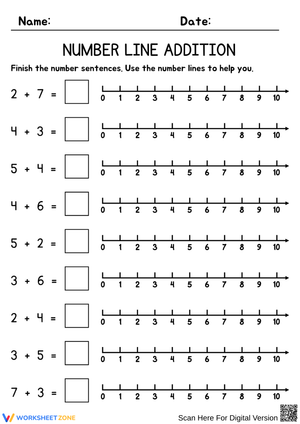
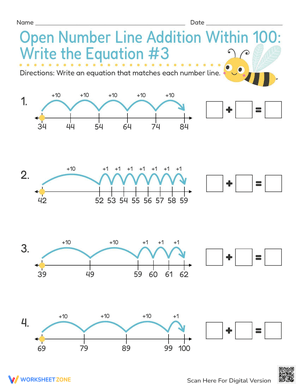
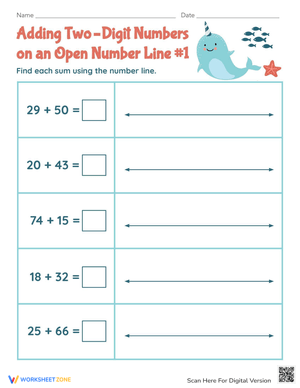
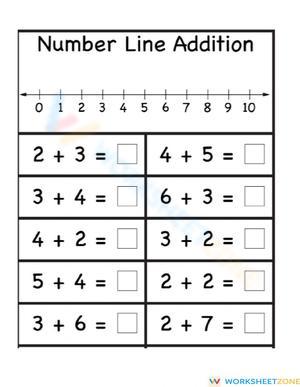
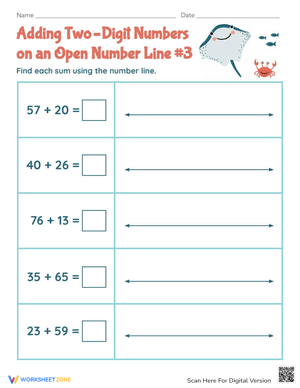
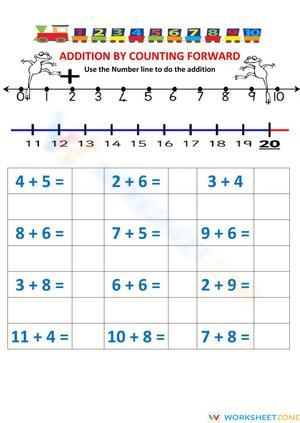
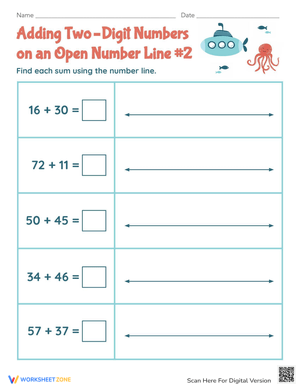
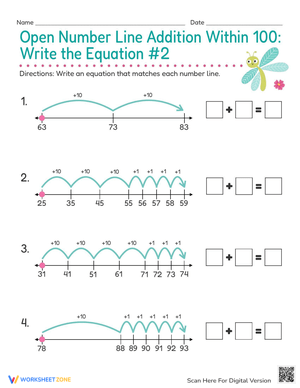
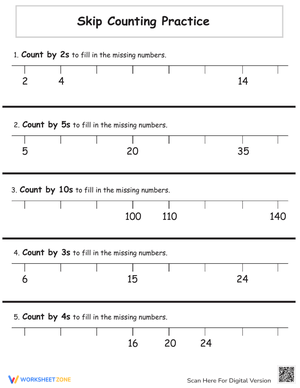
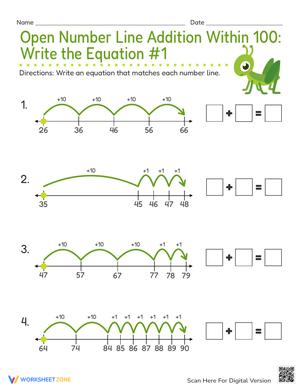
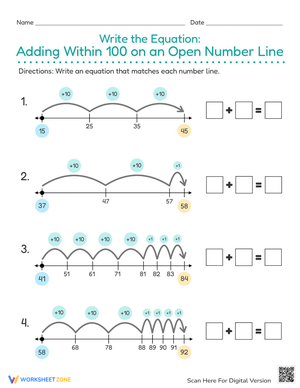
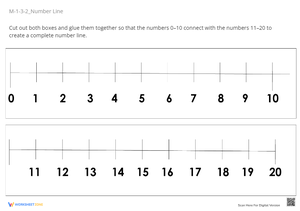
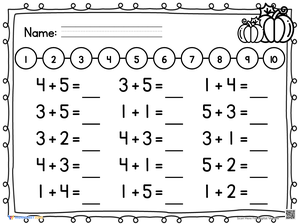
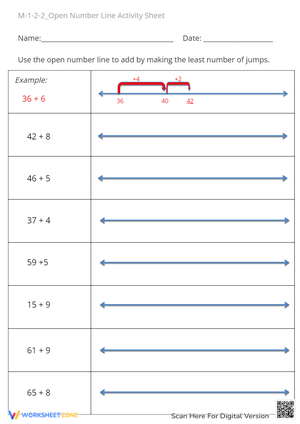
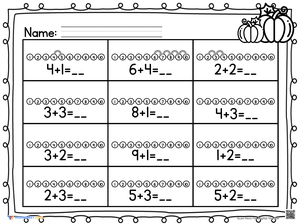
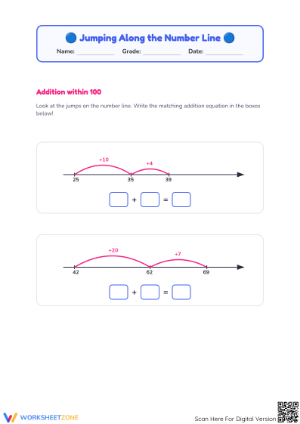
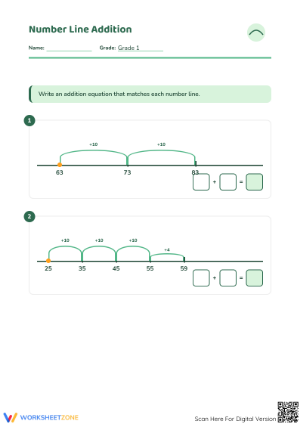
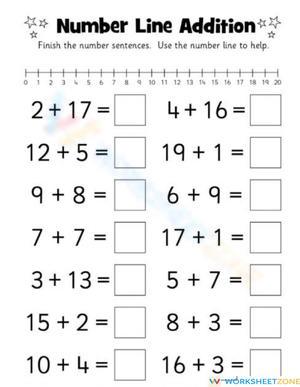
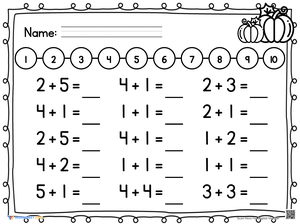
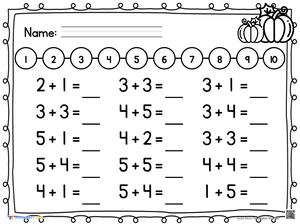
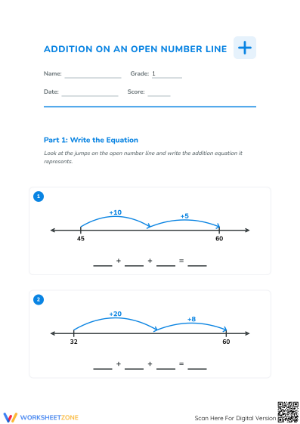
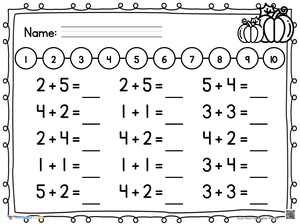
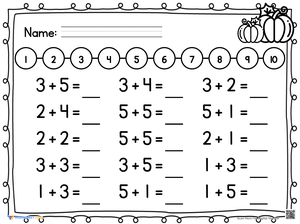
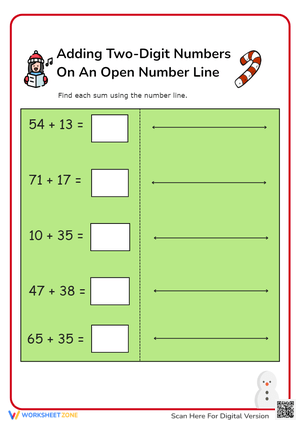
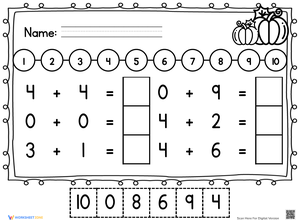
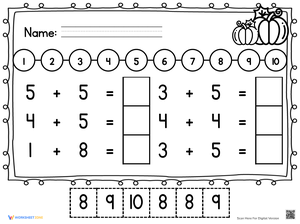
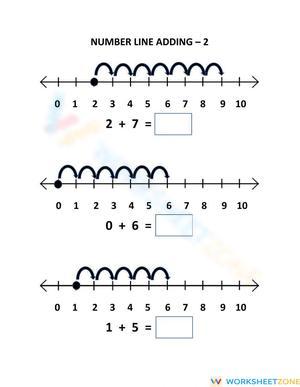
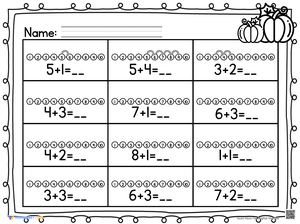
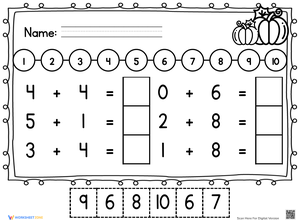
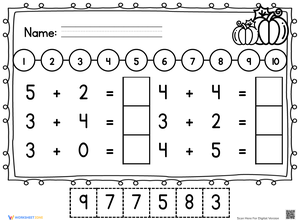
These addition on a number line worksheets for 1st grade target the specific developmental moment when students are ready to stop tallying everything from 1 and start launching from the larger addend — a shift that changes how first graders relate to equations for the rest of elementary school. The set covers sums within 20, moving students through three levels of independence: following pre-drawn arcs, drawing their own jumps from a marked starting point, and working from a completely blank number line with only an equation as a guide.
The Counting Errors First Graders Make Most Often
The most persistent error in number line addition at this age is counting the starting tick mark as the first jump. A student working on 5 + 3 places a pencil on 5, counts "one" without moving, and draws only two more arcs — landing on 7 and writing 7 as the sum. This is not carelessness; it comes from conflating the counting-objects model (where you count each item including the one you start on) with the counting-intervals model (where you count each movement). Telling students to "not count the starting number" does not fix it because the instruction is too abstract. What works is physical experience first — a floor number line where students take actual steps and count only when a foot lifts and lands. Most students correct the error within a few sessions once they have that movement experience in place.
A second consistent problem is drawing imprecise arcs that land between tick marks. When jumps are oversized or uneven, students lose visual track and guess at the landing spot. The worksheets print evenly spaced tick marks large enough for a first grader's hand to draw arcs that land cleanly, but teachers who see this error regularly should also notice the motor component — some students benefit from tracing a finger along laminated cards before moving to pencil on paper.
The third error is subtler: students who correctly start from the larger addend on simple problems revert to reading left-to-right as soon as the larger number appears second in the equation. For 2 + 8, they start at 2 and draw eight arcs — accurately, but inefficiently. The worksheets intentionally mix equation formats so teachers can see which students have internalized the commutative concept and which ones are following a memorized procedure.
What Each Worksheet Builds
- Locating a given starting number on a scaled number line (0–10 and 0–20 versions)
- Drawing arcs for each unit being added and marking each landing point
- Writing the sum after the final jump and recording the complete equation
- Reading pre-drawn jumps and writing the matching addition equation from the visual
- Choosing the more efficient addend as a starting point using the counting-on strategy
- Working with doubles and near-doubles within 20 using number line representation
Building These Worksheets Into Your Lesson Planning
The most efficient entry point is the eight minutes of morning work before the math block formally opens. One worksheet on the day you extend to a new number range — moving from within 10 to within 20, for instance — gives an immediate read on who carried the strategy forward and who needs a re-teach before the new content lands. Students who finish early can write their own equations on the back for a partner to solve on a blank number line.
For small-group pull-outs, the three-level structure means you are not printing separate packets for different groups — you are pulling the worksheet that matches where each group sits in the progression. The addition on a number line worksheets for 1st grade format makes this manageable: print once per week, sort by level the night before, and differentiated materials are ready without extra morning prep. Math centers work well too, especially when sheets go into dry-erase sleeves — students mark, check, and erase without burning through paper, and the act of erasing and redrawing a jumped arc when they catch a mistake reinforces that precision is part of the skill.
Standard Alignment
These worksheets address 1.OA.C.5 — relating counting to addition and subtraction — which is where the Common Core places explicit work on counting-on as a computational strategy. The standard lives in the Operations & Algebraic Thinking domain because the goal is not just a correct sum but an understanding that addition is forward movement through the number sequence. Number line work is the most direct instructional path to that understanding. Teachers following standards-aligned pacing guides typically introduce number line addition in the second quarter of first grade, after students have built reliable counting sequences to 20 but before they are expected to produce addition facts from memory.
Adjusting the Worksheets for Different Points in the Learning Curve
Students still working on number sequence to 10 need the pre-numbered, pre-arced format. Their working memory is occupied by identifying and reading numbers, and asking them to draw jumps simultaneously produces errors that obscure which skill is actually failing. Those students work best with the guided arc versions where they trace rather than generate independently.
Students who have the strategy but need fluency work do well with the blank number line versions under a light time limit — three equations in two minutes, number line provided, sum recorded — used as a warm-up before the main lesson. For students ready to push further, the same worksheets support a written reflection prompt: "Which number did you start from and why?" One honest limitation to flag: students with significant fine motor challenges find the arc-drawing task frustrating regardless of whether they understand the math. Enlarging the addition on a number line worksheets for 1st grade printouts to 115% on a school copier gives those students more room to work without changing the mathematical demand, and substituting straight hop lines for arcs removes the motor barrier entirely.
Frequently Asked Questions
Why do students keep counting the starting number as their first jump?
This error comes directly from the counting-all model students bring from work with physical objects. When you count five blocks, you touch each one including the first. The number line shifts the unit of counting from objects to movements — intervals — and that shift is not obvious to six-year-olds from looking at a page. Physical floor-line work, where students step and count only on each landing, resolves it faster than any paper-based correction strategy.
Should students stop using the number line once they know their addition facts?
The number line is not a temporary support to phase out — it is a mental model students carry forward. The goal is internalization, not removal. When students can describe where the jumps land without looking at the paper, the number line representation has done its job. Pushing students off the drawn number line before that internalization happens creates fluency gaps that surface in second-grade subtraction work.
Can these worksheets work for kindergarten or 2nd grade students?
The 0–10 versions are accessible to kindergarteners beginning to add within 10 who have some familiarity with number sequence. The 0–20 blank-line versions challenge second graders consolidating addition facts and preparing to apply the same forward-movement logic to subtraction. The addition on a number line worksheets for 1st grade set is built around first grade expectations, but the format reaches a full grade in either direction depending on the student's current skill level.













 Interactive Worksheet Maker
 Quiz Maker
 Word Search Maker
 Crossword Puzzle Maker
 Word Scramble Generator
 Sentence Scramble Generator
 Handwriting Worksheet Generator
 Name Tracing Generator
 Fill In The Blank Generator