


























Views
Downloads

Printable Open Number Line Addition | Grade 1 Math
Paste this activity's link or code into your existing LMS (Google Classroom, Canvas, Teams, Schoology, Moodle, etc.).
Students can open and work on the activity right away, with no student login required.
You'll still be able to track student progress and results from your teacher account.
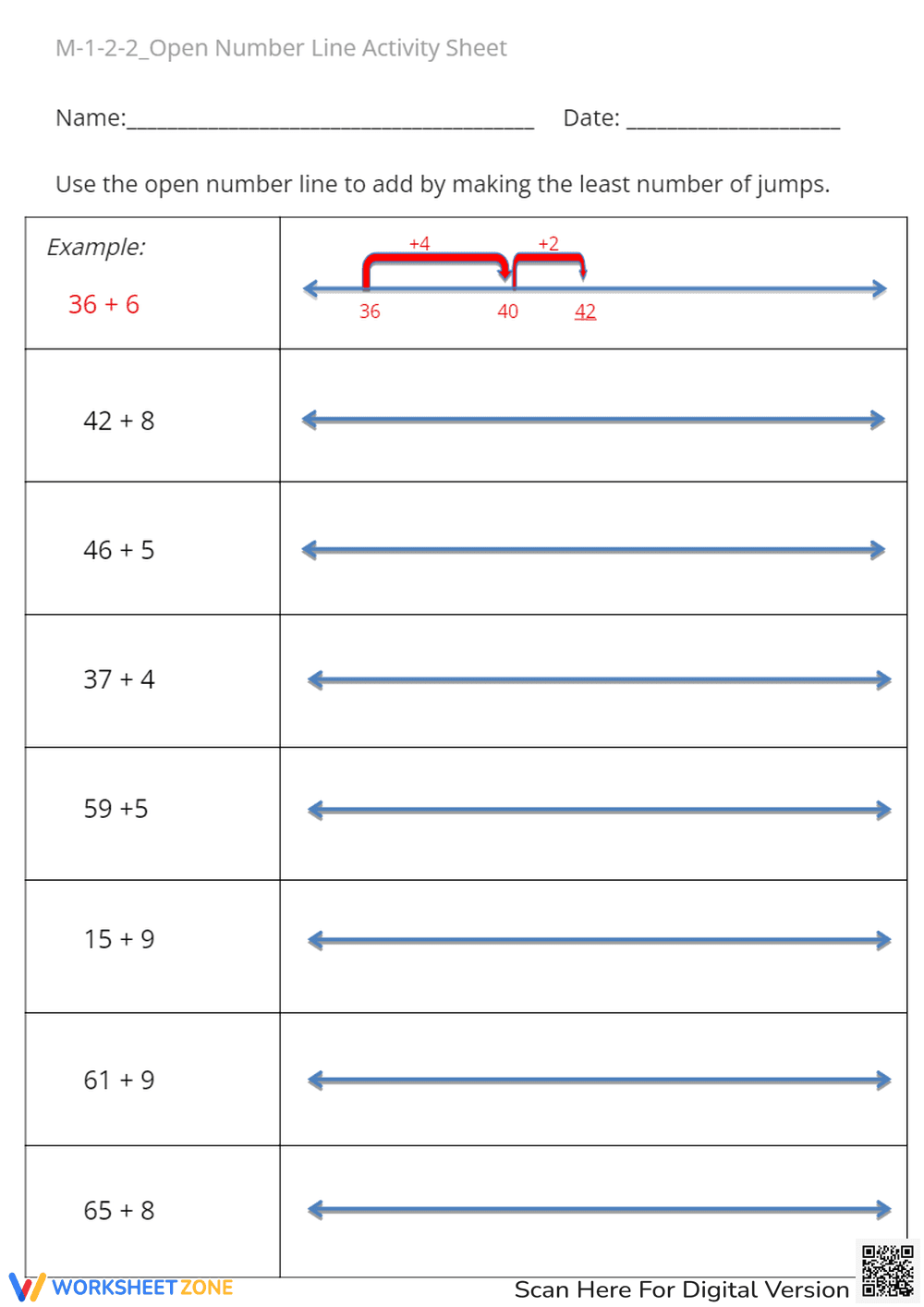
This focused worksheet provides Grade 1 students with targeted practice using open number lines to solve two-digit and one-digit addition problems. Visualizing the "make a ten" strategy helps young learners develop strong mental math foundations and place value understanding, ensuring they confidently add numbers within 100.
At a Glance
- Grade: 1 · Subject: Math
- Standard:
CCSS.MATH.CONTENT.1.NBT.C.4— Add within 100 using models and place value strategies- Skill Focus: Addition on an open number line
- Format: 1 page · 7 problems · Answer key included · PDF
- Best For: Independent practice and skill reinforcement
- Time: 10–15 minutes
This single-page resource features one worked example followed by seven addition problems. Students use an open number line to add a one-digit number to a two-digit number by making the least number of jumps. The layout provides ample space for students to draw jumps and label landing points. A complete answer key supports quick grading.
Skill Progression
- Guided practice: The worksheet opens with a modeled example demonstrating how to decompose an addend to reach the next ten.
- Supported practice: The initial problems feature numbers requiring a simple jump to the next ten, allowing students to apply the strategy easily.
- Independent practice: The final problems challenge students to apply the strategy to larger numbers, solidifying their grasp.
This structure follows a gradual-release model, moving from a clear example into independent application.
Standards Alignment
This resource aligns to primary standard CCSS.MATH.CONTENT.1.NBT.C.4: Add within 100, including adding a two-digit number and a one-digit number, using concrete models or drawings and strategies based on place value. Both standard codes can be copied directly into lesson plans, IEP goals, or district curriculum mapping tools.
How to Use It
Deploy this worksheet during independent work time immediately following direct instruction on open number lines. It serves as an excellent formative assessment tool; teachers can observe whether students are efficiently jumping to the next ten or relying on inefficient counting-by-ones strategies. Alternatively, use it as a targeted intervention activity for small groups struggling with mental addition. Expected completion time ranges from 10 to 15 minutes, depending on the student's familiarity with the visual model.
Who It's For
This activity is designed for Grade 1 students mastering place value and addition strategies. It is particularly beneficial for visual learners who need concrete models to understand abstract mental math concepts. For differentiation, teachers can provide base-ten blocks alongside the worksheet for students needing extra scaffolding. This resource pairs perfectly with an anchor chart demonstrating the "make a ten" jump strategy.
Developing proficiency with visual models like the open number line is a critical step in building early algebraic thinking and computational fluency. According to a recent EdReports 2024 analysis of elementary mathematics curricula, students who consistently use open number lines to model addition demonstrate a deeper understanding of place value and are less likely to make procedural errors when transitioning to standard algorithms. This worksheet specifically targets CCSS.MATH.CONTENT.1.NBT.C.4, requiring students to add within 100 using models and place value strategies. By explicitly prompting students to make the least number of jumps, the activity forces them to decompose numbers strategically rather than counting by ones. This targeted practice bridges the gap between concrete manipulatives and abstract mental math, ensuring long-term retention of essential arithmetic properties and preparing first graders for more complex operations.


