


























Views
Downloads
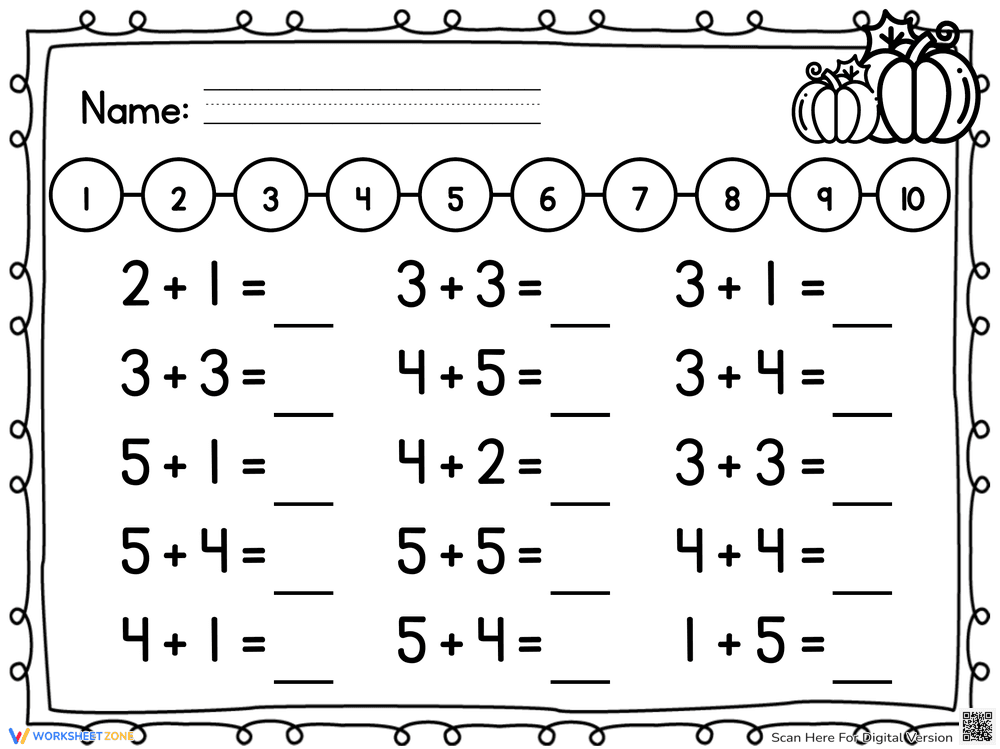

Thanksgiving Number Line Addition | Essential Grade 1 Math
Paste this activity's link or code into your existing LMS (Google Classroom, Canvas, Teams, Schoology, Moodle, etc.).
Students can open and work on the activity right away, with no student login required.
You'll still be able to track student progress and results from your teacher account.
This Thanksgiving-themed math worksheet helps early learners master addition within 10 using a visual number line strategy. By connecting abstract equations to a concrete linear model, students develop a stronger sense of number relationships and cardinality. This resource provides immediate practice for Kindergarten and first-grade students to build fluency in basic operations during the holiday season.
At a Glance
- Grade: 1 · Subject: Math
- Standard:
CCSS.MATH.CONTENT.K.OA.A.2— Solve addition problems within 10 using objects or drawings to represent the problem- Skill Focus: Number line addition within 10
- Format: 1 page · 15 problems · Answer key included · PDF
- Best For: Independent practice or morning work
- Time: 10–15 minutes
The worksheet features a clear, horizontal number line from 1 to 10 at the top of the page, decorated with festive pumpkin illustrations. Below the visual aid, students find 15 addition sentences arranged in three organized columns. Each problem includes a dedicated line for the sum, ensuring plenty of space for young writers. The single-page PDF format is designed for high-contrast printing and easy distribution.
This resource is designed for maximum efficiency in busy classrooms. Teachers can print the single-page PDF in less than 30 seconds. Distribution takes only a minute, as the instructions are self-explanatory for students familiar with number lines. Reviewing the 15 problems can be done as a whole-class activity or via the included answer key, requiring zero teacher preparation or additional materials beyond a pencil.
The primary focus is CCSS.MATH.CONTENT.K.OA.A.2, which requires students to solve addition and subtraction problems and add and subtract within 10. By using the number line, students also meet CCSS.MATH.CONTENT.1.OA.C.5, relating counting to addition (e.g., counting on 2 to add 2). Both standard codes can be copied directly into lesson plans, IEP goals, or district curriculum mapping tools.
Use this worksheet as a formative assessment after a direct instruction lesson on the "counting on" strategy. It is also an ideal choice for a Thanksgiving-themed math center or as a quick sub plan activity. Teachers should observe if students are correctly placing their finger on the first addend before "jumping" the value of the second addend. Completion typically takes 10 to 15 minutes.
This resource is tailored for Kindergarten students ready for symbolic addition and Grade 1 students needing fluency reinforcement. It provides excellent support for English Language Learners and students with IEPs who benefit from visual scaffolds. Pair this worksheet with a physical floor number line or pumpkin-themed counters for a multi-sensory math experience.
Research from Fisher & Frey (2014) emphasizes the importance of visual representations, such as number lines, in developing early mathematical proficiency. This Thanksgiving Number Line Addition worksheet aligns with these findings by providing a concrete linear model that bridges the gap between counting and operational fluency. By focusing on CCSS.MATH.CONTENT.K.OA.A.2, the resource targets the foundational skill of adding within 10, a critical milestone for future algebraic thinking. Studies by EdReports (2024) suggest that high-quality, focused practice on single-digit addition significantly improves long-term retention of math facts. This 15-task activity offers the structured repetition necessary for students to move from counting-all to counting-on strategies. The festive theme increases student engagement without distracting from the core instructional objective. This worksheet serves as a reliable tool for educators seeking to provide evidence-based, standards-aligned practice that supports the diverse needs of early elementary learners in a classroom setting.


