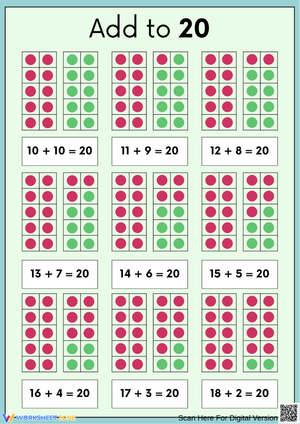
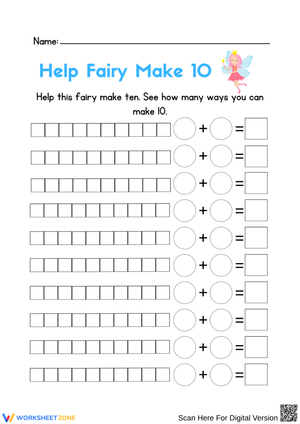
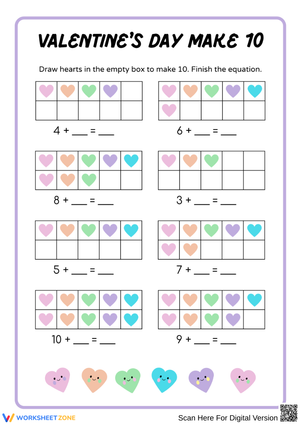
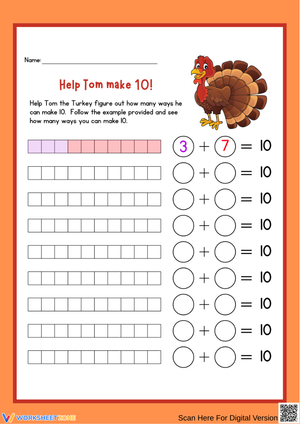
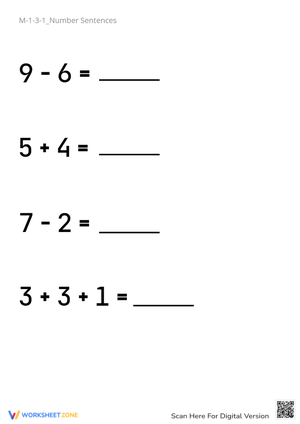
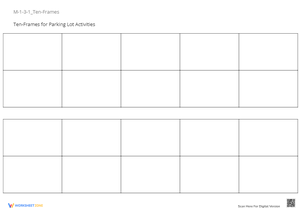
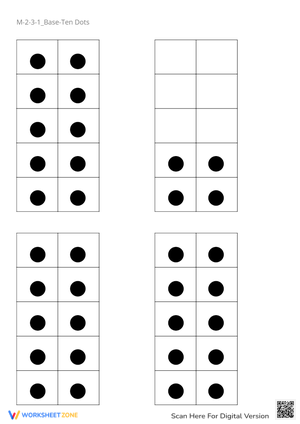
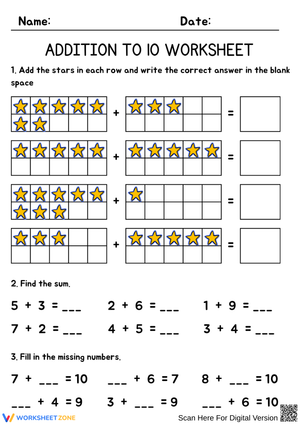
1st grade addition and ten frames worksheets give first graders a visual anchor they can return to long after physical counters are put away. This set targets addition within 20 — covering single-number recognition, the make-a-ten strategy, and double frames for sums into the teens. Teachers get focused, printable practice that drops into math centers, warm-up blocks, and targeted small-group sessions without any prep overhead.
Skills and Tasks in Each Worksheet
Each worksheet in the set isolates a specific ten-frame skill rather than mixing every concept into one exercise. That separation matters: students who are solid on subitizing single frames but shaky on decomposing for make-a-ten need different practice than students who have mastered both. The set covers:
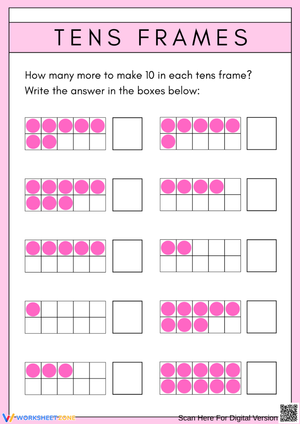
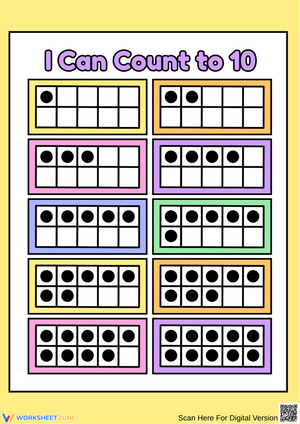
- Subitizing and number recognition — students look at a partially filled frame and write the number without counting dot by dot
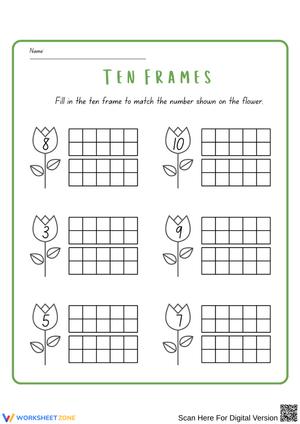
- Building numbers — students fill in a blank frame to match a given number, reinforcing canonical arrangements (five across the top row, then the bottom)
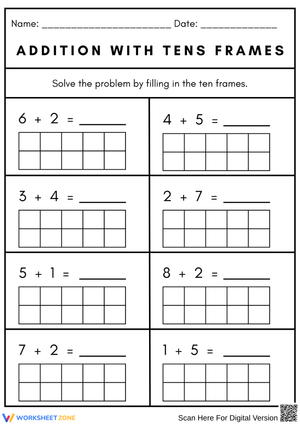
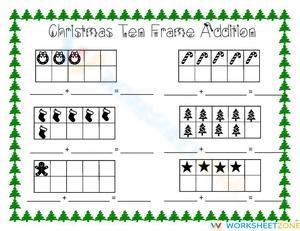
- Single ten-frame addition — students complete an equation like 4 + 3 by filling dots in two colors and writing the sum
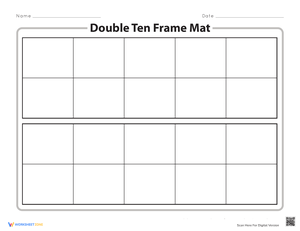
- Make-a-ten with double frames — students draw arrows or shade a contrasting color to show how they move dots from one frame to complete the other, then record the transformed equation
- Teen numbers as ten-and-some-more — double frames where the first is always fully filled; students read or build the second frame and record the number in place-value form
- Missing addends — a partially filled frame paired with an equation like __ + 4 = 10, requiring students to identify what's absent
Why the Ten Frame Format Works at This Stage
The concrete-pictorial-abstract progression explains why 1st grade addition and ten frames worksheets work as well as they do at this grade level. Most students arrive in first grade having used physical objects — counters, linking cubes — to represent quantities. The ten frame sits in the pictorial phase: it removes the physical object but preserves the spatial layout, so students can develop a reliable mental image of quantities before that image is stripped away entirely. The two-row structure — five across the top, five across the bottom — maps onto the subitizing range for most six- and seven-year-olds, who can visually chunk groups of five without counting. A student who sees seven filled squares doesn't need to count; they see a full top row and two more, which is exactly the mental model that makes "7 + 3 = 10" feel obvious rather than retrieved.
The make-a-ten strategy is where the format does its heaviest lifting. When students physically draw the dot movement — pulling 2 from the 5 to fill an 8 up to 10 — they are carrying out a decomposition on paper. The action makes the underlying algebra visible before students know what algebra is. By the time they meet two-digit addition in second grade, the regrouping logic is already familiar because they lived it in first grade with frames and crayons.
Student Errors These Worksheets Help You Catch
The most persistent mistake with double ten frames and make-a-ten is straightforward to see but harder to fix: a student solving 8 + 5 will move all five dots from the second frame into the first frame rather than the two needed to complete it. They understand there is a "moving" action, but they skip the decomposition step and simply relocate the entire second addend. The ten frame makes this error visible immediately — students end up with 13 dots crammed into a ten-box grid — and it opens a productive conversation about why we only move enough to fill the ten, not the whole group.
A second error surfaces when students record equations after working on a frame. A student who correctly shows 6 dots in one color and 4 in another will sometimes write "6 + 4 = 64" — concatenating the digits instead of adding them. This isn't random confusion; it reflects early place-value uncertainty about what it means to combine two quantities versus place two digits side by side. The error appears in actual first-grade work far more often than teachers expect, and catching it during ten-frame practice is far easier than catching it later in two-digit computation where the source is harder to trace.
Building These Worksheets Into Your Math Block
The most effective placement for 1st grade addition and ten frames worksheets is the first ten minutes of the math block — before new instruction begins. Students who work through one focused worksheet each morning Monday through Thursday build retrieval practice into the week without consuming significant instructional time. By Friday, that ten-frame skill feels fluent, and the review block moves faster because students have been quietly consolidating it all week.
For math center rotations, pair each worksheet with a small tray of two-color counters. Some students still need to physically place objects before they draw — letting them do both means the worksheet becomes a recording sheet for manipulative work rather than a replacement for it. Reserve the most open-ended worksheets — missing addends and write-your-own equations from a given frame — for the teacher-led small-group station, where you can listen to students reason aloud and catch decomposition errors before they harden into habits.
Standard Alignment
CCSS 1.OA.C.6 requires students to add and subtract within 20 using strategies such as making ten, decomposing a number leading to a ten, and applying the relationship between addition and subtraction. The make-a-ten exercises address this standard directly, in a visual format that matches how the strategy is typically introduced — with frames and physical markers before students move to bare equations. CCSS 1.NBT.B.2 addresses place value understanding, specifically that the numbers 11 through 19 are composed of a ten and some additional ones. The double ten-frame worksheets for teen numbers give students a concrete representation of this standard and tie place value directly to addition context, rather than treating the two as separate instructional topics.
Adjusting These Worksheets for a Range of Learners
For students who are not yet confident with the make-a-ten strategy, use the same 1st grade addition and ten frames worksheets but pair each one with a physical ten-frame mat and two-color counters. Let students build the problem with manipulatives first, then trace what they built onto the worksheet. This keeps the recording practice intact while reducing the cognitive load of holding a spatial arrangement in working memory — students work from what they can see, not what they have to imagine.
Students who move through the standard problems quickly benefit from two adjustments: equations with a missing middle term (for example, 8 + __ = 13, where both the sum and one addend are given), and prompts that ask them to generate two different equations that produce the same sum using a single frame. That second task — producing multiple expressions from one visual — moves into the commutative property and early algebraic thinking without requiring any new vocabulary from the teacher.
Frequently Asked Questions
At what point should students stop using the ten-frame visual and work from bare equations?
When a student accurately and quickly solves addition problems within 20 while explaining the strategy verbally — without glancing at a drawn frame — the visual support has served its purpose. For most first graders, this happens mid-year for sums within 10 and by spring for make-a-ten with sums in the teens. The worksheet progression naturally supports this fade: later exercises in the set show an empty frame as a reference but require students to work through the strategy mentally, with only the equation printed below.
How do the missing addend worksheets connect to subtraction?
A ten frame showing 10 dots with 4 circled alongside the equation "4 + __ = 10" is structurally the same problem as "10 – 4 = __." Students who work through missing addend exercises are building the part-part-whole understanding that makes subtraction sensible rather than arbitrary. First graders who practice missing addends fluently tend to handle subtraction in the second half of the year with far less difficulty, because they already grasp the relationship — they just haven't been told what to call it yet.
Do these worksheets work for kindergarteners who are ahead, or second graders who need review?
The single-frame and number-building worksheets are accessible to kindergarteners who have already been introduced to ten frames and are adding within 10. The double-frame and make-a-ten worksheets are squarely first-grade material and assume students can count on from a given number. For second graders using these for review, the missing addend and double-frame exercises are the most valuable — they reinforce the decomposition reasoning that directly supports two-digit addition, which is the core second-grade computation standard.













 Interactive Worksheet Maker
 Quiz Maker
 Word Search Maker
 Crossword Puzzle Maker
 Word Scramble Generator
 Sentence Scramble Generator
 Handwriting Worksheet Generator
 Name Tracing Generator
 Fill In The Blank Generator