


























Views
Downloads

Essential Number Line Addition Worksheet | Grade 1 Math
Paste this activity's link or code into your existing LMS (Google Classroom, Canvas, Teams, Schoology, Moodle, etc.).
Students can open and work on the activity right away, with no student login required.
You'll still be able to track student progress and results from your teacher account.
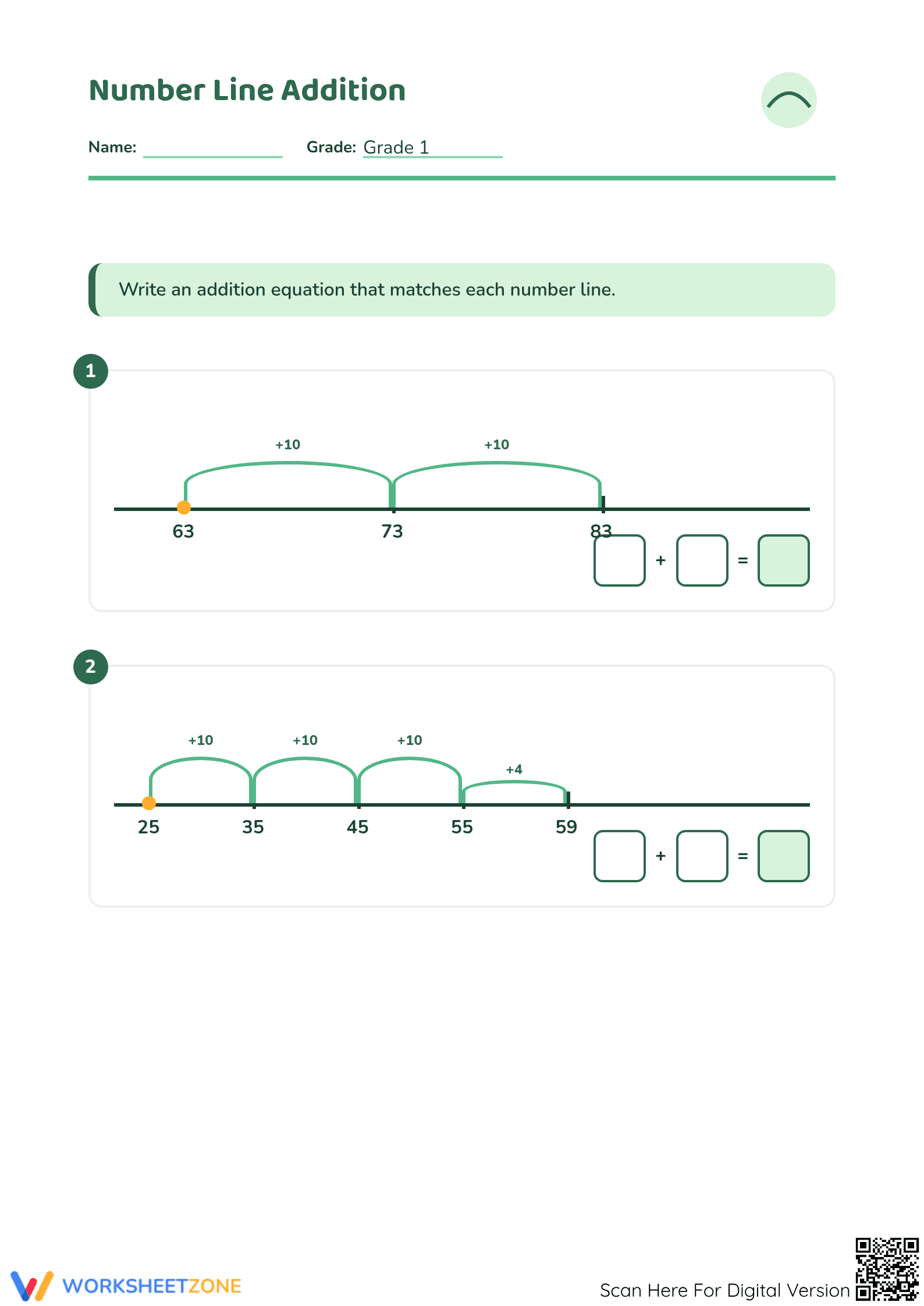
Mastering addition within 100 is a pivotal milestone for first-grade learners. This worksheet provides structured practice for students to visualize two-digit addition using an open number line. By translating jumps of tens and ones into mathematical equations, students develop a deep conceptual understanding of place value and addition strategies. The clear layout ensures students focus on mathematical logic.
At a Glance
- Grade: 1 · Subject: Math
- Standard:
1.NBT.C.4— Add within 100 using concrete models or drawings and strategies based on place value- Skill Focus: Open number line addition with two-digit numbers
- Format: 2 pages · 5 problems · Answer key included · PDF
- Best For: Independent practice or small group instruction
- Time: 15–20 minutes
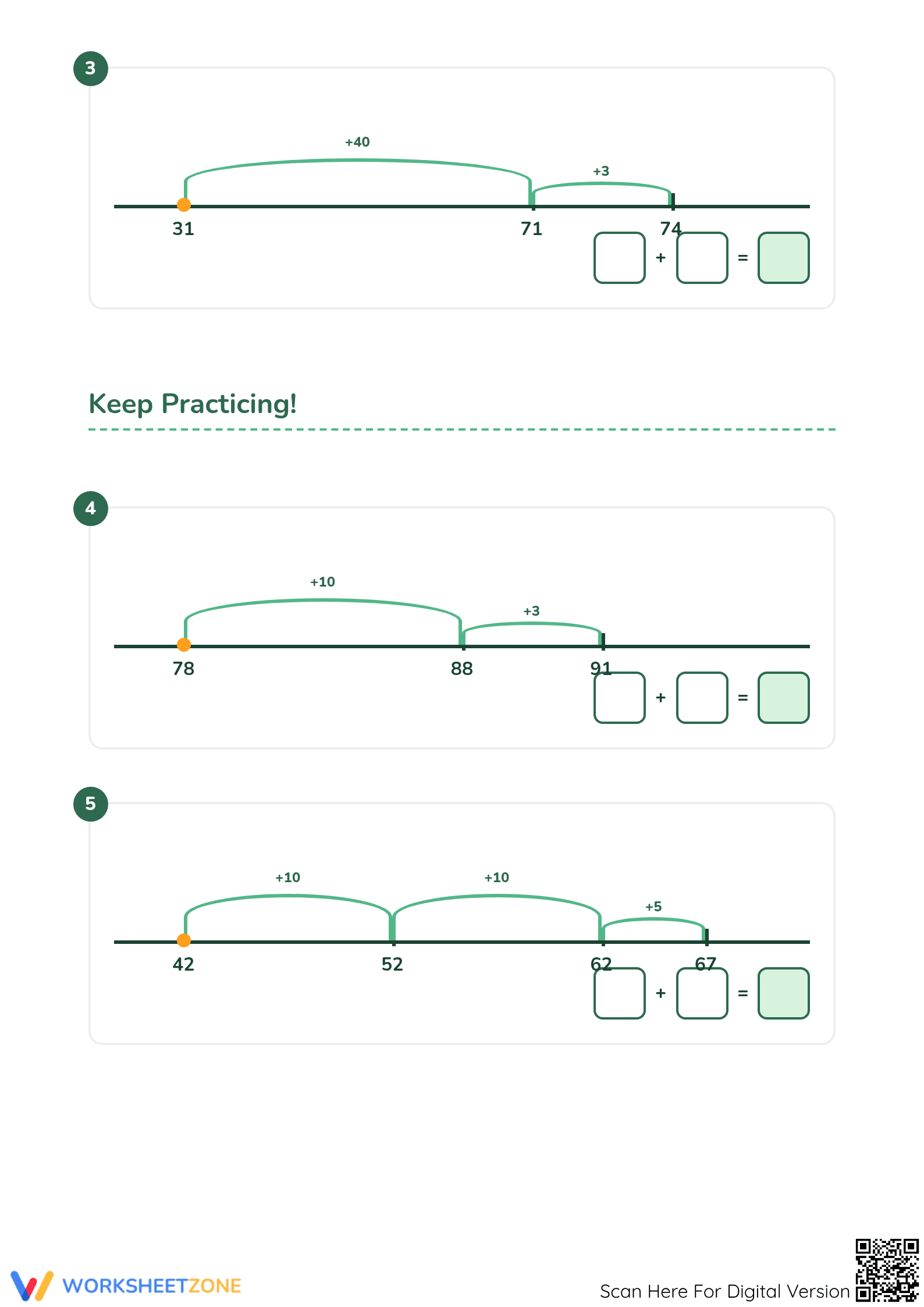
What's Inside: This 2-page resource features five addition problems paired with pre-drawn open number lines. These lines use jumps for tens and ones, helping students decompose numbers. The worksheet includes boxes for the starting number, addend, and sum, ensuring a record of mathematical thinking. A full answer key is provided for efficient grading.
Zero-Prep Workflow: This resource is designed for immediate use. First, print the two pages (30 seconds). Second, distribute to students; the intuitive visual cues require minimal instruction (1 minute). Finally, use the answer key to review work or facilitate peer-correction (1 minute). Total teacher prep is under two minutes, making it ideal for sub plans.
Standards Alignment: This resource is aligned with 1.NBT.C.4, requiring students to add within 100 using strategies based on place value and visual models. It specifically supports adding a two-digit number and a multiple of 10. The standard code can be copied directly into lesson plans, IEP goals, or district curriculum mapping tools.
How to Use It: Use this as a formative assessment to gauge how students bridge visual models with equations. Observe if they correctly identify the starting point versus jump values. Alternatively, assign it as a focused homework task after a lesson on place value to reinforce addition strategies. Expected completion time is 15 to 20 minutes.
Who It's For: This resource is for Grade 1 students transitioning to multi-digit operations. It offers scaffolding for learners who benefit from visual representations. For differentiation, provide base-ten blocks as a natural pairing resource. It is also an excellent tool for intervention groups focusing on foundational number sense and place value logic.
The use of open number lines is a research-supported strategy for developing flexible mental arithmetic. According to a RAND AIRS 2024 analysis of primary mathematics, visual models that represent the relative magnitude of numbers—such as number lines—significantly improve a student's ability to perform mental math without relying solely on rote memorization of algorithms. This worksheet targets the 1.NBT.C.4 standard by requiring students to decompose addends into tens and ones, a fundamental skill for operational fluency. By practicing the translation of number line jumps into formal equations, students internalize the additive properties of the base-ten system. Research from Fisher & Frey (2014) emphasizes that such guided practice with visual scaffolds facilitates a smoother transition to abstract mathematical reasoning. This 2-page resource ensures that students are not just calculating sums but are actively visualizing the process of addition within 100, a key requirement for success in subsequent grades.


