The First Grade Teacher's Guide to a Cursive Letter Chart
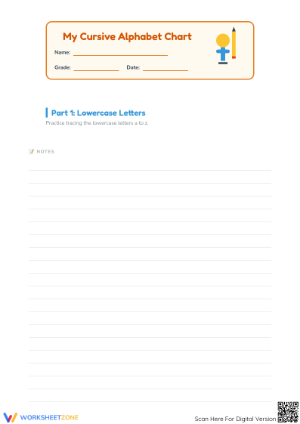
A 1st grade cursive letter chart is a single-page reference that lays out every uppercase and lowercase cursive letter in correct formation. For 6 and 7 year olds still building fine-motor control, that visual model matters more than any verbal explanation. The chart gives young writers a consistent picture of where each stroke starts, how the pencil loops and curves, and where one letter connects to the next.
In a first grade room, the chart works two ways. Displayed large near the board, it becomes a shared reference you can point to during whole-class modeling. Printed small as a desk strip, it gives each student a personal copy to glance at while tracing and copying. Both formats reinforce the same shapes, so students are not learning one version on the wall and a different one at their seat.
Because cursive letters are built from a small set of repeated strokes, a good chart also helps you talk about handwriting in terms students can grasp: undercurves, overcurves, loops, and tails. Naming those strokes as you point to the chart gives first graders shared vocabulary, so feedback like check your undercurve points straight back to a picture they can see.
Sequencing Cursive Letters for 6-7 Year Olds
The most reliable way to use the chart with first graders is to resist teaching it in alphabetical order. Handwriting specialists recommend introducing one or two letters at a time with a trace-then-copy sequence, starting with lowercase letters whose cursive forms echo the manuscript shapes children already know, such as c, a, and d. Because these letters share a common undercurve starting stroke, grouping them lets students transfer one motor pattern across several letters instead of relearning from scratch each day.
From there, move into letters that add loops and tails, then work up to the trickier connectors. Point to each target letter on the chart, model it slowly, and have students trace it in the air, then on paper, before copying independently. Covering the whole alphabet at once overwhelms early writers and usually produces sloppy habits that are hard to correct later.
Classroom Implementation
Short, consistent practice beats occasional long blocks for first graders. Aim for roughly 10 to 15 minutes of cursive work, three to five times per week, so students build letter-formation muscle memory without fatigue. A predictable slot also lets you tie each session directly to a letter or two highlighted on the chart.
A simple weekly rhythm keeps the chart at the center of instruction:
- Open with 60 seconds of whole-class modeling, tracing the target letter on the chart while students watch your stroke direction.
- Have students air-write the letter, then trace it on their desk strip.
- Move to guided practice on lined paper, circulating to catch reversed loops early.
- Close with a quick self-check: students compare their best attempt to the chart and mark the one they are proudest of.
Keep the chart visible during independent literacy centers, too, so students who finish early can practice a familiar letter without waiting for direct instruction. Over a full week, those small pockets of extra repetition add up, and the chart quietly reinforces correct formation even when you are working with another group.
Differentiating Cursive Practice
First graders arrive with very different levels of hand control, and the chart makes differentiation manageable. For students still building manuscript fluency, hold off on connectors and let them practice single cursive letters in isolation, matching each one to the chart. The goal at that stage is confident formation, not joined writing.
For students who move quickly, extend practice by asking them to copy short two-letter and three-letter combinations from the chart, focusing on smooth connections. You can also let advanced writers help set up desk strips for the group, which reinforces their own letter recognition. Because everyone works from the same chart, the room stays cohesive even when the tasks differ.
Frequently Asked Questions
1. Is cursive required in 1st grade, and does it vary by state?
Requirements vary widely. As of 2025, 25 states require cursive instruction at some point in elementary school, but most set proficiency for third or fifth grade. A few states, including California and Ohio, ask schools to begin cursive exposure as early as first grade, so check your own state and district guidance before planning.
2. What is the best order to teach cursive letters to 1st graders?
Start with lowercase letters whose cursive forms resemble manuscript shapes, such as c, a, and d, and introduce just one or two at a time. Group letters that share a starting stroke, then progress to loops, tails, and connectors once the basic undercurve is steady and automatic.
3. How long should daily cursive practice be for first grade students?
Short and frequent works best. Roughly 10 to 15 minutes, three to five times per week, builds muscle memory more effectively for young writers than one long weekly session. Consistency and clean modeling from the chart matter more than total minutes at this age.
4. How can teachers use the chart for whole-class versus independent practice?
Display a large chart near the board for whole-class modeling, pointing to each letter as you demonstrate stroke direction. Give students a small desk-strip version for independent tracing, copying, and self-checks, so the reference they use alone matches the one you model together.