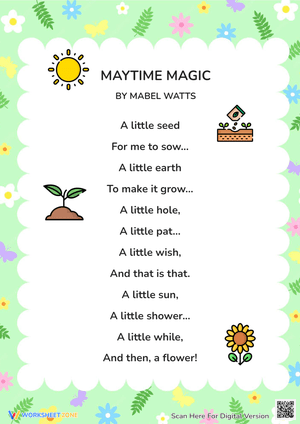
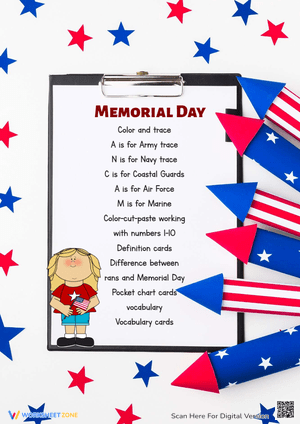
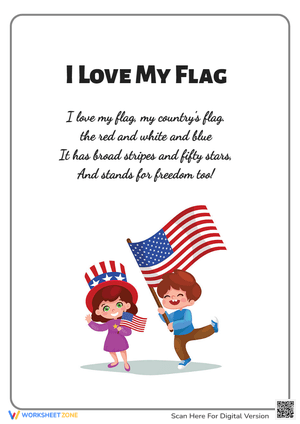
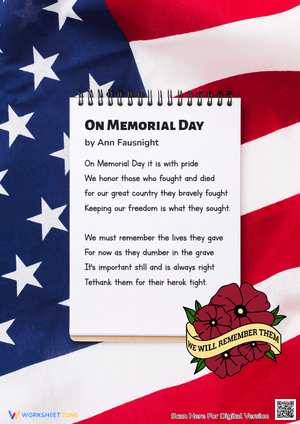
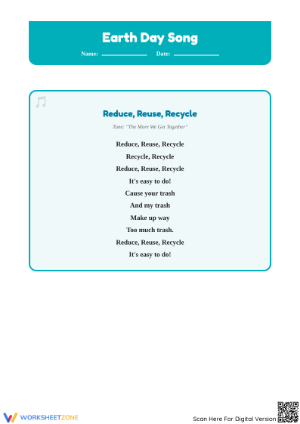
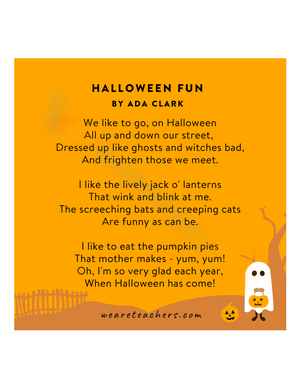
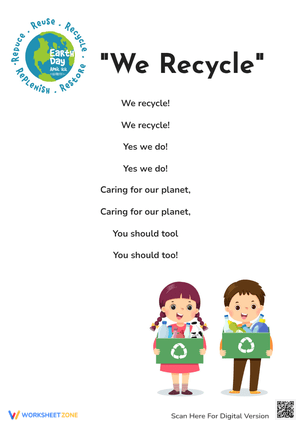
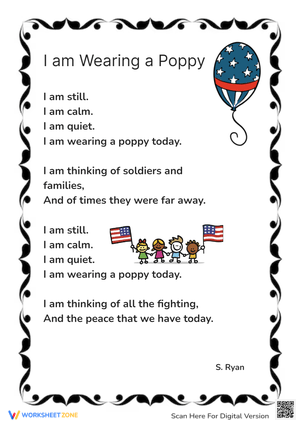
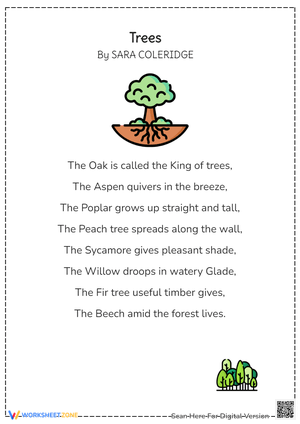
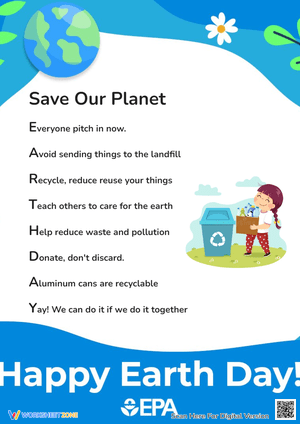
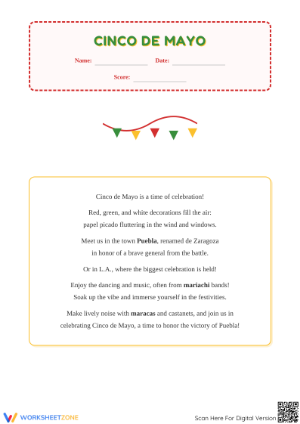
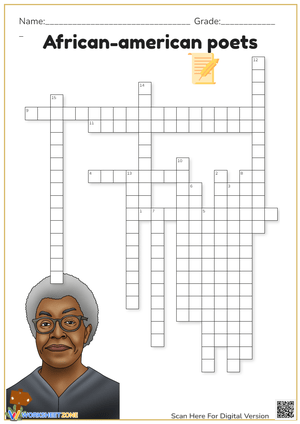
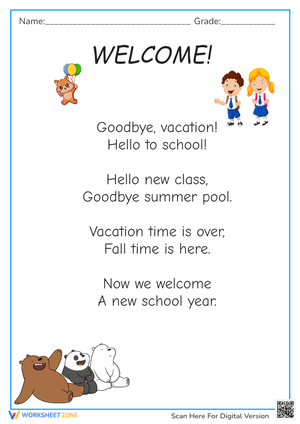
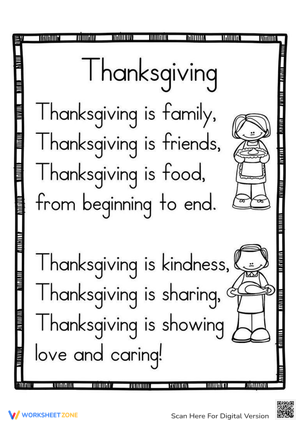
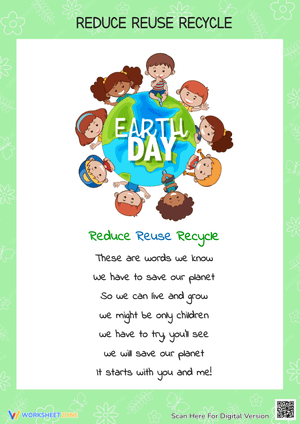
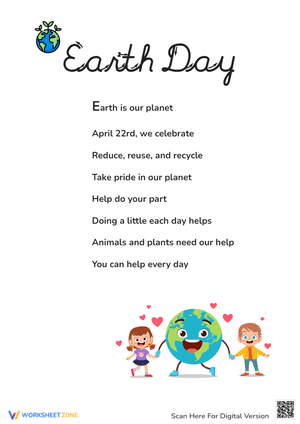
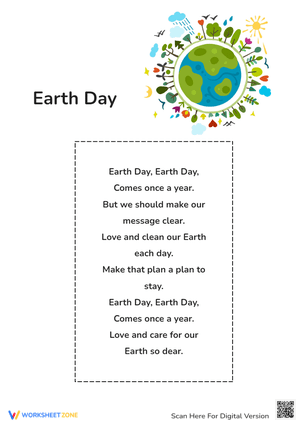
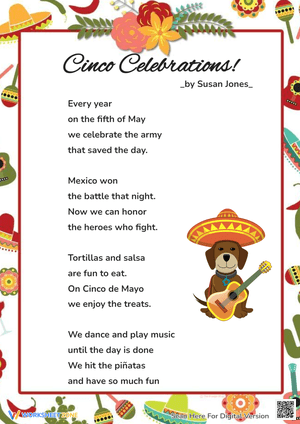
These 1st grade poems printable worksheets resources give teachers a text that pulls double and triple duty in early literacy instruction — building phonemic awareness through rhyme, supporting fluency through repeated reading, and providing beginning readers something short enough to finish in a single sitting, which matters when stamina is still fragile. Each worksheet pairs a brief poem with a focused response task so teachers move directly from modeled reading into student practice without a complicated transition.
The Specific Skills Targeted
These worksheets address a cluster of reading skills that reinforce each other at Grade 1 because, at this stage of development, phonemic awareness, fluency, and comprehension are not yet fully separated — gains in one tend to support the others.
- Rhyme recognition: Students circle rhyming pairs within the poem or match words from a word bank to lines in the text.
- Print tracking: Because poems use line breaks rather than continuous prose, they give young readers structured practice moving their eyes left-to-right and returning to the start of the next line correctly.
- Fluency and phrasing: Short texts with natural rhythm reward rereading — students hear their own voice improve over multiple passes through the same lines.
- Key detail comprehension: Focused questions ask students to identify who or what the poem describes, what action takes place, or which words name a sound or image.
- Pattern recognition: Many first-grade poems repeat a phrase or structural unit; noticing that repetition is both a comprehension and a word-study skill.
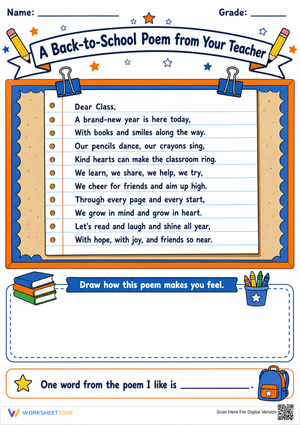
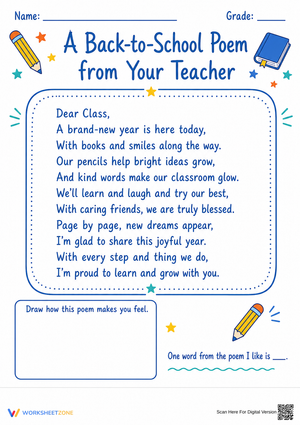
- Brief written response: Students complete sentence frames, label an illustration, or underline text evidence — tasks calibrated to Grade 1 writing stamina.
Teachers who reach for 1st grade poems printable worksheets pages for this kind of practice get the most out of them when the task stays narrow — one reading goal, one response type per worksheet — so cognitive load stays on reading rather than on deciphering multi-step directions.
Mistakes Students Make That These Worksheets Help You Catch
The most consistent error pattern is the confusion between rhyme and repetition. When asked to circle rhyming words, a number of first graders circle any word that appears more than once — "the rain, the rain" — because they understand that something is recurring, but they have not yet isolated the concept of matching ending sounds. A brief pre-task exchange ("listen — rain and train end the same way") clears this up faster than any printed direction on the worksheet itself.
A second pattern involves visual matching versus auditory matching. Students who clap out and correctly identify /cat/ and /hat/ as rhyming words in a read-aloud will stall when they must find those matches on the page — especially with vowel pairs like blue and flew or say and they, where spelling gives no obvious visual signal. When a student marks blue and true as the rhyming pair because both end in a three-letter cluster, that response tells you exactly where the next phonics conversation needs to go.
Students also tend to read poems too fast, treating them as prose without attending to line breaks. This collapses the rhythm and makes fluency work harder than it needs to be. One oral modeling pass — reading with deliberate phrasing and a brief pause at each line ending — gives students a concrete sound model before they attempt the text on their own.
Fitting Poetry Practice Into the Week's Lesson Structure
The most reliable approach is to introduce the poem on Monday through a shared read — aloud first by the teacher, then together as a class, then students whisper-read independently. Keep the same poem through the week. Tuesday's work focuses on one feature: a rhyming pair, a repeated phrase, or a tricky word. Wednesday is when the response worksheet fits naturally — students already know the text well enough that the printed task feels achievable rather than daunting. Thursday and Friday, a clean copy of the poem lives in a fluency folder for timed rereads or partner echo-reading.
A move worth adding to this routine: print each poem in two versions. One is an unmarked reading copy that stays clean all week. The other is the 1st grade poems printable worksheets response page students annotate — circling, underlining, or illustrating. When both versions exist, the reading copy stays legible for fluency work on Thursday and Friday, and students do not have to decode their own pencil marks while trying to read smoothly.
These worksheets also slot cleanly into the last eight minutes before a transition. The text is short enough that a student who arrives late to the activity can still access it. That reliability makes them useful in literacy centers, morning work bins, and take-home folders without requiring extra explanation or prep from the teacher.
Standard Alignment
These worksheets connect most directly to CCSS.ELA-LITERACY.RL.1.4, which asks first graders to identify words and phrases in stories or poems that suggest feelings or appeal to the senses. The response tasks — marking sensory words, noting repeated language, identifying what a poem describes — build exactly the text-level attention that standard targets. Worksheets also address RL.1.1 (asking and answering questions about key details in a text) when students respond to comprehension questions tied directly to the poem's content. In classroom terms, these are not enrichment activities orbiting core instruction — they are the core reading work, delivered through a text type the standards explicitly name at this grade level.
Adapting Each Worksheet for a Range of Learners
For students reading below grade level, remove the written response entirely and work with the poem as an oral task first. Read it together, have the student point to rhyming words you name aloud, and let them circle or mark with a highlighter rather than write. The poem text is the learning; the written response is evidence gathering, and it can wait until decoding is more secure. Pushing the writing task before a student is ready turns a reading activity into a frustrating fine-motor obstacle.
For students already reading independently, extend the response task beyond the printed prompt. Instead of completing a sentence frame, they write an original line that follows the poem's pattern, or they identify why the poet chose a specific word rather than a simpler synonym. Students who finish quickly compare two poems and note one structural similarity and one difference. This keeps the same worksheet useful across a wider reading range without requiring an entirely separate set of materials.
One honest constraint worth naming: the format works best when the poem sits near a student's instructional reading level. When a student is significantly below level, even a short text creates a decoding demand that leaves nothing available for the comprehension or rhyme task. In those cases, the teacher reads the poem while the student handles only the response — the phonemic awareness and comprehension practice transfers even without independent decoding.
Frequently Asked Questions
Do these worksheets work for fluency practice, or only comprehension?
Both. A short poem is one of the strongest fluency texts at Grade 1 because students can read it multiple times without feeling like they are doing the same assignment twice — phrasing and confidence shift noticeably between the first and fourth reading, and students hear that shift themselves. Comprehension questions on the same worksheet give a second entry point for students who gain fluency quickly but need more time processing what the poem actually means.
How many times should students read the poem before completing the response task?
Three full reads before the worksheet task is a practical minimum: one listen (teacher reads aloud), one shared read (class reads together), one independent or partner read. By the third pass, the text is familiar enough that the response task measures understanding rather than decoding. If a student is still working to decode on the third read, hold the worksheet for one more day before asking for a written response.
What makes a poem appropriate for Grade 1 versus Kindergarten or Grade 2?
At Grade 1, students handle poems with two or three stanzas, a slightly wider vocabulary range, and response tasks requiring a short sentence frame or one to two written words. Kindergarten poems typically stay under eight lines and rely almost entirely on high-frequency words. Grade 2 poems carry more figurative language and longer written responses. The 1st grade poems printable worksheets set sits in between — enough complexity to push readers forward without enough to shut them down.
Can these worksheets replace a formal reading assessment?
They function as formative checkpoints, not summative assessments. Each worksheet shows whether a student can identify a rhyming pair or answer a detail question on that day with that specific text. For formal assessment data, a standardized protocol is still necessary. But patterns across four or five worksheets — a student who consistently misidentifies rhyme, or who illustrates scenes unrelated to the poem's content — give teachers genuinely useful diagnostic information before a formal assessment window opens.












 Interactive Worksheet Maker
 Quiz Maker
 Word Search Maker
 Crossword Puzzle Maker
 Word Scramble Generator
 Sentence Scramble Generator
 Handwriting Worksheet Generator
 Name Tracing Generator
 Fill In The Blank Generator