


























Views
Downloads

Cinco de Mayo Poem Worksheet | Grade 2 Essential
Paste this activity's link or code into your existing LMS (Google Classroom, Canvas, Teams, Schoology, Moodle, etc.).
Students can open and work on the activity right away, with no student login required.
You'll still be able to track student progress and results from your teacher account.
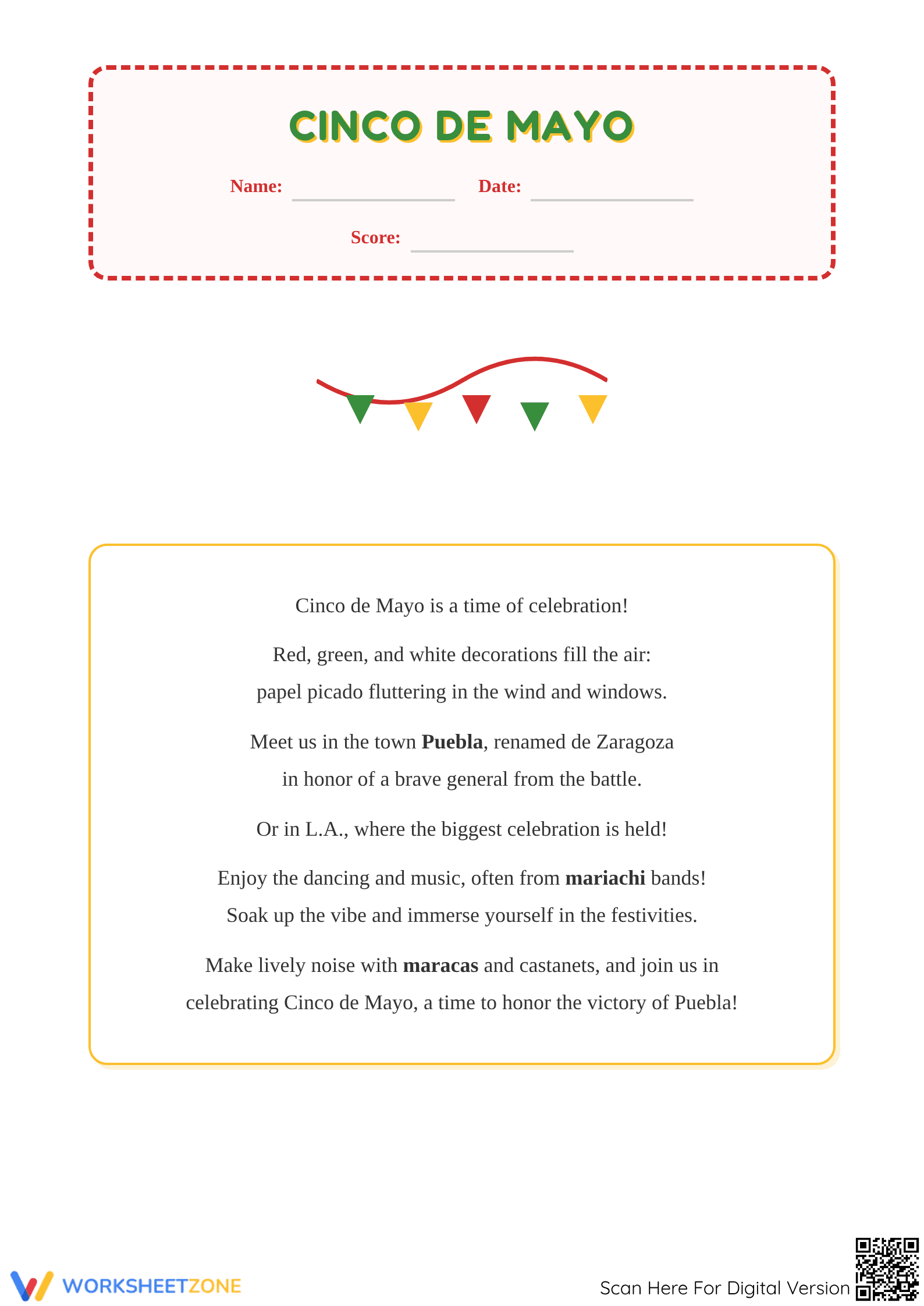
This Grade 2 Cinco de Mayo worksheet uses a thematic poem to develop reading comprehension and cultural awareness. Students engage with informational text through verse, identifying key details about the holiday's history and traditions. By connecting literacy with social studies, learners improve their ability to extract specific facts from a structured text while expanding their academic vocabulary.
At a Glance
- Grade: 2 · Subject: ELA Reading
- Standard:
CCSS.ELA-LITERACY.RI.2.1— Ask and answer questions to demonstrate understanding of key details in a text- Skill Focus: Reading comprehension and holiday vocabulary
- Format: 3 pages · 9 problems · Answer key included · PDF
- Best For: Holiday-themed literacy centers or sub plans
- Time: 20–30 minutes
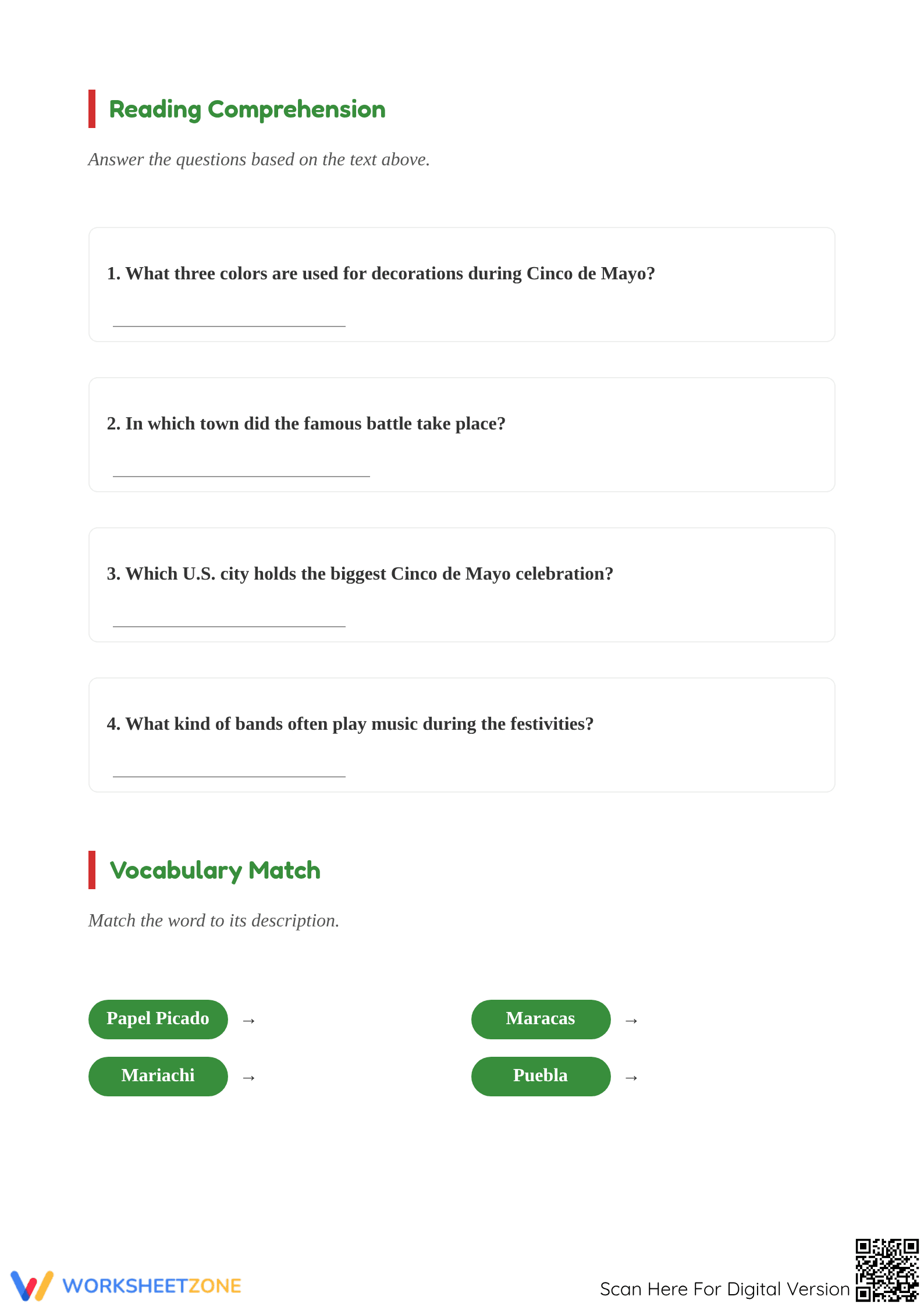
What's Inside: This comprehensive 3-page PDF includes a multi-stanza poem rich with cultural references like Puebla, mariachi, and papel picado. Following the text, students complete four text-dependent comprehension questions and a four-term vocabulary matching activity. The final page features a creative "Festive Drawing" prompt, allowing students to visualize the concepts they just read about. A full answer key is provided for immediate feedback.
Zero-Prep Workflow
- Print: Generate copies of the three-page document for your class in under 30 seconds.
- Distribute: Hand out the packets during your ELA block or as a morning work assignment.
- Review: Use the included answer key to review responses as a whole group or for quick individual grading.
This resource serves as a reliable, self-contained sub plan with a total teacher prep time of under 2 minutes.
Standards Alignment: The primary focus is CCSS.ELA-LITERACY.RI.2.1, which requires students to answer who, what, where, and why questions to show text mastery. Additionally, the vocabulary section supports CCSS.ELA-LITERACY.L.2.4 by helping students determine the meaning of domain-specific words. Both standard codes can be copied directly into lesson plans, IEP goals, or district curriculum mapping tools.
How to Use It: Assign this worksheet during a dedicated holiday unit to bridge the gap between social studies and literacy. It works best as an independent practice activity after a brief introduction to the history of the Battle of Puebla. Teachers can use the comprehension section as a formative assessment to observe how well students locate evidence within the poem. Expect completion within 20 to 30 minutes.
Who It's For: This resource is tailored for Grade 2 students but is highly accessible for Grade 1 enrichment or Grade 3 review. It is ideal for general education classrooms, ESL/ELL groups needing cultural context, and homeschoolers looking for holiday-themed activities. Pair this with a video of a mariachi performance or a physical papel picado craft for a multi-sensory learning experience.
This educational resource aligns with the CCSS.ELA-LITERACY.RI.2.1 standard, focusing on the essential skill of answering text-dependent questions to confirm comprehension. According to research by Fisher & Frey (2014), integrating thematic content with literacy instruction enhances student engagement and aids in the retention of complex vocabulary. By utilizing a poem as the primary text source, this worksheet encourages students to navigate different literary structures while extracting factual information. The inclusion of a vocabulary matching task further reinforces the connection between context clues and word meaning, a critical component of early elementary reading success. This structured approach ensures that students are not merely reading for surface-level enjoyment but are actively processing informational details. Educators can rely on this tool to provide evidence-based practice that meets rigorous state requirements while maintaining a high level of student interest through culturally relevant holiday themes.


