




























Views
Downloads

Printable Back-to-School Poem | Grade 1 ELA

Paste this activity's link or code into your existing LMS (Google Classroom, Canvas, Teams, Schoology, Moodle, etc.).
Students can open and work on the activity right away, with no student login required.
You'll still be able to track student progress and results from your teacher account.
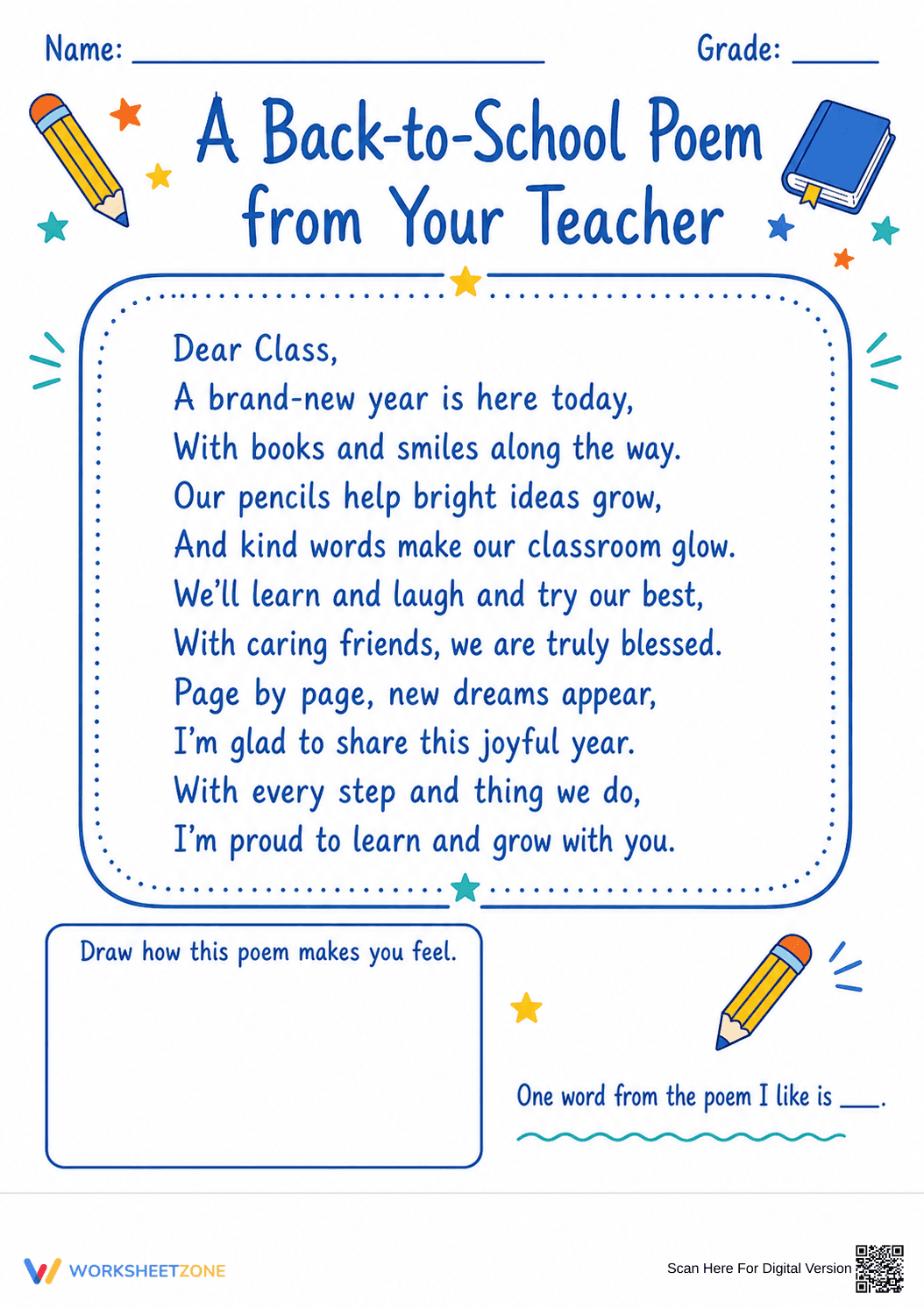
This printable back-to-school poem worksheet welcomes students while introducing foundational reading skills. First graders read a cheerful poem, then complete two brief response activities. The page helps young learners connect emotionally with text and identify specific vocabulary words, setting a positive tone for the classroom community.
At a Glance
- Grade: 1 · Subject: ELA
- Standard:
CCSS.ELA-LITERACY.RL.1.4— Identify words in poems that suggest feelings- Skill Focus: Poetry comprehension and vocabulary
- Format: 1 page · 2 tasks · No answer key · PDF
- Best For: First week morning work
- Time: 15–20 minutes
This single-page resource features an original, ten-line rhyming poem written from the teacher's perspective. Below the text, students find two response tasks: a blank drawing box prompting them to illustrate how the poem makes them feel, and a fill-in-the-blank sentence frame to select their favorite word. The layout uses clear typography and friendly graphics to engage early readers.
Teachers can implement this activity with virtually zero preparation.
- Print (1 minute): The design prints quickly on standard paper.
- Distribute (1 minute): Hand out the sheets as students arrive.
- Review (3 minutes): Read the poem aloud together, then allow students to complete the tasks independently.
Total teacher prep time is under two minutes, making this an excellent option for busy mornings or sub plans.
This worksheet aligns directly with primary reading standards, specifically CCSS.ELA-LITERACY.RL.1.4: Identify words and phrases in stories or poems that suggest feelings or appeal to the senses. By asking students to draw their emotional response and isolate a specific word they like, the activity bridges basic decoding with emotional comprehension. Both standard codes can be copied directly into lesson plans, IEP goals, or district curriculum mapping tools.
Use this resource during the first week of school as morning work. Before direct instruction begins, the teacher can read the poem aloud, modeling fluency. Alternatively, place it in an independent literacy center. As a formative assessment tip, observe which words students choose to write in the blank; this provides quick insight into vocabulary recognition. Expected completion time is 15 to 20 minutes.
This worksheet is designed for first-grade students, though it works well for kindergarteners with teacher support. The visual drawing prompt provides built-in differentiation for English Language Learners, allowing them to demonstrate comprehension non-verbally. Pair this resource with a read-aloud of a popular back-to-school picture book.
Integrating poetry into early childhood classrooms fosters both emotional intelligence and foundational literacy. This resource targets CCSS.ELA-LITERACY.RL.1.4, requiring students to identify words in poems that suggest feelings. According to a recent EdReports 2024 analysis, instructional materials that combine social-emotional themes with explicit text-dependent tasks significantly increase student engagement during the critical first weeks of school. By asking learners to visualize their emotional response and isolate specific vocabulary, this worksheet supports dual coding—a cognitive process where verbal and visual information are processed simultaneously. This method strengthens memory retention and helps young readers connect abstract text to concrete personal experiences. The low-stakes nature of the drawing and fill-in-the-blank tasks ensures that students can practice these essential comprehension skills in a supportive, welcoming format, setting a positive academic trajectory for the rest of the school year.


