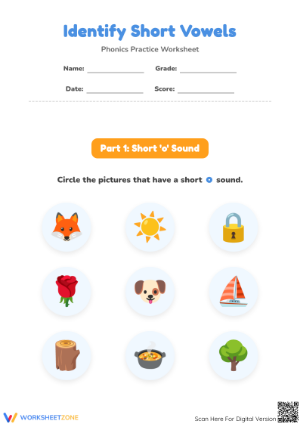
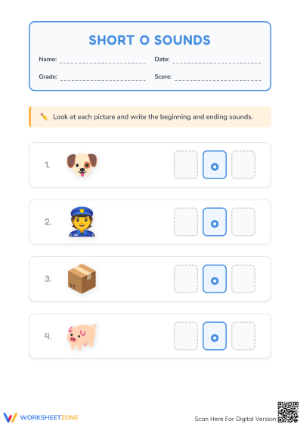
1st grade short vowels worksheets give teachers a targeted tool for the phonics gap that shows up most clearly in early spelling: students who know their letters but reach for the wrong vowel every time. In first grade, the transition from letter naming to actual decoding runs through CVC words—cat, bed, pit, hot, bug—and the vowel in the middle is consistently the hardest part to hear and hold. This set of worksheets addresses that medial sound directly, giving students repeated practice with the listening and writing tasks that actually move the needle.
The Specific Skills These Worksheets Target
Short-vowel work at this level should build sound-symbol connections students can use independently in real reading, not just on worksheets. Each worksheet in the set asks students to do one or more of the following:
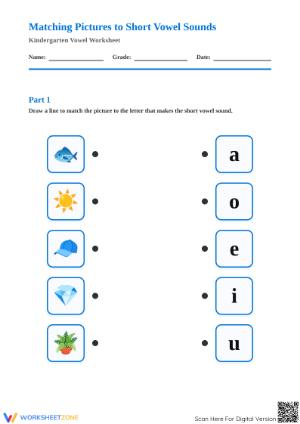
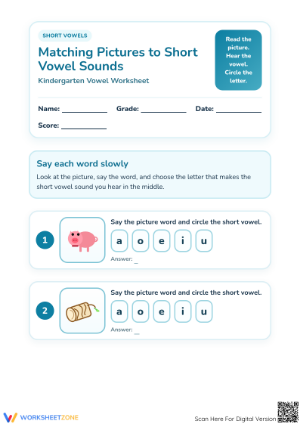
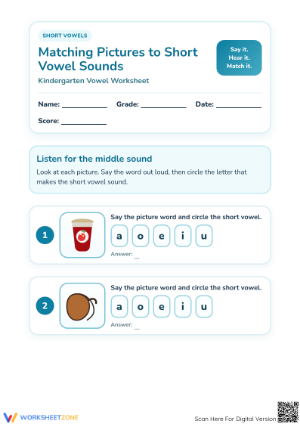
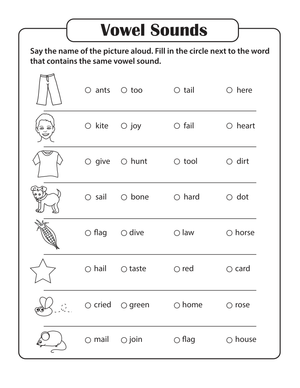
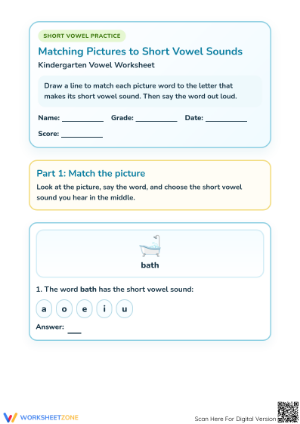
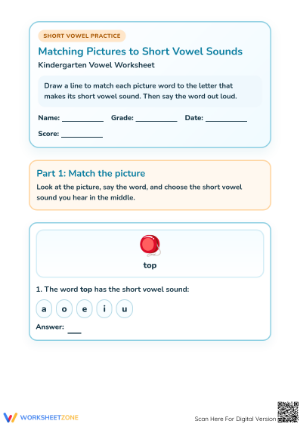
- Medial sound identification: Students say a word like fog, isolate the /o/, and name it before writing anything—the listening step comes first.
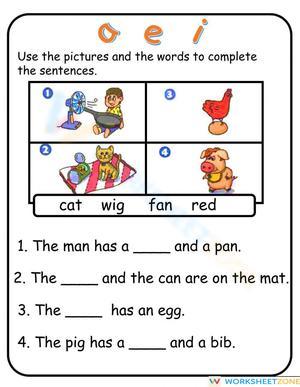
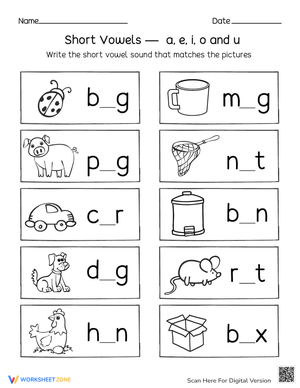
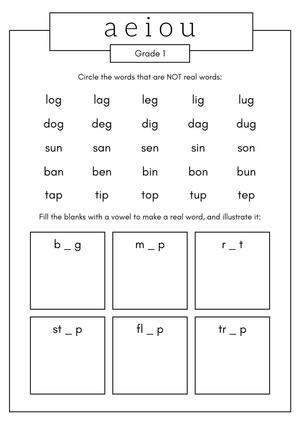
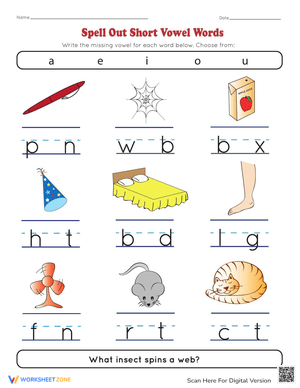
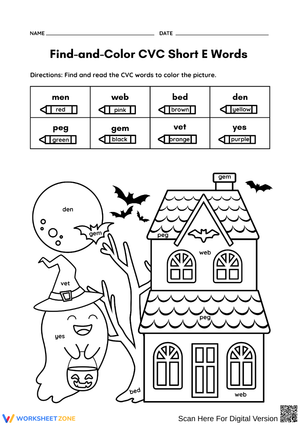
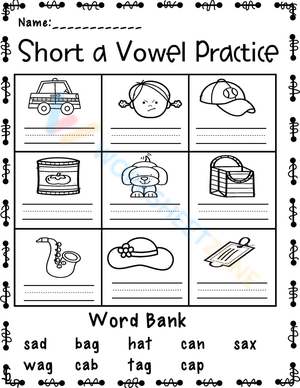
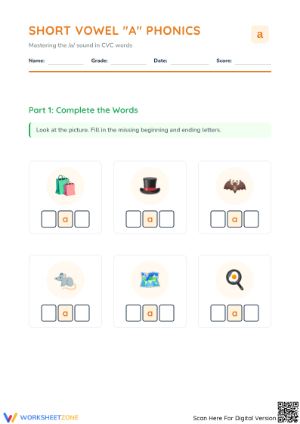
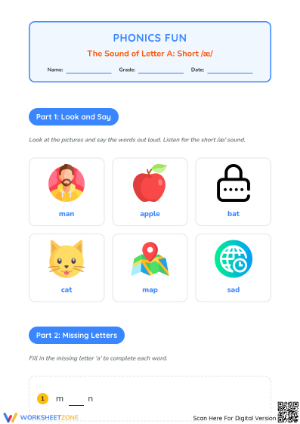
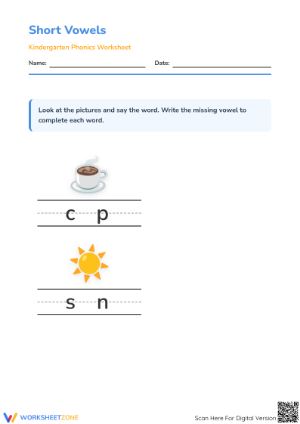
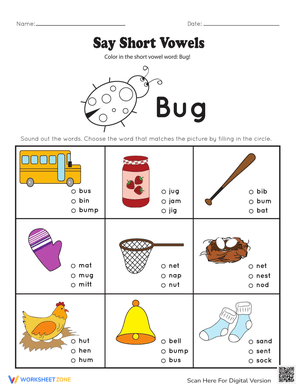
- Missing-vowel completion: Given c__t paired with a picture, students choose among all five short vowels based on what they actually hear, not on pattern memory.
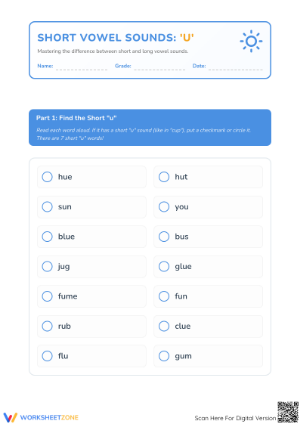
- Vowel sorting: Students group CVC words under the correct vowel header, which forces comparison across sounds rather than recognition in isolation.
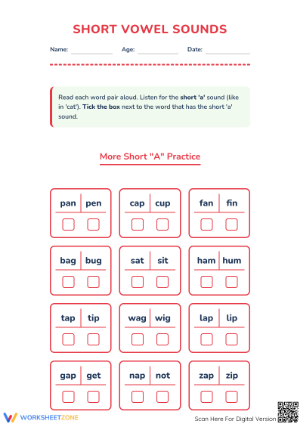
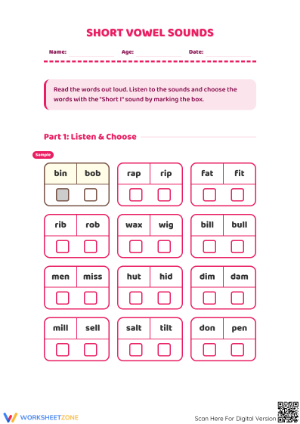
- Minimal pair reading: Some worksheets place pairs like pin/pen or hot/hit side by side so students attend to the vowel rather than using initial and final consonants as their only cue.
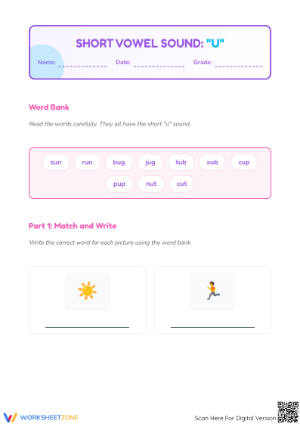
- Word-family pattern work: Families like -at, -en, -ig, -op, and -ug give students a predictable frame for reading new words by analogy.
- Short decodable sentences: Moving beyond the word level confirms that the vowel sound matters in connected text, not only in drills.
The sequence across the set moves from single-vowel focus into mixed-vowel review. That progression matters because students can often learn short a in isolation without truly distinguishing it from short e—the contrast work comes later and is where durable learning happens.
Mistakes Students Make That These Worksheets Help You Catch
The most predictable first-grade vowel error is not random. Students default to short a when they're uncertain, because it's the first short vowel introduced in nearly every phonics program and words like cat and map appear constantly in early texts. A student who spells hit as hat is not guessing wildly—they're substituting the one short vowel they feel confident about. That error pattern is diagnostic: it tells you the student has a sound-letter connection for a but hasn't yet secured the others.
The short /e/–short /i/ pair produces the second most common confusion. At normal conversational pace, pen and pin are acoustically close enough that many first graders genuinely cannot tell them apart by listening alone. Slowing down pronunciation sometimes helps, but the more effective move is having students notice the difference in mouth position—the jaw drops slightly more for /e/. 1st grade short vowels worksheets that isolate just these two vowels, with familiar words and clear picture support, give teachers a practical tool for that targeted two-vowel contrast work rather than cycling through all five simultaneously.
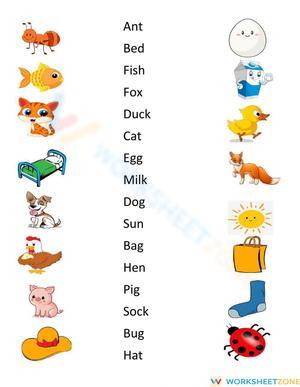
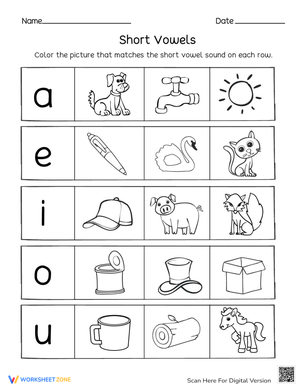
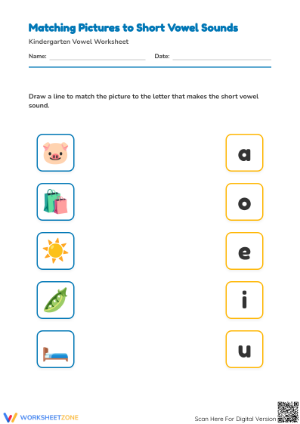
A subtler problem surfaces in picture-matching tasks: students who have seen the same images repeatedly can correctly circle the picture of a fox under short o by image recognition rather than sound processing. Rotating in less familiar pictures—a twig for short i, a sled for short e—removes that shortcut and gives a clearer view of what students actually hear.
How to Build These Worksheets Into Your Lesson Plans
These worksheets work best as structured practice that follows direct instruction, not as the lesson itself. During a 10-minute phonics segment, spend the first three minutes on oral warm-up: say four or five CVC words, have students stretch each one aloud, and ask two or three students to name only the middle sound. That primes auditory attention so students arrive at the worksheet already listening rather than just looking.
Small-group time is where these pages earn their keep. With four or five students around a table, a teacher can hear every answer, catch the student who writes e but says /i/, and address the confusion before it hardens. Use the worksheet as a conversation starter rather than silent seatwork—"Say the word. Say just the middle. Now write it."—and errors appear immediately instead of surfacing in a stack of papers after pickup.
For literacy centers, pair a worksheet with a small set of picture cards and a dry-erase marker. Students say the word, tap each sound on their fingers, write the vowel on the board, then check against the card. That tapping step slows the task enough that students actually process the medial sound rather than rushing to circle an answer. 1st grade short vowels worksheets with uncluttered layouts convert to this kind of center routine without extra laminating or teacher setup.
Standard Alignment
These worksheets address CCSS.ELA-LITERACY.RF.1.3b, which requires first graders to decode regularly spelled one-syllable words. Short-vowel CVC work is the most direct instructional path to that standard: when a student reads hop rather than guessing hap, they are demonstrating exactly what RF.1.3b describes. The worksheets also support RF.1.2c, which targets phoneme isolation—specifically isolating the initial, medial, and final sound in a spoken single-syllable word—because medial-sound identification is built into most of the task types here.
In classroom terms, RF.1.3b enters instruction in the fall of first grade and remains a benchmark through the winter assessment window. Districts using DIBELS or mCLASS will see short-vowel accuracy show up directly in Nonsense Word Fluency scores: students who haven't secured medial vowel sounds score lower on CVC nonsense words even when their initial and final consonants are solid. Using these worksheets formatively—reviewing student responses before the next lesson rather than grading them—gives teachers exactly the data those screening tools are designed to surface.
Differentiating These Worksheets Across Ability Levels
First-grade classrooms reliably span three or four years of reading readiness in September. These worksheets can serve that range without requiring separate material sets for each group.
- Students still building phoneme awareness: Use single-vowel pages with strong picture support. Have students say the word and tap its sounds before they look at the page. Reducing the item count—five items done carefully—matters more than finishing the full worksheet.
- On-level students: Assign mixed-vowel sorting and missing-vowel tasks with picture clues. These tasks require genuine sound discrimination rather than pattern memory.
- Students ready to extend: Remove picture support and ask students to read short sentences, then independently write a new CVC word following the same vowel pattern. That production step separates recognition from encoding.
- Students in intervention: Limit each session to the two vowels a student most often confuses. Narrowing the field reduces cognitive load and makes the contrast easier to hear and practice.
One practical move for mixed-ability small groups: the same worksheet can function as an oral task for some students—teacher reads each item aloud, student responds verbally—while others complete it in writing. That flexibility avoids managing three separate printable sets during a 20-minute rotation.
Frequently Asked Questions
Are the worksheets organized by individual vowel, or do they all mix the five sounds together?
Both structures are represented. Some worksheets focus on a single vowel—short a alone, short i alone—while others present mixed-vowel tasks that require students to choose among all five sounds. Teachers can sequence them as a vowel-by-vowel introduction or move directly to mixed review if students have already had exposure to each sound individually.
When in first grade are these worksheets most useful?
Single-vowel pages tend to fit best in the first half of the year, once students have phoneme segmentation but before multisyllabic work begins. Mixed-vowel review pages are typically most valuable after winter break, when consolidating distinctions between sounds matters more than introducing new ones. 1st grade short vowels worksheets used as brief spaced review in the spring—five or ten minutes, two or three times per week—help prevent the backslide in vowel accuracy that often appears after extended breaks.
Can these worksheets work for advanced kindergartners or second graders who need review?
Yes on both ends. Kindergartners who have solid phoneme awareness and basic letter-sound knowledge can work through single-vowel CVC pages without modification. Second graders who scored low on short-vowel items in fall screening benefit from the same targeted two-vowel approach described in the differentiation section—the task format is direct and efficient without feeling remedial when the content is matched to what the student actually needs to practice.












 Interactive Worksheet Maker
 Quiz Maker
 Word Search Maker
 Crossword Puzzle Maker
 Word Scramble Generator
 Sentence Scramble Generator
 Handwriting Worksheet Generator
 Name Tracing Generator
 Fill In The Blank Generator