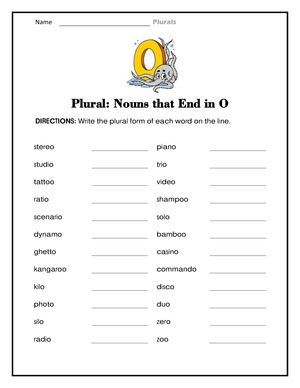
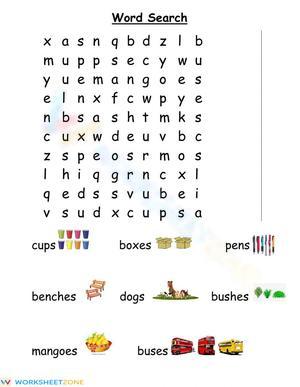
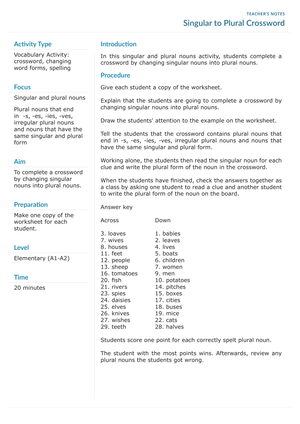
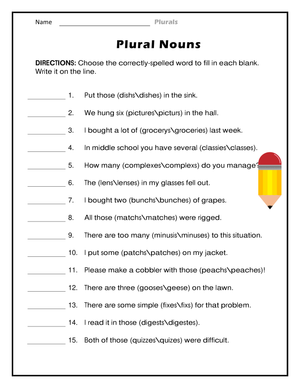
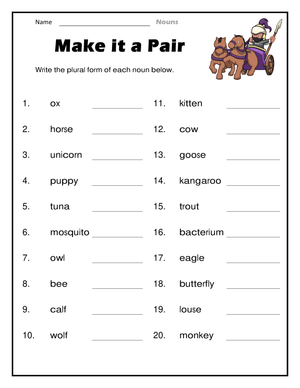
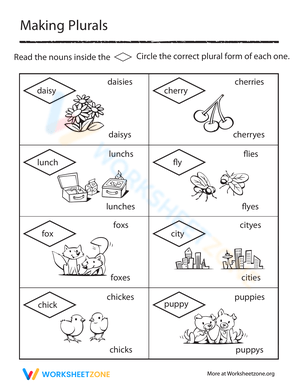
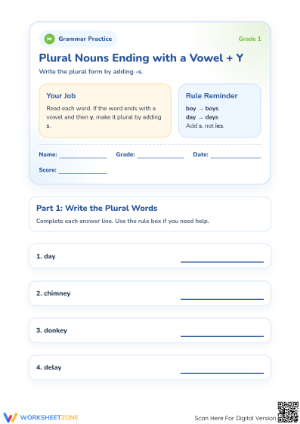
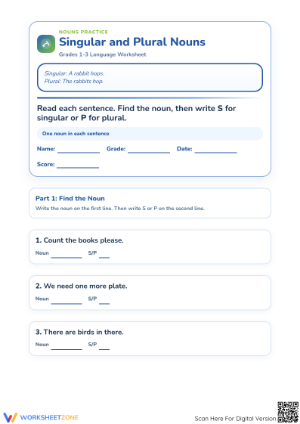
These 1st grade singular and plural nouns printable worksheets cover two of the most rule-governed shifts in first-grade grammar: forming basic plurals with -s and knowing when -es is required instead. Each worksheet targets one pattern so students are building on a single rule at a time rather than toggling between overlapping cases mid-task. The set runs from simple CVC words like dog and hat through words ending in -ch, -sh, and -x, with a small number of common irregular forms introduced near the end of the sequence.
What Each Worksheet Covers
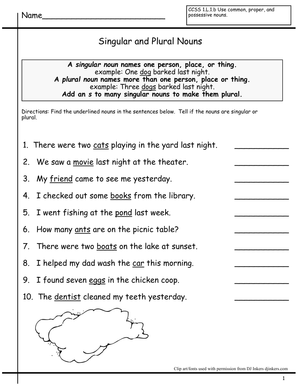
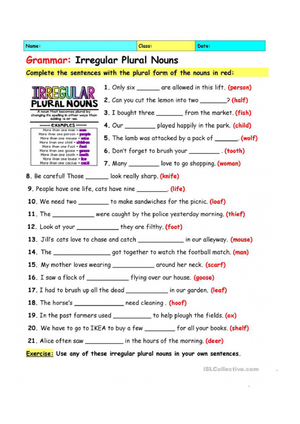
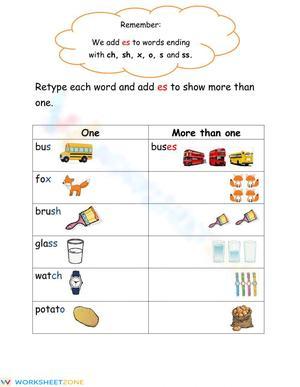
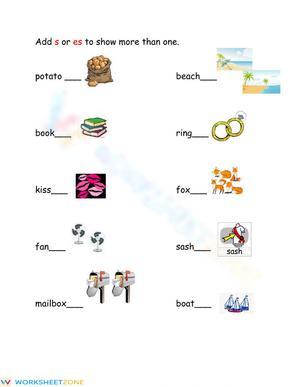
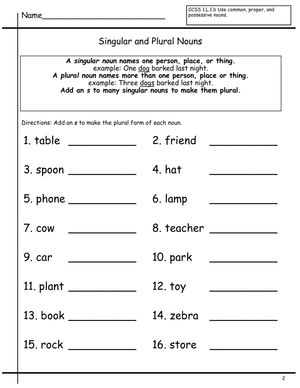
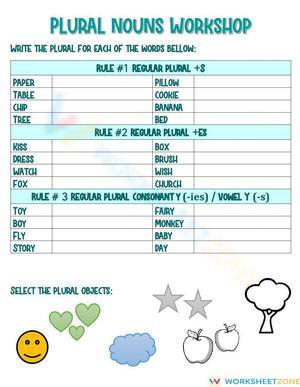
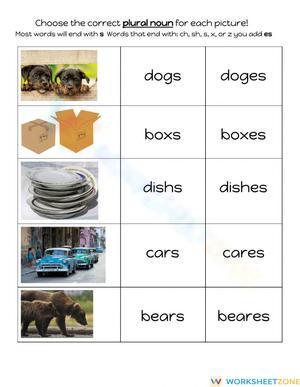
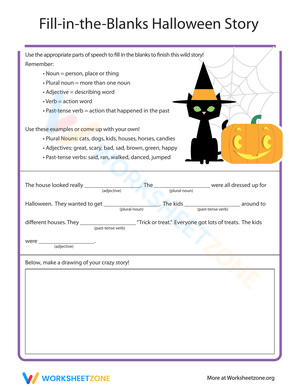
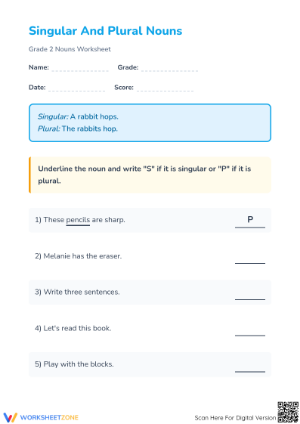
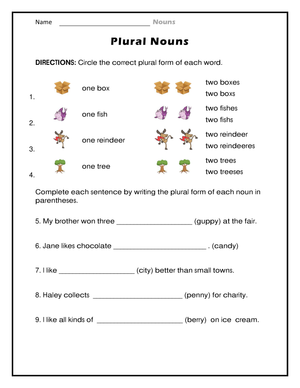
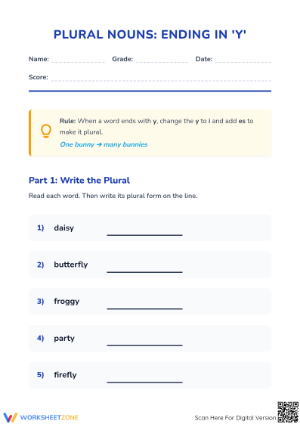
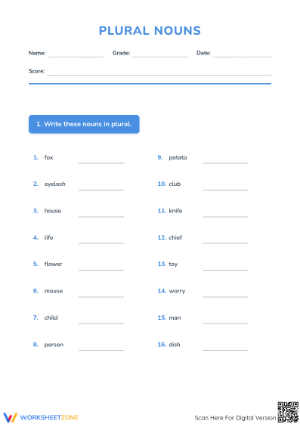
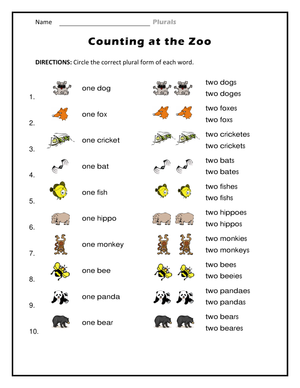
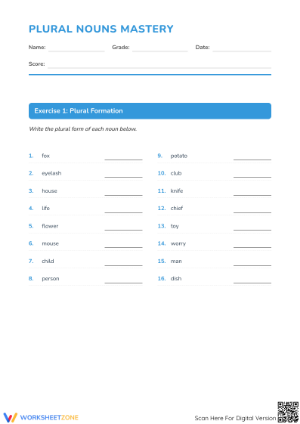
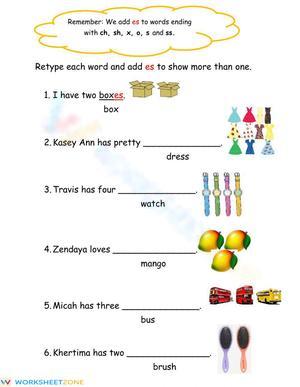
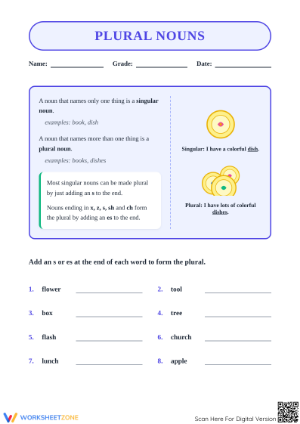
The 1st grade singular and plural nouns printable worksheets in this collection begin where the unit does — with the basic -s rule applied to words students already read automatically. Keeping the vocabulary familiar is deliberate: when students do not have to work to decode the word, their full attention lands on the grammar rule. Worksheet tasks include rewriting singular nouns in plural form, filling in sentence frames (I see three ____), and circling the correct noun form in short reading sentences. Later worksheets move to the -es ending and organize words by their final letters: -x words (box, fox), -sh words (dish, brush), -ch words (peach, bench). A small group of worksheets near the end introduces irregular plurals — feet, teeth, children, men — as exposure rather than mastery targets, which reflects how most first-grade teachers actually sequence the unit.
Mistakes Students Make That These Worksheets Help You Catch
The most reliable error at this level is not forgetting the plural ending — it is overgeneralizing the -s rule with complete confidence. Students who have locked in the basic pattern write boxs, dishs, and buss without hesitation because they are applying what they know. The -es worksheets are most effective when preceded by a quick oral exercise: ask students to say a word with just an -s added. Most first graders hear immediately that buss and dishs feel wrong in their mouths, and that phonetic moment — recognizing that the word becomes hard to pronounce — is a stronger anchor for the spelling rule than any written explanation. A second error pattern appears specifically on sentence-frame tasks: students write the plural form correctly in the blank but then revert to the singular form inside the completed sentence because they are echoing the model word in parentheses. A student who writes apples in the blank but reads back I see three apple has the morphology without the transfer. That split is worth catching early because it signals the student treats the rule as a fill-in exercise rather than a writing convention.
How to Build These Worksheets Into Your Lesson Plans
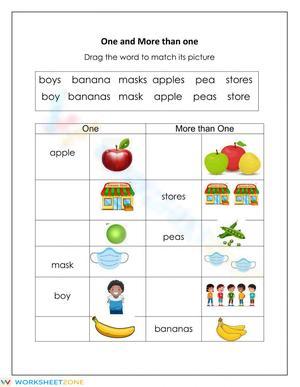
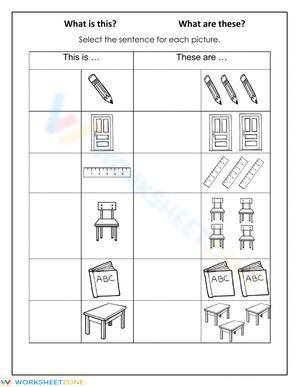
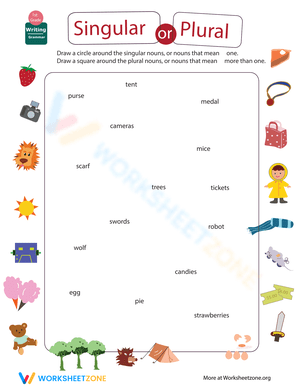
Most teachers fit these into the fifteen-minute grammar block that follows morning meeting or run them as a literacy-center rotation while small groups are pulling. A noun sort — students cut word cards from the worksheet and glue them under a One column or a More Than One column — runs well as an independent center task because the two-column structure lets students self-check without waiting for teacher confirmation. The cutting and sorting also keeps first graders physically anchored to the task longer than a fill-in format alone does.
One technique worth adding regardless of format: have students write the base noun in pencil first, then trace the -s or -es suffix in colored pencil. The visual separation between root and suffix helps students see the ending as something attached, not something that was always part of the word — a distinction that matters most for students building spelling and phonics knowledge simultaneously. The 1st grade singular and plural nouns printable worksheets with sentence-frame tasks are better handled in teacher-guided practice the first time through, because students need a live model of how the plural form functions inside a sentence rather than in isolation.
Standard Alignment
These worksheets address CCSS ELA L.1.1.C, which asks first graders to use singular and plural nouns with matching verbs in basic sentences. That standard is doing two things simultaneously — morphology and sentence grammar — which is why the sentence-frame format matters beyond just writing a plural form in a blank. A task that asks for apples in isolation checks whether a student knows the rule. A task that asks a student to complete I see three ____ checks whether the plural form carries into actual sentence construction, which is the behavior L.1.1.C targets. Teachers in states using alternative frameworks will find that the core competency — producing plural nouns with correct endings inside basic sentences — is addressed in equivalent first-grade language arts standards across most state adoptions.
Differentiating These Worksheets Across the Progression
For students still consolidating the basic -s rule, hold the -es worksheets until the foundational pattern is automatic in writing — not just in recognition tasks, but when students generate plural forms without a model in front of them. Adding a word bank to any worksheet drops the retrieval demand and lets those students focus entirely on identifying which form is correct. For students who move through both rules quickly, pull in the irregular-plural worksheets earlier and ask them to sort words into three columns: add -s, add -es, and completely different word. That three-way sort has students reasoning about categories rather than memorizing a list of exceptions, which produces better retention and works within the same worksheet format without requiring additional materials.
Frequently Asked Questions
When is the right time to introduce the -es rule?
After students apply the basic -s rule reliably in their own writing — not just when identifying the correct form on a recognition task, but when generating plural forms independently. For most first-grade classes that falls a few weeks into the grammar unit. The -es rule takes hold faster when the foundational rule is already automatic, because students are not splitting attention between two unfamiliar patterns at once.
Do these worksheets address irregular plural nouns?
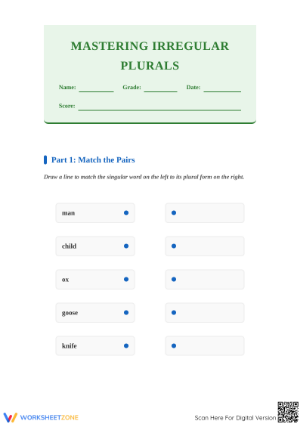
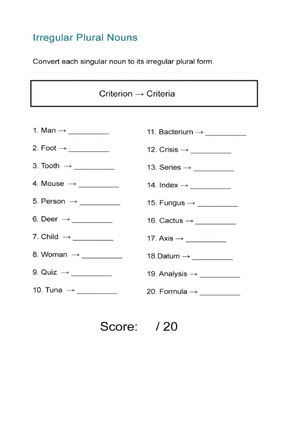
A small number of worksheets include the highest-frequency irregular forms: feet, teeth, men, women, children. These are framed as words that follow different rules rather than as a full unit on irregulars. First grade is exposure territory for these forms; systematic instruction belongs in second grade, once the regular patterns are solid.
How can I run these in a literacy center without direct supervision?
Laminate the noun-sort and picture-matching worksheets and give students dry-erase markers — a single worksheet becomes a reusable center task students can complete and erase repeatedly. The 1st grade singular and plural nouns printable worksheets that include an answer key printed on the back are the most reliable choice for fully independent center use, because students confirm their own work without coming to the teacher. Sentence-frame worksheets need at least one teacher-guided run-through before they work independently.
What should I do when a student keeps writing -s on words that need -es?
Return to the oral step before anything written. Ask the student to say the word with just an -s attached — dishs, boxs, benchs — and ask whether it sounds right. Most students catch the problem aurally before they catch it in print. Once the student can hear why -es is necessary, the written rule sticks considerably faster. A small desk reference listing the five endings that trigger -es supports the student while the rule is still forming, without turning every plural decision into a guessing exercise.
Are these worksheets better for practice or for assessment?
The fill-in and rewrite formats are most useful as formative tools — they surface quickly which rule a student has not yet internalized, and that information drives small-group planning. For summative evidence, a sentence-writing task that asks students to use plural nouns in sentences they compose themselves gives cleaner data on transfer than a controlled worksheet does. Use these worksheets to build the knowledge; measure transfer with an open-ended writing task.












 Interactive Worksheet Maker
 Quiz Maker
 Word Search Maker
 Crossword Puzzle Maker
 Word Scramble Generator
 Sentence Scramble Generator
 Handwriting Worksheet Generator
 Name Tracing Generator
 Fill In The Blank Generator