


























Views
Downloads


Printable Singular and Plural Nouns Worksheet | Grade 2
Paste this activity's link or code into your existing LMS (Google Classroom, Canvas, Teams, Schoology, Moodle, etc.).
Students can open and work on the activity right away, with no student login required.
You'll still be able to track student progress and results from your teacher account.
This singular and plural nouns worksheet helps Grade 2 students distinguish between one and more than one. By identifying nouns within complete sentences, learners build the grammatical foundation necessary for subject-verb agreement and clear writing. It provides a straightforward path to mastering noun number identification through contextual practice.
At a Glance
- Grade: 2 · Subject: ELA
- Standard:
CCSS.ELA-LITERACY.L.2.1.B— Form and use frequently occurring irregular plural nouns and regular plurals- Skill Focus: Singular and Plural Nouns
- Format: 2 pages · 10 problems · Answer key included · PDF
- Best For: Independent grammar practice and formative assessment
- Time: 10–15 minutes
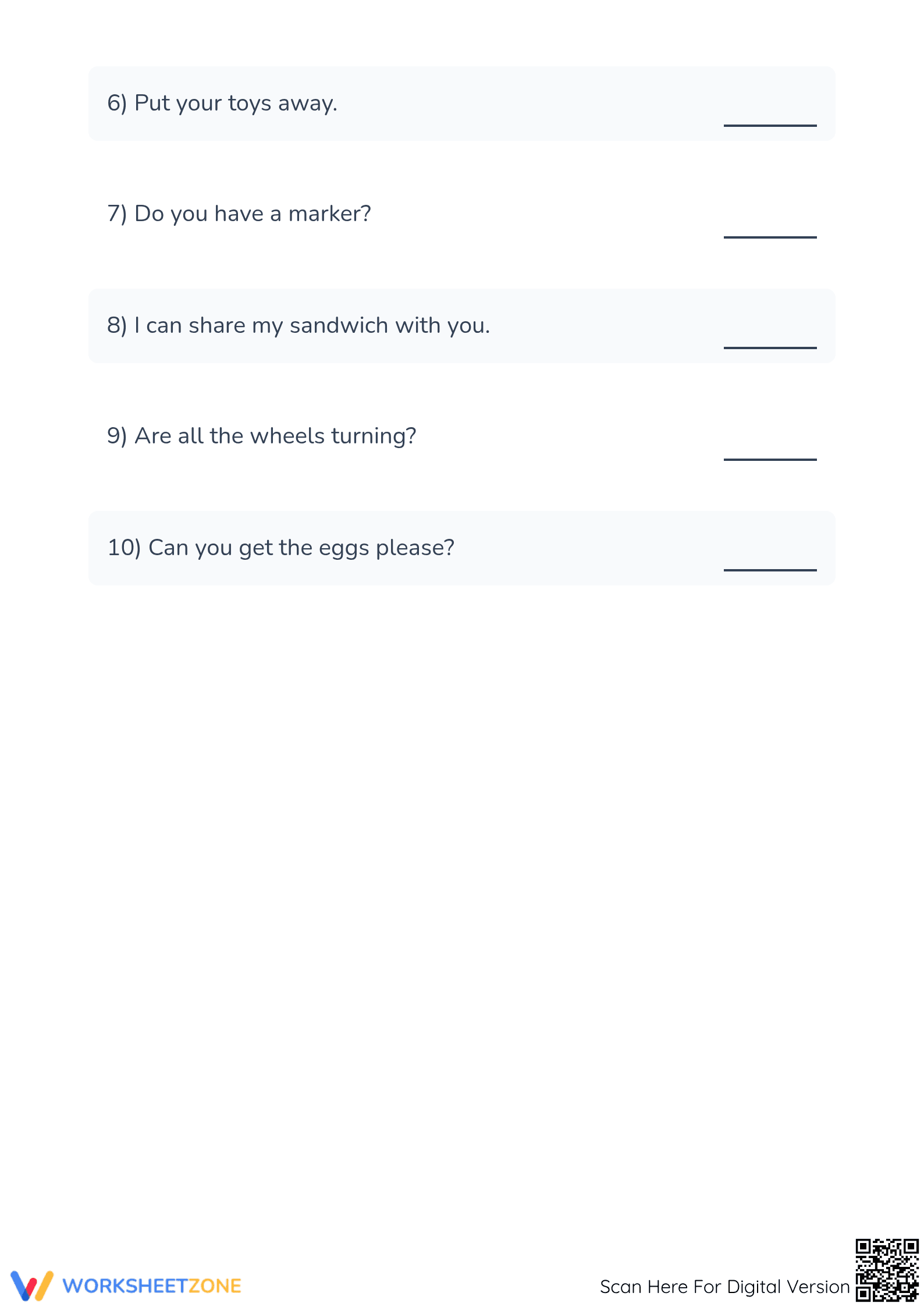
This 2-page PDF features 10 sentence-based tasks. Each item requires students to underline a specific noun and categorize it as singular (S) or plural (P). The layout includes a clear example at the top to model the expected response. A comprehensive answer key is provided to facilitate quick grading or student self-correction, making it an efficient tool for busy classrooms.
Skill Progression
- Guided Practice: The worksheet begins with a modeled example showing how to underline the noun and label its number correctly.
- Supported Practice: The first five problems use high-frequency nouns like pencils and erasers to build student confidence in identifying plural markers.
- Independent Practice: The final five problems require students to recognize plural nouns in varied sentence positions, reinforcing the concept of noun number without additional scaffolds.
This structure follows the gradual release of responsibility model, moving from teacher-led examples to independent student mastery.
Standards Alignment
The primary focus is `CCSS.ELA-LITERACY.L.2.1.B`, which requires students to form and use frequently occurring nouns. This resource specifically targets the identification aspect of the standard. It also supports L.1.1.C by reinforcing the concept of matching nouns with their correct numerical form. Both standard codes can be copied directly into lesson plans, IEP goals, or district curriculum mapping tools.
How to Use It
Use this worksheet as a formative assessment after a direct instruction lesson on pluralization rules. It is also effective as a morning work activity or a quick exit ticket. Teachers should observe if students are looking for the "-s" suffix or relying on the context of the sentence to determine if the noun represents one or many. Completion typically takes 10 to 15 minutes.
Who It's For
This resource is designed for second-grade students but is highly effective for first-grade enrichment or third-grade review. It is particularly helpful for English Language Learners (ELLs) who are practicing the morphological changes in English nouns. Pair this with a physical sorting activity using classroom objects for a multi-sensory learning experience that bridges the gap between concrete and abstract grammar concepts.
Research from Fisher & Frey (2014) emphasizes that grammatical mastery is best achieved when skills are practiced within the context of complete sentences rather than isolated word lists. This Grade 2 worksheet aligns with that evidence-based approach by presenting 10 contextualized tasks. By requiring students to identify singular and plural nouns (CCSS.ELA-LITERACY.L.2.1.B), the resource reinforces the morphological awareness necessary for reading fluency and writing precision. According to the RAND AIRS 2024 report, structured grammar practice that includes immediate feedback—such as the included answer key—significantly improves student retention of linguistic rules. This printable PDF serves as a reliable tool for formative assessment, allowing educators to pinpoint specific gaps in a student's understanding of noun number before moving toward more complex irregular plural forms. It provides a clear, measurable way to track progress toward foundational ELA standards while minimizing teacher preparation time.


