


























Views
Downloads

Essential Plural Nouns Worksheet | Grade 1-3 ELA
Paste this activity's link or code into your existing LMS (Google Classroom, Canvas, Teams, Schoology, Moodle, etc.).
Students can open and work on the activity right away, with no student login required.
You'll still be able to track student progress and results from your teacher account.
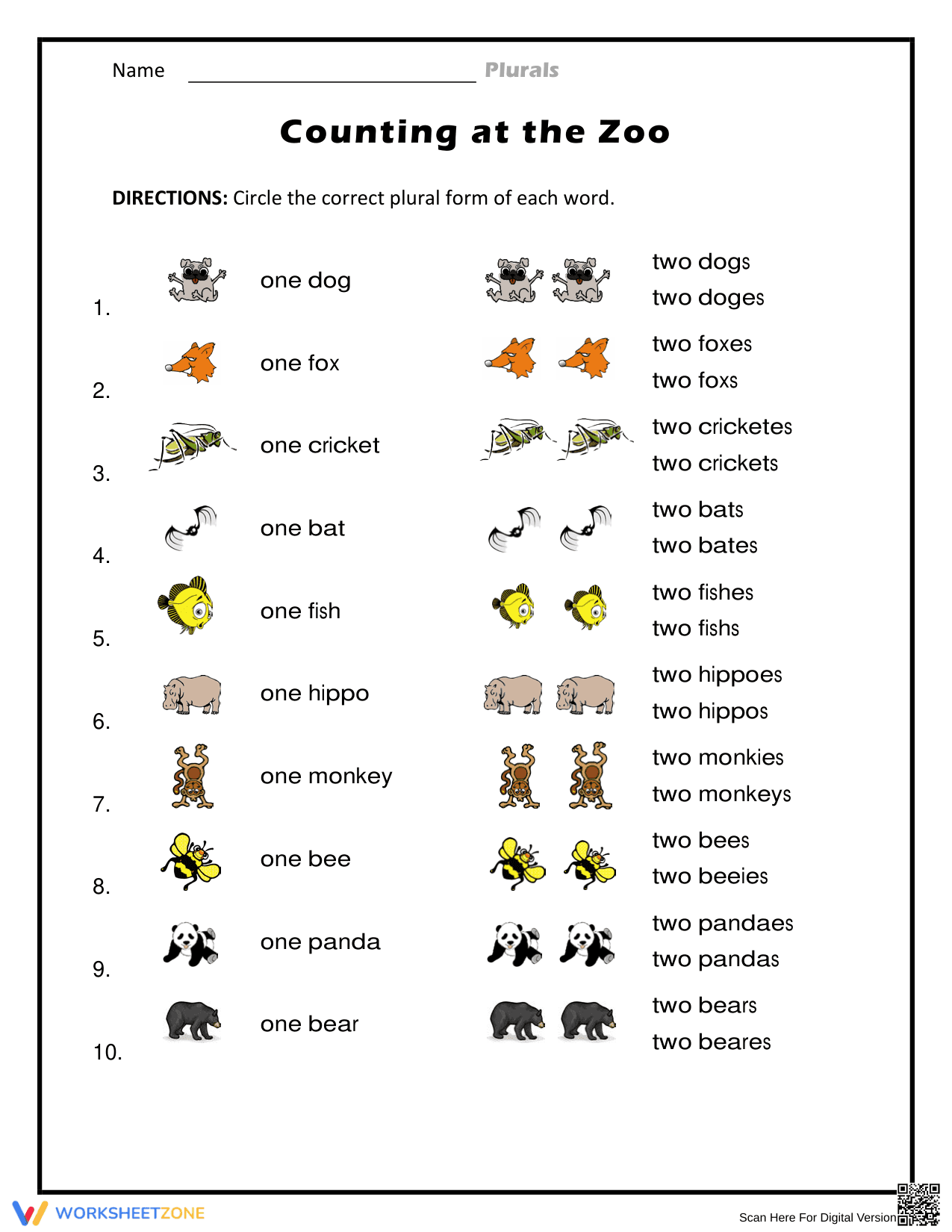
This essential Grade 1-3 plural nouns worksheet helps students master the fundamental grammar skill of forming plurals through an engaging zoo-themed activity. Students demonstrate their understanding by identifying the correct plural spelling for ten different animals, bridging the gap between singular recognition and accurate written pluralization in early elementary English Language Arts.
At a Glance
- Grade: 1–3 · Subject: ELA / Grammar
- Standard:
CCSS.ELA-LITERACY.L.1.1.C— Form and use plural nouns correctly in basic grammar exercises- Skill Focus: Regular and common irregular plural nouns
- Format: 1 page · 10 problems · Answer key included · PDF
- Best For: Independent grammar practice or quick formative assessment
- Time: 10–15 minutes
The worksheet features a clean, student-friendly layout with ten distinct tasks centered on zoo animals. Each item includes a singular noun label with a corresponding illustration (one dog), followed by a plural illustration (two dogs) and two multiple-choice spelling options. This visual-heavy approach provides scaffolding for early readers while focusing purely on the mechanics of pluralization across a single-page PDF document.
Implementing this resource takes less than two minutes of teacher preparation. First, print the single-page PDF directly from your browser or saved file. Second, distribute the copies to students for a quick morning work task or grammar warm-up. Finally, review the answers as a whole group using the included answer key to identify common misconceptions regarding "s" and "es" endings or internal spelling changes.
This resource is primarily aligned with CCSS.ELA-LITERACY.L.1.1.C, which focuses on using singular and plural nouns with matching verbs, though it specifically targets the morphological formation of the nouns themselves. It also supports CCSS.ELA-LITERACY.L.2.1.B by introducing common irregulars and ending variations. Both standard codes can be copied directly into lesson plans, IEP goals, or district curriculum mapping tools.
Use this worksheet as a formative assessment after a direct instruction lesson on pluralization rules. Observe whether students struggle with nouns ending in "x" (foxes) versus simple "s" additions (dogs). It also serves as an excellent "do-now" activity to activate prior knowledge before a writing workshop. Expected completion time is roughly twelve minutes, making it an ideal tool for structured rotations or station work.
This resource is designed for Grade 1 through Grade 3 students who are developing foundational grammar and mechanics skills. It is particularly effective for English Language Learners (ELL) who benefit from the clear visual cues and repetitive task structure. Pair this worksheet with a short informational text about zoo animals or a classroom anchor chart detailing common plural spelling patterns.
The formation of plural nouns is a critical component of morphological awareness, which Fisher & Frey (2014) identify as a key predictor of later reading and writing success in elementary learners. By isolating the pluralization task within a controlled 10-item set, this worksheet aligns with evidence-based practices for scaffolded grammar instruction. Research from the RAND AIRS 2024 report emphasizes that frequent, low-stakes practice with high-frequency nouns, such as the animals featured in this zoo-themed set, reinforces the orthographic mapping required for automaticity in written expression. Mastery of standard CCSS.ELA-LITERACY.L.1.1.C ensures that students can accurately communicate quantity and number, a foundational skill that supports more complex syntactic structures in later grades. This worksheet provides the targeted repetition necessary for students to internalize the distinction between singular and plural forms before moving toward irregular plural patterns and advanced noun-verb agreement.


