


























Views
Downloads



Printable Plural Nouns Worksheet | Grade 3 Grammar
Paste this activity's link or code into your existing LMS (Google Classroom, Canvas, Teams, Schoology, Moodle, etc.).
Students can open and work on the activity right away, with no student login required.
You'll still be able to track student progress and results from your teacher account.
This comprehensive plural nouns worksheet provides targeted practice to help students master both regular and irregular noun forms. By working through multiple exercise types, learners will develop the grammatical accuracy needed to form plurals correctly and ensure proper subject-verb agreement in their everyday writing.
At a Glance
- Grade: 3 · Subject: English
- Standard:
CCSS.ELA-LITERACY.L.3.1.B— Form and use regular and irregular plural nouns.- Skill Focus: Plural Nouns
- Format: 3 pages · 39 problems · Answer key included · PDF
- Best For: Independent practice and grammar review
- Time: 20–30 minutes
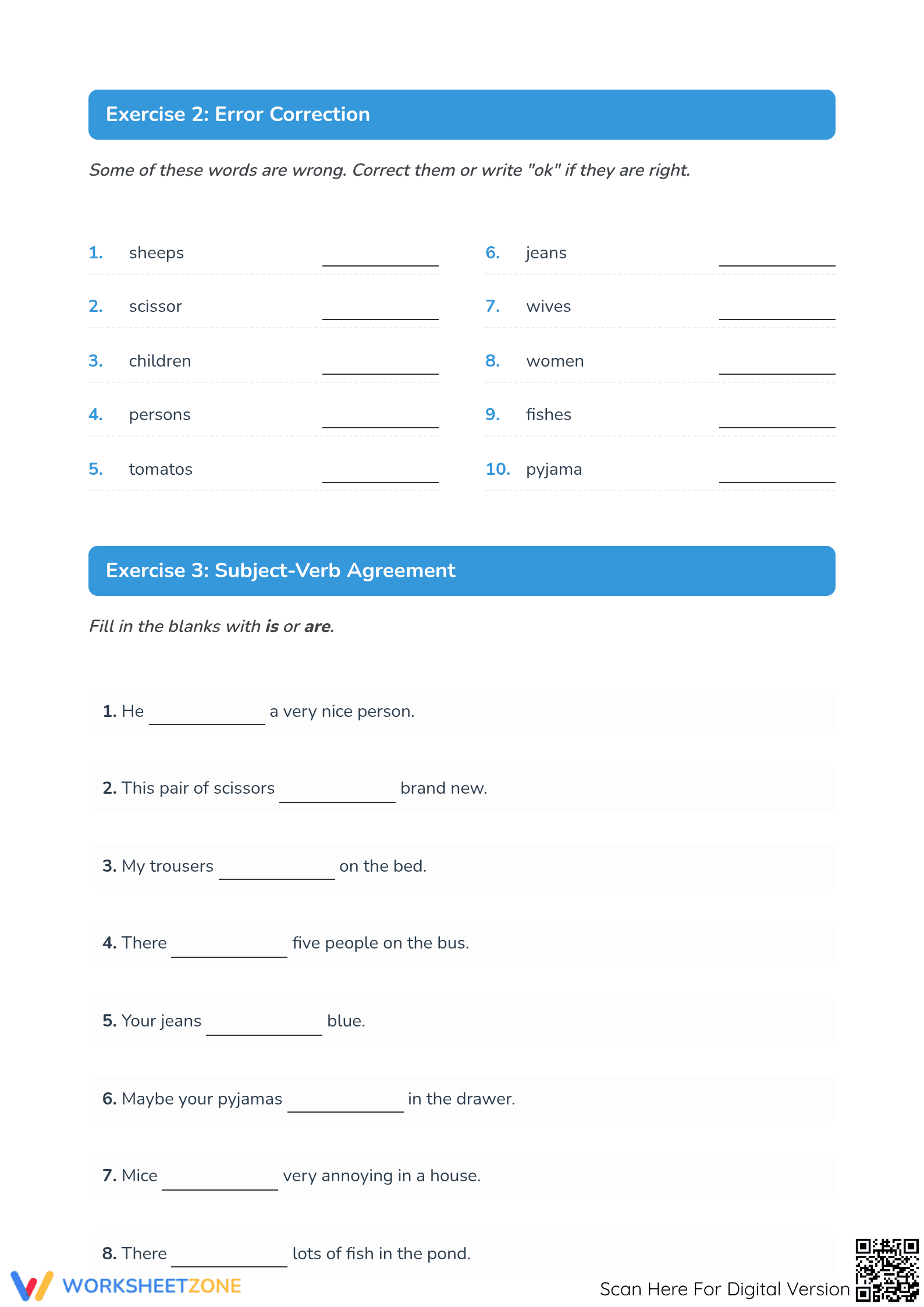
This three-page resource features 39 distinct problems divided into four focused exercises. Students begin with direct plural formation, move on to error correction, tackle subject-verb agreement with tricky plural nouns, and finish by applying plurals in sentence contexts. A complete answer key is included to make grading fast and accurate.
Skill Progression
- Guided practice: The first exercise offers 16 straightforward word-level conversions, allowing students to practice basic spelling rules for regular and irregular plurals.
- Supported practice: The middle sections challenge students with 18 problems focused on error correction and subject-verb agreement, requiring them to identify mistakes and choose between "is" and "are" for plural subjects.
- Independent practice: The final section features 5 sentence-level application tasks where students must generate the correct irregular plural noun from a base word in brackets.
This gradual-release approach ensures students build confidence before applying their skills to more complex sentence structures.
Standards Alignment
This resource is directly aligned to CCSS.ELA-LITERACY.L.3.1.B, requiring students to form and use regular and irregular plural nouns. It also supports foundational language skills by reinforcing subject-verb agreement with collective and irregular nouns. Both standard codes can be copied directly into lesson plans, IEP goals, or district curriculum mapping tools.
How to Use It
Deploy this worksheet during your grammar block after direct instruction on irregular plural rules. It works exceptionally well as an independent practice activity or a homework assignment. For formative assessment, observe how students handle the error correction section; if they struggle to identify incorrect forms like "sheeps" or "tomatos," you may need to review specific spelling patterns. The entire packet typically takes 20 to 30 minutes to complete.
Who It's For
This worksheet is designed for third-grade students developing their foundational grammar skills, but it also serves as an excellent review for fourth graders. English Language Learners (ELLs) will particularly benefit from the explicit practice with irregular forms and subject-verb agreement. Pair this activity with a classroom anchor chart detailing common irregular plural noun endings to provide additional scaffolding for students who need it.
Mastering grammar conventions like those covered in CCSS.ELA-LITERACY.L.3.1.B is essential for developing clear and effective written communication. When students learn to form and use regular and irregular plural nouns, they build the necessary foundation for reading comprehension and writing fluency. According to Fisher & Frey (2014), explicit grammar instruction combined with targeted, contextual practice significantly improves students' ability to transfer these skills into their independent writing. This worksheet provides that critical bridge between isolated skill drills and applied language use. By moving from simple word conversion to sentence-level application, learners internalize the spelling rules and syntactic patterns required for academic success. Consistent practice with these foundational language standards ensures that students can communicate their ideas accurately and confidently across all subject areas.


