Singular Nouns printable worksheets for 1st Grade
These singular nouns printable worksheets for 1st grade anchor early grammar instruction in the concrete — one picture, one word, one decision at a time. Teachers get a set of focused, print-ready pages that ask students to identify, label, match, and use single naming words drawn from the world they already know: desk, bird, friend, bus. The tasks stay intentionally short, keeping reading demand low enough that vocabulary does the grammatical work rather than decoding effort.
The Skills Each Worksheet Targets
A well-designed collection of singular nouns printable worksheets for 1st grade includes both identification tasks and production tasks — teachers need both data points, because a student who circles a noun inside a picture bank may still hesitate when asked to write one inside a meaningful sentence. The variety in format is not cosmetic; it surfaces different gaps.
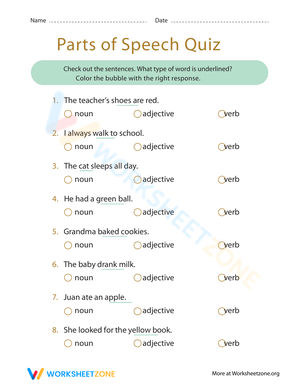
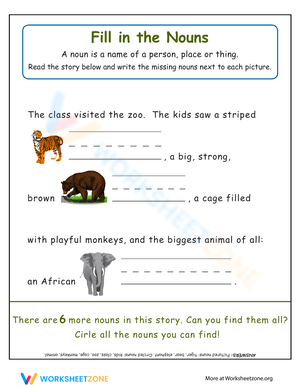
- Picture labeling: Students write the singular noun beneath one image — cat, cup, tree.
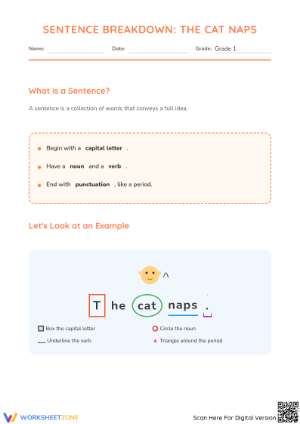
- Circle the naming word: Students find and mark the noun inside a short phrase or group of words.
- Match to picture: Students draw lines connecting written nouns to corresponding images.
- Sort by "one": Students sort words or images showing a single item into the correct column.
- Sentence completion: Students select a noun from a small word bank to fill a blank in a simple sentence.
- Cut-and-paste review: Students physically move singular noun cards into labeled boxes, slowing them down enough to make a deliberate choice before placing each word.
The sentence completion and cut-and-paste formats reveal the most about conceptual depth. Circling confirms that a student can distinguish a noun from non-nouns in isolation; completion tasks show whether that understanding holds when the noun needs to carry meaning inside a sentence.
Error Patterns to Watch for When Reviewing Student Work
The most persistent error at this level is not failing to recognize nouns — it's over-applying the label. First graders who have just learned that nouns name "persons, places, animals, or things" will confidently circle run or big because those words appear near pictures they recognize. They're responding to familiarity, not grammatical category. On a worksheet using the phrase "a brown dog," a meaningful share of students will mark brown because the image is brown. That's a diagnostic signal: the student hasn't yet separated the naming function from the describing function, and more circling tasks won't close that gap on their own.
A second pattern appears consistently in labeling tasks: students write the action they see in the picture rather than the noun. A picture of a girl jumping produces the written response "jump" from a sizable portion of the class. This isn't carelessness — six-year-olds naturally attend to what's happening in an image, not to the object in it. The correction is fast: before students touch a labeling page, point to each picture and ask "What is this?" instead of leaving them to interpret the image freely. That one framing shift changes what they write.
Fitting These Worksheets Into Your Weekly Grammar Routine
These pages work best as an immediate mini-lesson follow-up, not as standalone seatwork. Teach the concept with three or four physical objects — hold up one pencil, one book, one stapler — then hand students a worksheet so they move from concrete to print in under two minutes. A matching or circling page fits well in that slot because students finish in five to eight minutes, leaving enough time to review answers together before attention drifts.
Literacy centers are a natural second home. A cut-and-paste worksheet in a grammar tub, alongside a small basket of picture cards students can reference, gives them a self-correcting anchor point. Morning work is another strong fit: a labeling page needs almost no verbal setup, which matters during the first ten minutes of the day when some students are still settling. Teachers who use these pages as formative checks scan completed work for the error patterns above rather than marking every item — thirty seconds per page is usually enough to identify who needs reteaching before the next lesson moves forward.
Why This Concept Belongs in First Grade, Not Kindergarten
Naming words appear in every decodable reader a first grader opens — the nouns are typically the most semantically transparent words on the page. Teaching students to notice and label those words builds vocabulary and grammar metalanguage at the same time. The concept is placed in Grade 1 rather than kindergarten because recognizing a noun requires students to shift from identifying a word's sound to categorizing its function, a cognitive step that depends on a level of print experience most students reach mid-year in first grade, not before.
Singular nouns also provide the clearest on-ramp to plural noun work. When students have a stable understanding of what a noun is in its one-item form, "more than one" has a direct reference point. Teachers who compress this foundation and move quickly into plurals tend to see students conflate the two concepts for the remainder of the year. The time spent on the singular form here pays forward into every noun-related lesson that follows.
Making These Pages Work for Every Learner in the Room
Because singular nouns printable worksheets for 1st grade keep their tasks short and visual, they adapt across ability levels without requiring a fully separate version for each group. Emerging readers handle tracing and picture-matching formats well — the visual anchor carries the grammar concept even when decoding is still developing. Before those students touch any page, a quick oral rehearsal makes the task accessible: teacher points to each image in order, student says the noun aloud, then pencils come out. That two-minute preview reduces the chance that reading difficulty gets misread as grammar confusion.
Students ready for more can turn each labeled noun into a short sentence in the margin — one sentence per noun, no additional prompt. That extension costs teachers almost no preparation time and gives advanced students real writing work rather than extra circling. For students with fine motor challenges, circling and coloring formats accomplish the same grammatical objective as writing tasks; the physical demand changes but the concept target stays fixed.
Standard Alignment
These worksheets address CCSS.ELA-LITERACY.L.1.1b, which requires first graders to use common, proper, and possessive nouns. Singular noun identification sits at the entry point of that standard — students need a stable working definition of "one naming word" before they can meaningfully compare singular and plural forms or begin to understand possessive marking. The task variety built into singular nouns printable worksheets for 1st grade means teachers can address this portion of L.1.1b across whole-group instruction, small-group reteach, and independent practice without needing a different resource at each phase. Most Grade 1 teams address this standard in the first quarter and then build toward plural nouns and possessives as the year progresses.
Frequently Asked Questions
What exactly counts as a singular noun for first graders?
Any word that names one person, one place, one animal, or one thing. At Grade 1, teachers stay with concrete, picturable examples — boy, park, frog, chair — rather than abstract nouns like happiness or idea, which require a level of conceptual abstraction most six-year-olds aren't ready to apply in a grammar task.
How many practice sessions do first graders typically need?
Three to five separate sessions spread across a week, rather than several pages completed in one sitting. Spaced practice holds better than massed practice at this age — a labeling page on Monday, a matching page on Wednesday, and a sentence-completion page on Friday gives students time to consolidate between sessions and shows teachers whether understanding is holding or fading before moving on.
Can these pages serve as a formal assessment?
They work reliably as formative checks, less so as summative evidence. Heavy visual support means a student can perform well on a worksheet and still struggle to identify nouns in running text without that picture help. For a more complete summative picture, pair the worksheet data with a brief oral conference: point to three nouns in a shared-reading text and ask the student to name and categorize each one independently.
How do I introduce the term "singular" to a six-year-old without losing them?
Hold off on the term early. "One naming word" communicates the same concept and matches the vocabulary most first graders bring to the lesson. Once students reliably identify and produce single naming words with confidence, singular can be introduced as the formal label for something they already do well — a far more effective sequence than leading with terminology and working backward to meaning.
Clear All