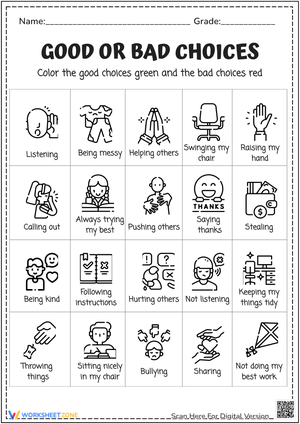
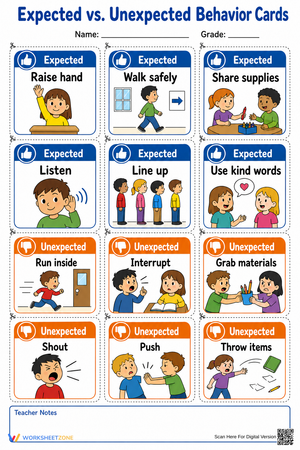
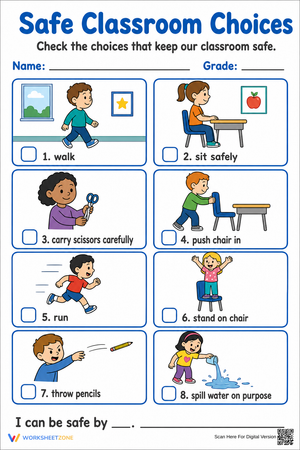
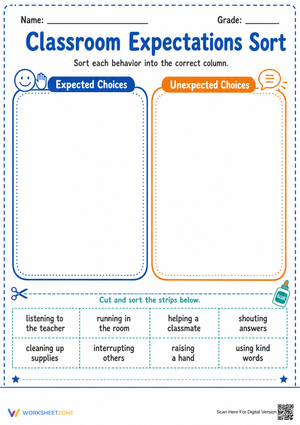
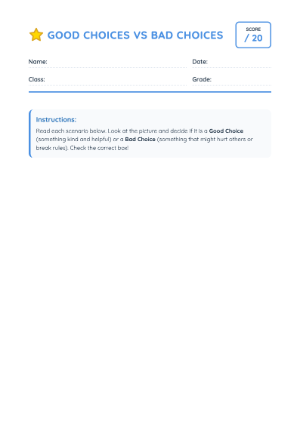
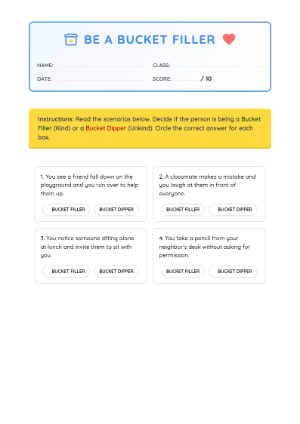
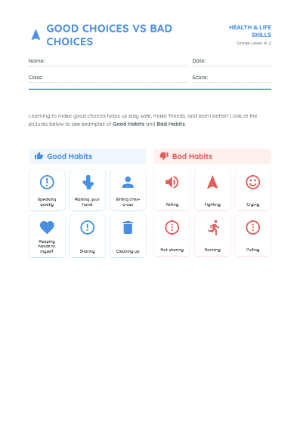
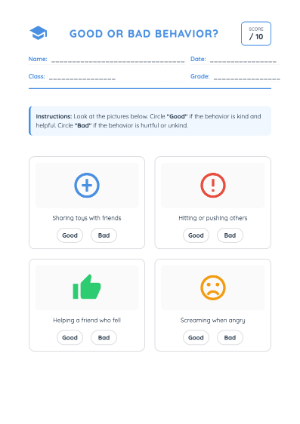
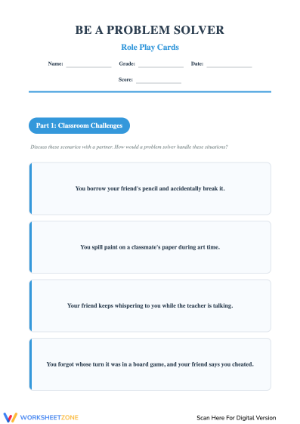
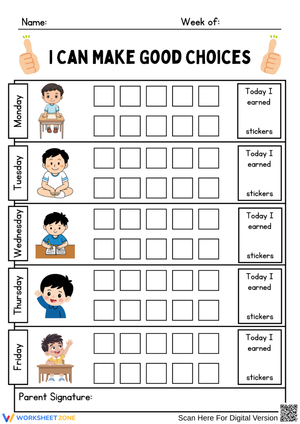
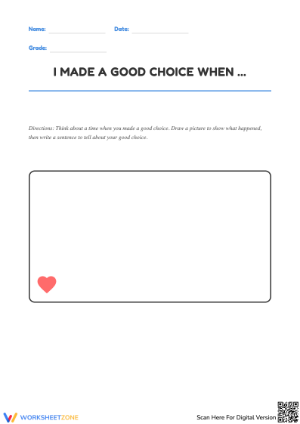
These good choices bad choices pdf worksheets for 1st grade give teachers a concrete anchor for the hardest part of September: establishing what positive behavior actually looks like before the first conflict arises. First grade is when students are learning impulse control, perspective-taking, and how their individual actions affect the people sitting next to them — not as abstract values, but as practiced habits. These worksheets move behavioral instruction off the verbal reminder and onto the page, where students can slow down and examine what a choice looks like before they have to make one.
The Specific Skills Each Worksheet Targets
Each worksheet addresses discrete, observable behaviors rather than broad character traits. Students spend their time doing one of several targeted tasks:
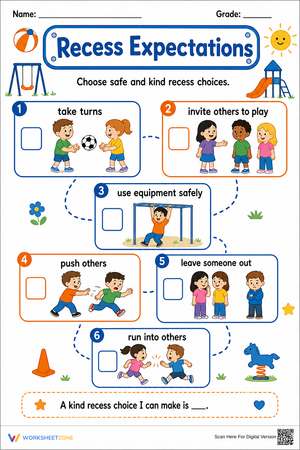
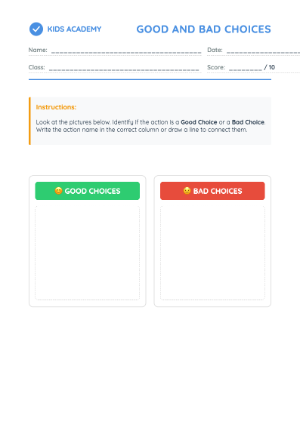
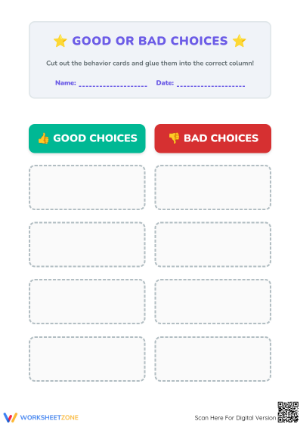
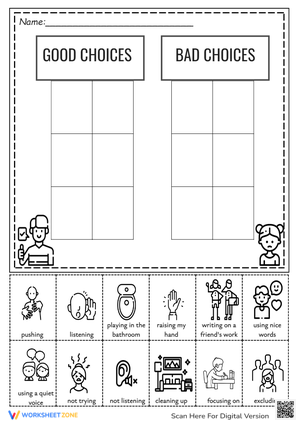
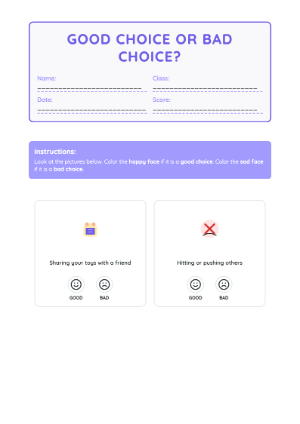
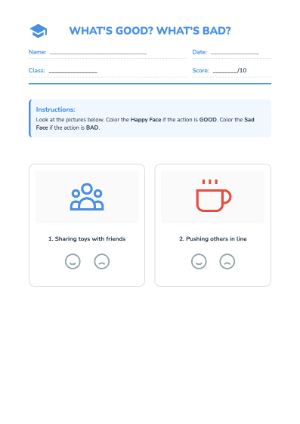
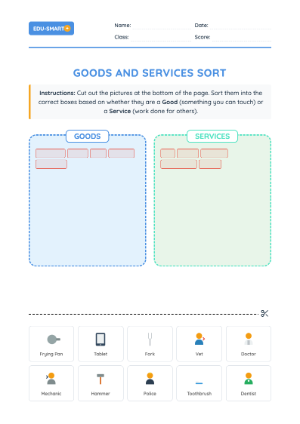
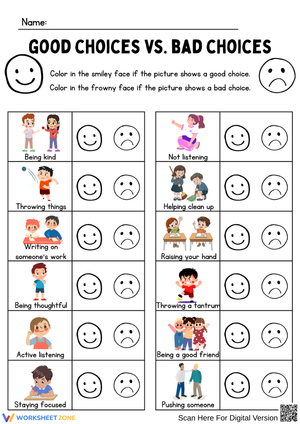
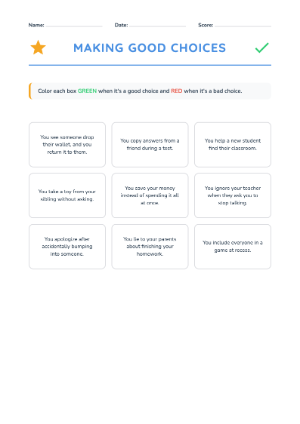
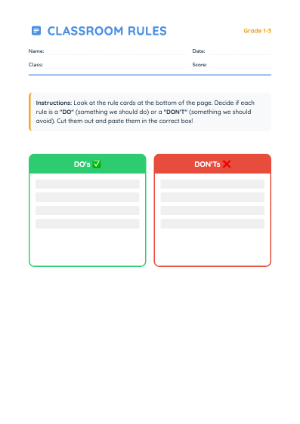
- Sorting illustrated classroom and playground scenarios into positive and negative behavior columns, then gluing cut images in place
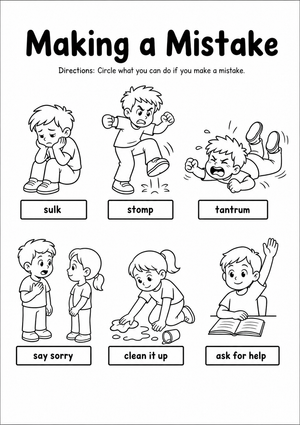
- Circling the child in a scene who is making the safer or kinder decision, then explaining why in a single sentence
- Drawing an alternative ending to a scenario that began with a poor choice — replacing the original action rather than simply labeling it wrong
- Matching behaviors to stated classroom expectations ("walking feet," "listening ears," "taking turns")
- Identifying how a character in a scene might be feeling, and tracing that feeling back to a classmate's specific behavior
The feeling-identification tasks deserve particular attention. Many 1st graders can label their own emotions but have not yet connected those emotions to the choices of other people. Asking students to name what the child in the picture is feeling — and then work backward to find the behavior that caused it — builds empathy in a way that purely corrective classroom management never reaches.
Why This Format Works at This Grade Level
At six and seven, students reason most clearly from what they can see and handle. Telling a first grader to "make good decisions" registers about as well as telling them to "be responsible." Showing them a picture of a child grabbing a marker from another student's hand, then asking where that picture belongs, makes the behavior legible in a way the verbal instruction alone does not. The sorting format exploits this developmental reality rather than working against it.
The cut-and-paste structure does something else that matters: it ties a physical action to a judgment. Moving an image from the pile to the "red choice" column is a small motor commitment to a decision. That commitment — even a minor one — strengthens the memory trace associated with the concept. It is the same reason experienced teachers have students underline evidence rather than simply identify it verbally. Doing something with the material makes it stick in a way that passive recognition does not.
Student Mistakes Worth Anticipating and Correcting
The error that surfaces most often involves context-dependent sorting. A student correctly places "raising your hand" in the positive column and "calling out" in the negative column during quiet seat work — then shouts across the room during free exploration without recognizing the contradiction. The worksheet taught the rule; it did not yet teach the student to read the situation. Teachers who catch this gap use the worksheet scenarios as discussion starters rather than silent work, asking: Is this always a good choice, or does it depend on where you are? That question produces more learning than the sorting task itself.
A second pattern: students who categorize based on the child depicted rather than the behavior shown. In classrooms where certain students have established reputations, peers sometimes sort an image as a "bad choice" picture because the illustrated character resembles someone they associate with misbehavior. This reveals more about classroom social dynamics than about behavioral understanding — but it surfaces during worksheet discussions in ways that are worth addressing directly and early. A brief whole-group conversation about judging the action and not the person resets the task and teaches something the worksheet alone could not.
Standard Alignment
These worksheets align primarily with the CASEL framework's responsible decision-making competency, which at the K–2 level is described as identifying solutions to personal and social problems and anticipating the consequences of one's actions. Sorting and scenario-response tasks practice exactly that cognitive sequence. Many districts also count these activities toward state health education standards addressing interpersonal skills and conflict prevention, particularly standards that require students to distinguish between safe and unsafe behaviors in school settings.
For teachers in PBIS schools, each worksheet functions as a Tier 1 explicit instruction tool — the proactive behavioral teaching that PBIS research consistently identifies as the most effective universal support a teacher can deliver. Repeated, structured practice on expected behaviors in the first eight weeks of school reduces reactive discipline for the rest of the year, and these worksheets give that practice a replicable, printable form.
Fitting These Worksheets Into Your Weekly Rhythm
The most effective placement for good choices bad choices pdf worksheets for 1st grade is not a dedicated "social skills period" — it is the 10 minutes of morning meeting on the days before high-transition events. Students who rehearse what respectful hallway behavior looks like on paper before picture day or a fire drill carry that rehearsal into the actual situation in a way that abstract reminders do not produce. The low-stakes practice environment lets students make the sorting error on paper rather than in the cafeteria line.
A second natural fit is the reflection station. When a student makes an impulsive choice — shoving in line, snatching a pencil — directing them to a quiet area with a worksheet shifts the consequence from purely punitive to instructional. The student marks where on the worksheet their behavior landed, draws what a different choice would have looked like, and rejoins the group. This preserves the instructional moment without isolating the student in front of peers, and it generates a documented record that is useful if a parent conversation becomes necessary.
Early finishers are a third practical use. Keeping a folder of these worksheets available means students who move through the main assignment quickly have something purposeful to do that connects directly to classroom expectations — not busywork, but continued practice in the skills the whole class is building.
Adjusting the Work for a Range of Learners
For students reading at or above grade level, push past the sort-and-paste format. Ask them to write a second sentence explaining the consequence of the negative behavior they identified, or to generate their own scenario that belongs in each column. Students who can articulate why a choice is problematic — not just recognize it in a picture — are developing the reasoning that transfers into actual behavioral change rather than worksheet compliance.
For students with limited English proficiency or early readers, the visual format already removes much of the language barrier, but teachers can simplify further by eliminating written components entirely and focusing on sorting and circling tasks alone. Color-coded columns — green and red — remove the word-decoding step and let students demonstrate behavioral understanding without that barrier in the way.
Students who struggle with the concept itself — who repeatedly sort scenarios incorrectly and cannot explain their reasoning — benefit most from small-group instruction where the teacher narrates her own thinking aloud: I see a child pushing. I ask myself: does pushing keep everyone safe? No. So this picture goes in the red column. That internal dialogue, made external and visible, gives students a process to borrow until they build their own. No graphic organizer or hint card does the same work as hearing a clear adult model reason through the decision step by step.
Frequently Asked Questions
How is the set organized — do the worksheets need to be used in sequence?
Each worksheet in the set stands on its own, covering a distinct skill or format — sorting activities, scenario-response tasks, feeling-identification exercises, and reflection pages. Teachers pull individual worksheets based on the current classroom focus without working through the set in any fixed order. If your class is struggling with physical aggression on the playground this week, you go to that worksheet; you do not work up to it.
Can these worksheets support students who have behavioral goals in their IEP?
They work especially well in that context when used as data collection tools. A student who consistently sorts peer-conflict scenarios incorrectly gives their teacher documented, specific evidence of where behavioral instruction needs to concentrate. That level of specificity is useful during IEP meetings and progress monitoring reviews in a way that anecdotal teacher observations alone cannot provide.
Should I use the word "bad" with first graders, or is there language that works better?
Many teachers in trauma-informed classrooms swap "bad choices" for "red choices," "sad choices," or "unexpected choices." The distinction matters because "bad choice" can slide into "bad kid" in a six-year-old's thinking — and once a student internalizes that identity, behavioral instruction becomes much harder. Good choices bad choices pdf worksheets for 1st grade that use color-coded columns rather than the word "bad" make that language swap seamless — students interact with the visual category, not the label.
Do these work well in small intervention groups?
Small-group use is often where the strongest learning happens. When three or four students work through a sorting worksheet together and have to reach consensus on an ambiguous scenario — was borrowing without asking a red choice or just an unexpected one? — the discussion itself becomes the instructional moment. Good choices bad choices pdf worksheets for 1st grade used this way generate the kind of peer reasoning that whole-class lessons rarely create time for, and the disagreement between students is more instructive than any worksheet answer key.












 Interactive Worksheet Maker
 Quiz Maker
 Word Search Maker
 Crossword Puzzle Maker
 Word Scramble Generator
 Sentence Scramble Generator
 Handwriting Worksheet Generator
 Name Tracing Generator
 Fill In The Blank Generator