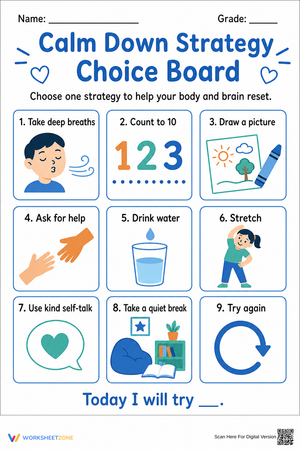
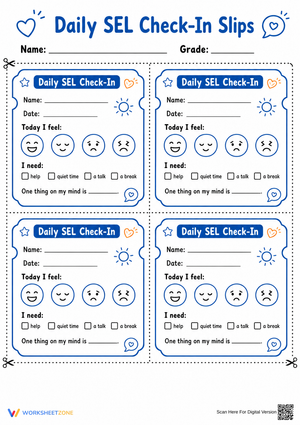
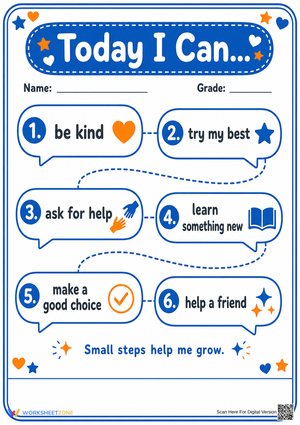
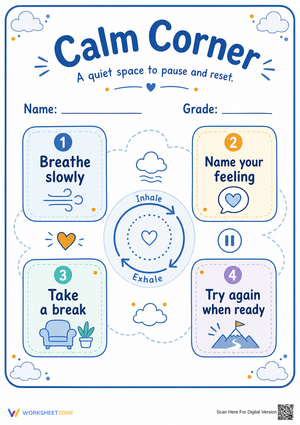
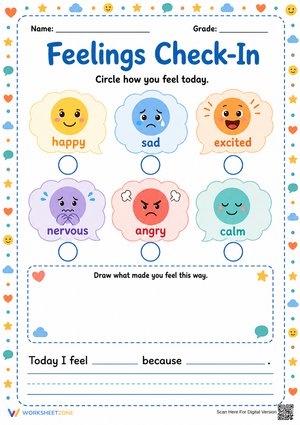
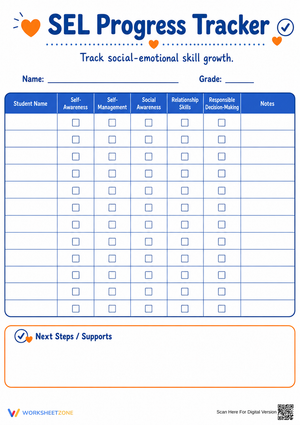
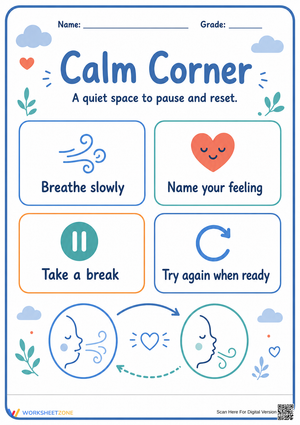
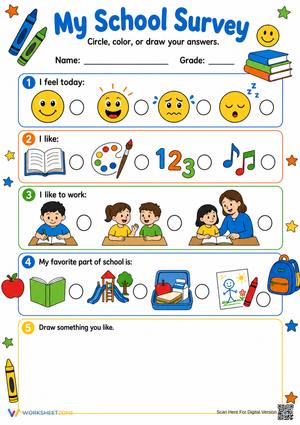
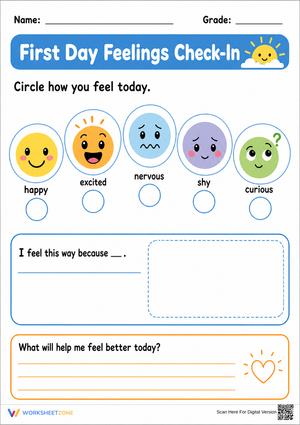
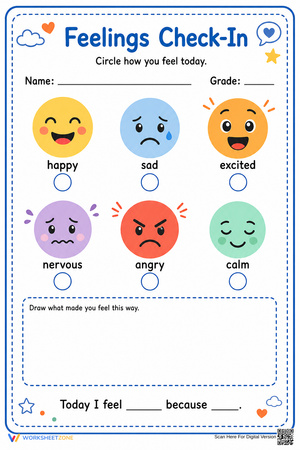
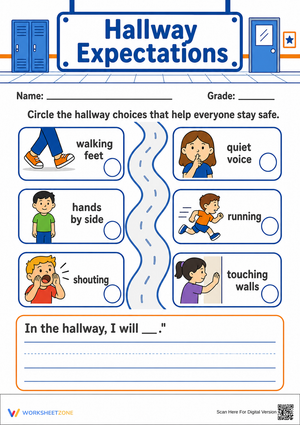
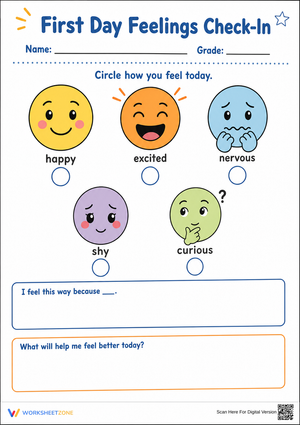
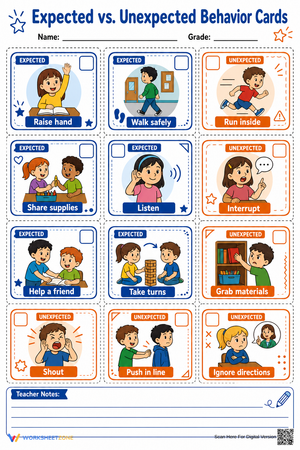
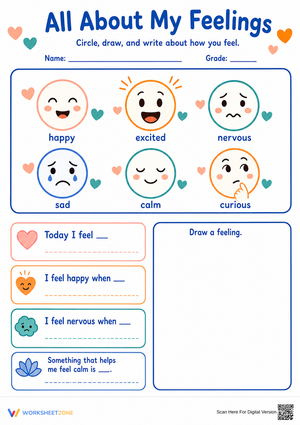
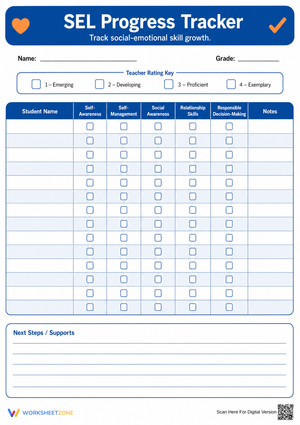
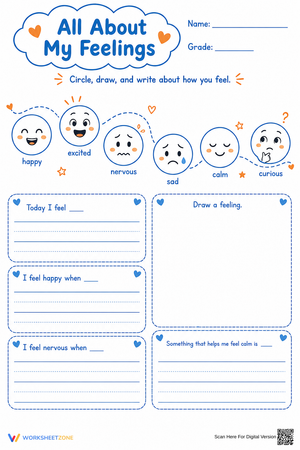
These emotions and feelings worksheets pdf for 1st grade give teachers a set of standalone, printable activities that address the specific SEL skills six- and seven-year-olds are developmentally ready — and overdue — to practice. Each worksheet isolates one task: matching feeling words to drawn faces, mapping where an emotion registers in the body, predicting how a story character feels after a described situation, or pairing a big feeling with a concrete coping move. The result is a set teachers can slot into morning meeting, the calm-down corner, or the quiet ten minutes after lunch without building a separate lesson around each one.
The Specific Skills Targeted
The worksheets address five distinct skill categories, each on its own activity so students build one concept before connecting it to the next:
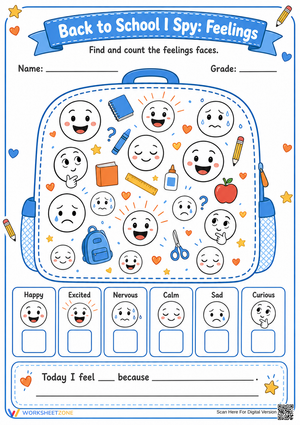
- Emotion-face matching: Students draw lines between feeling words and illustrated facial expressions, building a direct link between abstract vocabulary and visible social cues.
- Body mapping: Students color a body outline to show where an emotion registers physically — the tight shoulders of worry, the hot face of embarrassment, the heavy legs of sadness.
- Scenario prediction: A brief, relatable situation — a block tower falls; a friend saves a seat at lunch — is described in simple language, and students choose from a visual emotion menu to name the character's feeling.
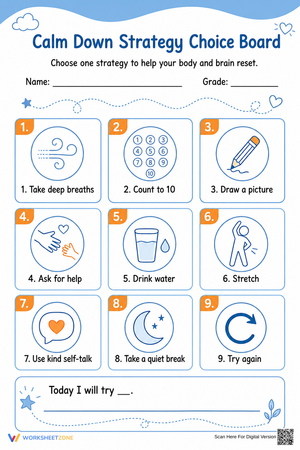
- Coping strategy sorting: Students match big feelings to strategies they can actually use: slow breaths for anger, drawing for sadness, telling a trusted adult for fear. The pairing makes each strategy feel attached to a specific trigger rather than presented as generic advice.
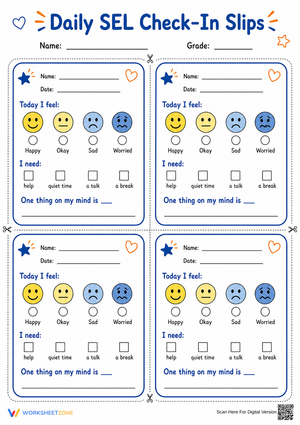
- Feelings thermometer: Students mark their current mood on a numbered scale, then color the corresponding section. Teachers who display a large version on the board can turn this into a collective check-in that shows students their classmates feel differently — and that this is unremarkable.
Covering five categories matters because emotional literacy is not a single skill. A student who correctly matches six feeling words on a vocabulary exercise may still project their own reaction onto a character in a scenario. Separate worksheets surface separate gaps.
Why This Format Works for Six- and Seven-Year-Olds
First graders are still in the middle of early reading acquisition. A worksheet that requires sustained reading to participate shifts cognitive load away from the actual work — identifying and labeling internal states — toward decoding print. The activities in this set use minimal text and rely on images, coloring, and drawing as the primary response mode. That is not simplification for its own sake; it matches where most first graders are in literacy development. Cognitive load theory is useful here: when the conceptual task is genuinely hard, the surface-level task needs to stay simple. Naming an internal state is hard for a six-year-old even when the word is in front of them. The emotions and feelings worksheets pdf for 1st grade activities in this set consistently keep the reading demand low so students spend their working memory on the emotional content, not on decoding the instructions.
Body mapping appears at this grade for a specific developmental reason. Around age six, children begin distinguishing between physical sensation and emotional state — understanding that a racing heart is not just a body event but a signal that something emotional is happening. Worksheets that ask students to color where an emotion lives inside push that distinction into explicit, named awareness at exactly the moment children are ready to make it.
Three Early Error Patterns Worth Addressing Directly
The most common error in early SEL work is feeling-behavior conflation. Students say "I feel like hitting" and treat that as an emotion label. When a body-mapping worksheet asks them to show where anger lives inside — not what they do when they are angry — the conflation surfaces immediately. The student who writes "hitting" in the anger zone has not yet separated the internal state from the behavioral impulse. That is a teachable moment, and the worksheet creates the conditions to catch it.
A second pattern is binary vocabulary. Many first graders arrive able to say "good" or "bad," full stop. On scenario worksheets, these students default to "happy" or "sad" regardless of the context clues in the situation. A scenario where a child is picked last for a team produces "sad" from students with thin vocabulary and "left out" or "embarrassed" from students with more range. Noticing who defaults to binary labels during independent worksheet work tells you exactly where to direct vocabulary instruction next.
A third pattern — subtler — is projection. Students with strong personal reactions to a scenario write their own feeling rather than the character's. A student who is terrified of dogs will mark "scared" on a worksheet where every context clue points toward a character's excitement about getting a puppy. This error passes unnoticed in whole-group discussion, where it blends into the noise. On paper, it is visible, and it opens a direct conversation about how different people can feel differently in the same situation — among the most important concepts in early empathy instruction.
Where These Worksheets Slot Into a Typical School Day
Morning meeting is the most efficient entry point. A feelings thermometer worksheet takes about five minutes: students mark their own level, color the section, and then you graph the class results on the board. The graph shows students that some classmates arrive at a 2 and others at an 8, and both are normal. That collective visibility — seeing that your neighbor feels differently, and that this is unremarkable — is a foundational perspective-taking lesson, and it happens before the academic block even starts.
The calm-down corner use case is different in kind. Keep a small stack of body-mapping and coping-strategy worksheets there — not as an assignment, but as something a student can reach for when overwhelmed. Coloring a body outline during an emotional moment gives restless hands a task and pulls attention gently toward self-observation rather than escalation. Students who practice this at low levels of distress are more likely to reach for it during genuine upset. The worksheet becomes a familiar move rather than an unfamiliar demand.
Scenario-based worksheets work well paired with a read-aloud. After the story, before discussion, students complete the worksheet independently — predicting or labeling the character's feelings at key moments. When discussion opens, it has a concrete anchor. This prevents the pattern where four confident students carry the conversation while the rest of the class waits passively.
Adjusting the Set for a Range of Learners
For students still building basic emotional vocabulary, limit the word bank on any given worksheet to four to six core terms: happy, sad, angry, scared, surprised, frustrated. Presenting fifteen options produces guessing rather than identification. For students who have those terms solid, remove the word bank entirely and have them generate labels independently, or introduce gradations — the difference between nervous and terrified, between pleased and overjoyed. Moving from emotion category to emotion intensity is a genuine cognitive stretch at this grade, and the scenario worksheets support it without requiring a separate activity.
English language learners benefit from the drawing-heavy format because it reduces the language bottleneck considerably. Adding a bilingual word bank or allowing students to label in their home language first gives them an on-ramp without requiring them to wait until they have enough English to participate. Students who freeze with any open-ended prompt do better with the multiple-choice emotion menus on the scenario worksheets, which hold the task open without collapsing it into guesswork. At the other end of the range, the emotions and feelings worksheets pdf for 1st grade set works as a fast starting point for advanced students, who can move through the identification task quickly and then extend by writing a sentence explaining why the character feels that way — adding causal reasoning to the labeling work.
Standard Alignment
These worksheets align with CASEL's Self-Awareness competency, which for early elementary requires students to accurately name their own emotions, recognize that emotions vary in intensity, and begin to understand that others may feel differently in the same situation. Each of those three benchmarks maps directly to a worksheet type in this set: emotion matching and body mapping address the naming task; the feelings thermometer addresses intensity; scenario prediction addresses perspective-taking.
Many state-level SEL standards use CASEL's framework as their backbone. Illinois Standard 1A for early elementary, for example, requires students to "identify and describe a variety of feelings." The set addresses that standard across multiple modalities — matching, drawing, coloring, and choosing — which gives teachers more diagnostic information than a single recall task would.
Frequently Asked Questions
How do I explain the difference between a feeling and a behavior to a first grader?
The most direct language: "A feeling is something that happens inside you. A behavior is what you do with your body." Then anchor it to a concrete pair: "Angry is a feeling. Throwing is a behavior." The body-mapping worksheet reinforces this because it asks students to show where anger lives inside — not what they do when they feel it. The emotions and feelings worksheets pdf for 1st grade activities in this set consistently separate internal state from behavioral response, which gives teachers a ready-made reference point for the conversation when it comes up.
How many emotion words should a first grader have by the end of the year?
Most SEL frameworks for early elementary target a working vocabulary of eight to twelve distinct labels by the end of 1st grade — not just recited, but usable in context. The more meaningful benchmark is whether a student chooses the right word for a described situation rather than defaulting to a generic one. A student who can list ten emotion words but marks "sad" every time on scenario worksheets has not yet internalized the vocabulary. The scenario activities in this set give teachers a direct window into that distinction.
Can these worksheets replace a dedicated SEL curriculum?
No. These worksheets build and reinforce specific skills; they are not a complete instructional sequence. A standalone worksheet does not provide the explicit instruction, teacher modeling, or structured discussion that a full SEL curriculum delivers. What this set does well is give teachers a low-prep, high-frequency practice tool — something concrete to reach for during morning meeting, a transition, or the eight minutes before afternoon pickup when a brief, purposeful activity beats unstructured time.