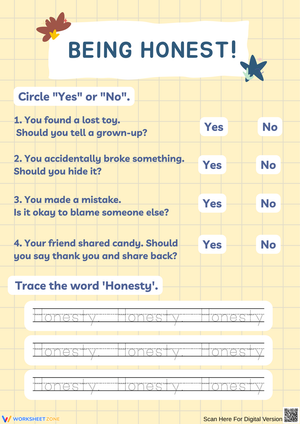
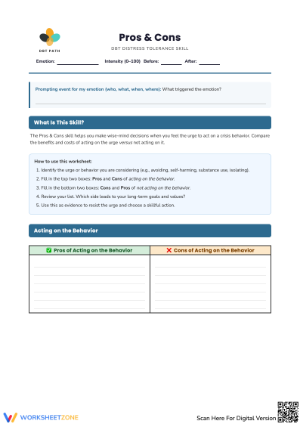
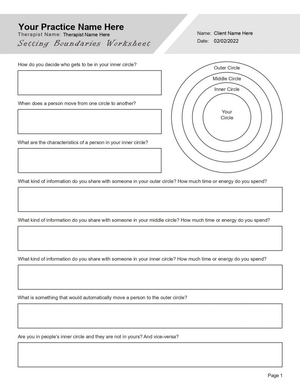
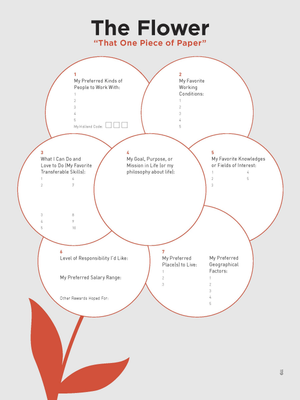
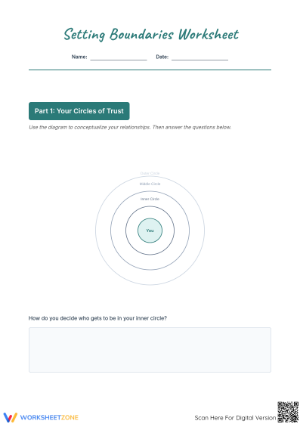
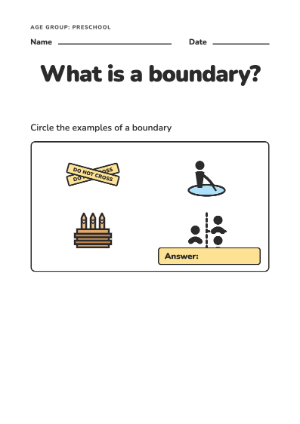
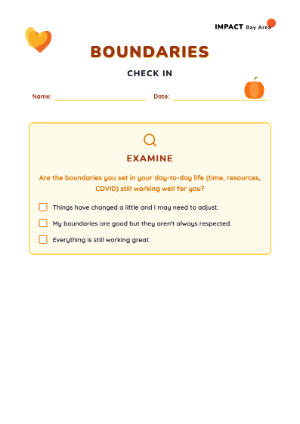
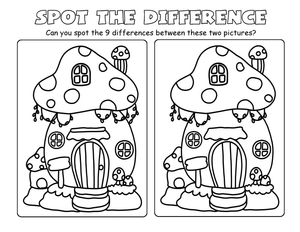
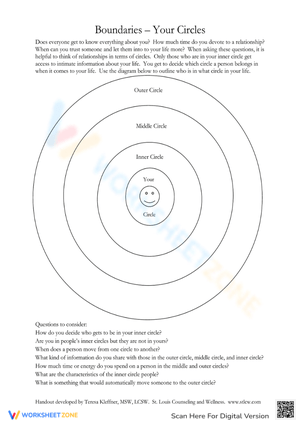
These behavior printable pdf worksheets for 1st grade give teachers a direct, picture-supported way to address the social expectations that 6- and 7-year-olds are only beginning to internalize. At this age, children are leaving the largely self-directed environment of kindergarten and entering a classroom where waiting, listening, and resolving small conflicts are daily prerequisites for learning — not peripheral skills. Each worksheet isolates a single behavioral concept, which matches the developmental reality that first graders process and apply one idea at a time before they can generalize across situations.
The Behavioral Concepts Covered Across the Set
The worksheets address the range of social skills that elementary teachers and school counselors most frequently need to reinforce explicitly in first grade. Topics span:
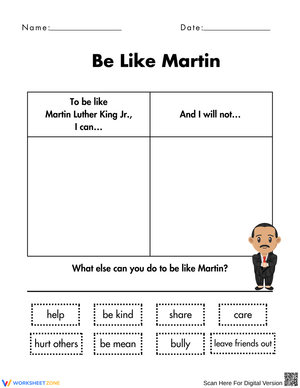
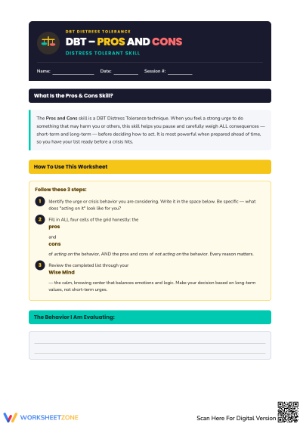
- Good-choice versus poor-choice sorting: Students examine illustrated classroom scenarios — a child raising a hand, pushing to the front of the line, sharing supplies — and sort picture cards into the correct category. The cut-and-sort format keeps hands engaged while processing is happening.
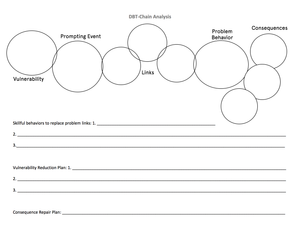
- Cause-and-effect consequence chains: Each worksheet presents a behavior and asks students to draw or circle what happens next, with the emphasis on how actions affect other people rather than on rule-following alone.
- Feelings identification and matching: Students match facial expressions to feeling words, then select an appropriate response to each emotion. Vocabulary stays at five or six core emotion words — enough for first graders to use reliably without overloading working memory.
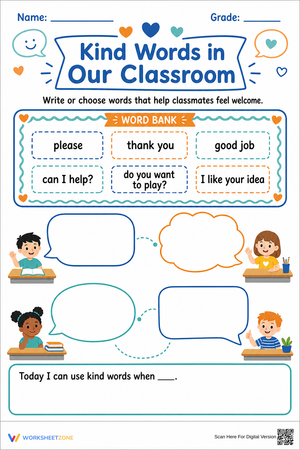
- Perspective-taking sentence stems: Students complete short frames such as "My friend might feel ___ when I ___." These frames move students past surface behavior into the beginning of empathy reasoning.
- Multi-step direction following: A separate cluster of worksheets targets the listening behaviors that underpin academic success — sitting, tracking the speaker, waiting — presented as illustrated checklists students mark as they practice each one.
Common Misconceptions to Watch For and Correct
The error that appears most consistently in sorting activities involves emotional expression in illustrations. A worksheet might show a child sharing crayons while wearing a nervous or uncertain expression — and a significant portion of the class sorts that card as a "bad choice" because they are reading the character's face rather than the action. This is developmentally appropriate: first graders are still learning to separate what someone does from how they feel while doing it. The fix is to pause on exactly that card during the whole-class debrief and ask, "What did the child do?" before asking, "How did the child feel?" That distinction — action versus emotion — is worth a dedicated five-minute discussion rather than a quick correction.
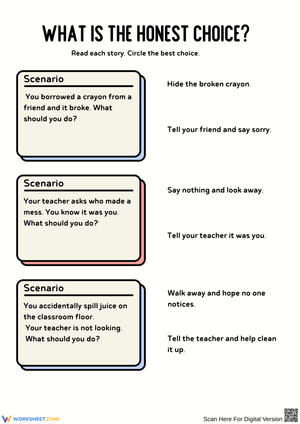
On cause-and-effect worksheets, students default almost universally to punitive consequences rather than natural ones. When asked "what happens next?" after a character grabs a toy, the near-universal response is "you get in trouble" or "go to timeout." Students rarely articulate how the other child feels or what the relationship loses. This pattern tells you they understand behavioral rules as external enforcement rather than as social contracts — and that is precisely where first-grade character instruction needs to push. Redirecting students to think about the other person in the scenario, not the authority figure who might intervene, shifts the conversation in a more lasting direction.
How to Work These Worksheets Into Your Instructional Week
The ten minutes after students return from lunch — when regulation is at its lowest and re-focusing on academics is a genuine battle — is one of the most productive windows for behavior printable pdf worksheets for 1st grade. A sorting worksheet or two-question scenario check gives students a concrete, low-stakes task that settles the room without demanding the full cognitive load of a literacy or math block. Monday mornings work similarly: a feelings-matching worksheet during morning meeting, before the calendar routine, establishes the social tone for the week before academic expectations ramp up.
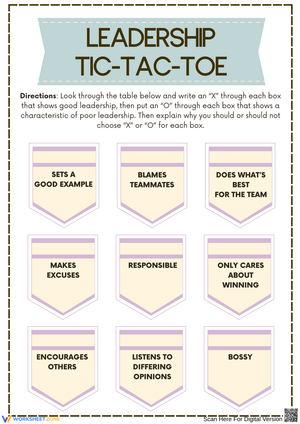
For PBIS-aligned classrooms, these worksheets map directly onto the matrix language your school has already established. If your hallway expectation is "Be Responsible," pull a worksheet showing hallway scenarios and have students identify which character is demonstrating that exact value — use your school's posted words, not generic ones. School counselors running small-group pull-out sessions find that one focused worksheet anchors the conversation without over-structuring it; the illustrations give quieter students an entry point when they are not yet ready to speak first.
One honest limitation: do not assign these worksheets as a consequence for misbehavior. When a child who has just had an incident is handed a "making good choices" printable as a discipline tool, the worksheet becomes associated with shame rather than learning. The same materials that work well in morning meeting become actively counterproductive in that context. Reserve them for proactive instruction and targeted small-group review.
Adjusting the Set for a Range of Learners
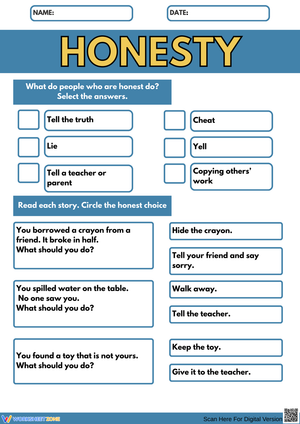
For students who are still emerging as readers, the picture-heavy design of behavior printable pdf worksheets for 1st grade means they participate fully without needing text support — the illustrations carry the meaning. Read the scenario aloud for the whole class before releasing students to work independently, and walk through the first example together as a group. This brief guided walkthrough prevents the most common source of confusion: students circling answers randomly because they did not understand the task format, not because they lacked the social knowledge.
For students ready to move beyond the recognition level, the most effective extension is not a harder worksheet — it is a more open-ended task built on the same scenario. After completing a sorting worksheet, ask those students to select one "poor choice" card and write or dictate what the character could do differently and explain why. That shift from identifying to generating requires the next level of thinking. Separately, the sentence-stem worksheets occasionally frustrate students who prefer open-ended expression; for them, replacing the printed stem with a blank space and a drawing box produces richer, more genuine responses than forcing them into a prescribed frame.
Standard Alignment
These worksheets align with CASEL's five core social-emotional learning competencies — self-awareness, self-management, social awareness, relationship skills, and responsible decision-making — which most US states have embedded into elementary SEL or health education standards. The cause-and-effect and scenario worksheets also connect to Common Core Speaking and Listening standards SL.1.1 and SL.1.3, because the structured class discussion that follows each worksheet is where collaborative conversation and accountable listening get practiced. School counselors working within the ASCA National Model will find alignment to the Personal/Social Development domain, specifically the self-knowledge and responsible decision-making standards — the worksheets provide the concrete practice activity that those standards require but do not prescribe.
Frequently Asked Questions
Are these worksheets designed for whole-class instruction, or do they work equally well in small counseling groups?
Both settings work, but the approach differs. In a whole-class lesson, the worksheet functions as a shared reference point — students complete it individually, then discuss as a group, and the discussion is where most of the learning actually happens. In a counseling pull-out group of four or five students, the worksheet is more of a conversation anchor: the counselor can pause on any item and go deeper without the pacing constraints of a full class. Either way, the worksheet completed and filed without a debrief does relatively little. The follow-up conversation is what makes it instructionally worthwhile.
How long should a lesson built around one of these worksheets typically take?
Plan for 15 to 20 minutes if you include a brief whole-class model, independent work time, and a 5-minute discussion. If students already know the format, you can run the full sequence in 12 minutes. These worksheets are not designed to fill a 45-minute block — that length of independent seatwork on a single social concept will lose first graders entirely. Use any remaining time for a related read-aloud or short role-play rather than extending the worksheet activity itself.
Can these be used effectively with kindergartners or 2nd graders?
The sorting and scenario worksheets work with confident kindergartners toward the end of the school year. For 2nd graders, the concepts will feel familiar but the illustration-heavy format may feel too young — the stronger move is to use the same scenarios and add a written reflection prompt that pushes 2nd graders to explain their reasoning rather than simply identify the correct choice. Teachers who use behavior printable pdf worksheets for 1st grade consistently report that 2nd graders in their building benefit most from the cause-and-effect and perspective-taking worksheets specifically, since those formats transfer to more complex social situations than the basic sorting activities do.