Understanding Concepts of Print in the Early Childhood Classroom
Before a child can begin decoding individual phonemes or blending sounds into words, they must first grasp the physical mechanics of a book and the logic behind the marks on a page. Teachers recognize that these skills are the earliest indicators of future reading success. When a student understands that we read from left to right or that a group of letters forms a single word, they are building the cognitive map necessary for all subsequent literacy instruction. Using a concepts of print worksheets in your classroom provides a structured way to assess and reinforce these emergent skills during small group rotations or individual practice time. Print awareness requires explicit instruction and frequent exposure to high-quality text. In a kindergarten setting, this begins with the realization that print carries meaning. Students learn that the squiggles on the page represent the same words that their teacher speaks aloud.
Identifying Book Parts and Mechanics
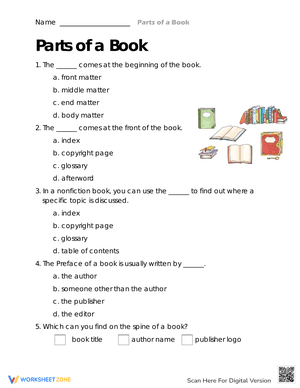
One of the first steps in developing print awareness is learning the physical components of a book. Students must be able to identify the front cover, the back cover, and the spine. While this may seem intuitive to adults, young learners need to explicitly understand that the front cover usually contains the title and the author's name. Worksheets that ask students to label these parts or color them according to instructions are effective for cementing this knowledge.
When children can confidently pick up a book and orient it correctly, they are demonstrating the first stage of book handling skills. This basic orientation is a prerequisite for any formal reading instruction. Beyond the covers, understanding the roles of the author and the illustrator is a fundamental part of literacy development. Teachers can use concepts of print worksheets to help students distinguish between the person who writes the words and the person who creates the pictures.
Mastering Directionality and Tracking
Directionality is one of the most visible aspects of print awareness. In English, we read from left to right and from the top of the page to the bottom. For many children, this is a new concept that must be practiced repeatedly. Concepts of print worksheets often include tracking exercises where students follow a line with their finger or a pencil, moving from a starting point on the left to an endpoint on the right. These activities help train the eyes to move in the specific patterns required for fluent reading. Without a firm grasp of directionality, students may skip lines, read words in the wrong order, or struggle to find where to begin on a new page. Another key component is the return sweep, which is the ability to move from the end of one line of text to the beginning of the next line below it. This diagonal eye movement is a sophisticated skill for a young child.
Distinguishing Between Letters, Words, and Sentences
As children grow in their print awareness, they must learn to distinguish between the different hierarchical levels of text. This begins with the ability to tell the difference between a single letter and a whole word. Concepts of print worksheets often include sort and find activities where students circle individual letters in one color and entire words in another. This visual discrimination is vital for phonics instruction, as students need to know exactly which unit of text they are supposed to be sounding out. Helping children see that letters are the building blocks that come together to form words is a major conceptual leap in early literacy development. Understanding what constitutes a word also involves recognizing the importance of white space. Students must learn that the gaps between groups of letters are what separate one word from the next. Many early readers struggle with this, often trying to read several words as one long string of sounds.
The Role of Punctuation Awareness in Early Reading
Punctuation marks are the road signs of written language, and introducing them early is a key part of print awareness. While students do not need to know every complex rule of grammar, they should understand the basic functions of periods, question marks, and exclamation points. These symbols tell the reader when to stop, when to ask, and when to show excitement. Concepts of print worksheets can introduce these marks in a simple, visual way, perhaps by having students circle the punctuation at the end of every sentence. This helps them realize that print has rhythm and tone that is guided by these small marks, moving beyond just a sequence of words. Recognizing punctuation also plays a significant role in developing reading fluency and expression. Even before a child can decode every word, they can practice reading the punctuation. For example, a teacher might show a sentence ending in an exclamation point and ask the student to say it with an excited voice.
Teacher Tips for Effective Print Awareness Instruction
Integrating print awareness into your daily routine is an effective way to ensure all students master these essential skills. One strategy is to use Big Books during whole-group shared reading. These oversized books allow every child in the room to see the print clearly as you model tracking, point out book parts, and discuss punctuation. While you read, intentionally make mistakes—like starting at the back of the book or reading from right to left—and let the students correct you. This interactive approach makes the learning process engaging and reinforces their understanding through peer-to-peer teaching. Supplementing these lessons with a concepts of print worksheets allows for individual reinforcement of the concepts you have modeled together. Small group instruction also allows you to differentiate your teaching based on each student's specific needs. For some students, you may need to focus purely on book handling and directionality, while others may be ready to distinguish between sentences and words.
Why Print Concepts are the True Foundation of Literacy
While much of early literacy instruction focuses on phonemic awareness and letter-sound correspondence, it is the concepts of print that provide the necessary context for these skills to take root. Without an understanding of how print is organized on a page, the most advanced decoding skills lack direction. A child who knows the sound of every letter but does not know to read from left to right will struggle to string those sounds together in a meaningful way. In this sense, print awareness is the skeletal structure upon which all other reading skills are hung. It provides the logic and the order that allows the decoding process to happen efficiently. The transition from picture reading to print reading is one of the most significant cognitive shifts in a child's educational journey. Developing print awareness shifts their focus to the text itself, helping them realize that the words are the primary source of the narrative. Mastering these mechanics is the first step on a path toward independent reading.
According to the resources at Reading Rockets, these foundational skills are best taught through a combination of explicit instruction and immersive literacy experiences. Furthermore, Scholastic emphasizes that consistent teacher modeling and the use of diverse text types are fundamental for helping students internalize these mechanics. By combining these expert-recommended strategies with targeted practice using concepts of print worksheets, teachers can create a comprehensive literacy program that meets the needs of every emergent reader in their classroom.
Frequently Asked Questions about Concepts of Print Worksheets
1. Why are concepts of print fundamental for learning to read?
Concepts of print provide the essential framework for understanding how written language is structured. Before students can decode words, they must understand directionality, book orientation, and the distinction between print and pictures. Without these skills, the decoding process lacks the necessary context and order required for fluent reading and comprehension.
2. What specific skills are included in concepts of print?
The primary skills include book handling (identifying the front, back, and spine), directionality (reading left to right and top to bottom), understanding the return sweep, distinguishing between letters, words, and sentences, and recognizing the function of punctuation marks. It also includes identifying the roles of the author and illustrator in the creation of a book.
3. How can I help my child develop print awareness at home?
Parents can support print awareness by reading aloud daily and pointing to words as they read. You can ask your child to find the title of the book, show you where to start reading on a page, or identify a specific letter. Using a concepts of print worksheets at home can also provide structured practice in a fun, low-pressure environment.
4. At what age should children start learning concepts of print?
Instruction usually begins in preschool and is a major focus throughout kindergarten. However, children can begin developing these skills as soon as they start interacting with books. The earlier a child is exposed to regular reading and book-handling, the more naturally these concepts will develop.
5. Can I use worksheets to assess my students' print awareness?
Yes, concepts of print worksheets are effective for both instruction and assessment. They allow you to see if a student can correctly label book parts, track text in the right direction, and identify the differences between letters and words. This data helps you plan future instruction and provide targeted support to students.















 Interactive Worksheet Maker
 Quiz Maker
 Word Search Maker
 Crossword Puzzle Maker
 Word Scramble Generator
 Sentence Scramble Generator
 Handwriting Worksheet Generator
 Name Tracing Generator
 Fill In The Blank Generator