The Importance of Syllable Awareness in Early Literacy Instruction
For primary school teachers, providing structured syllables worksheets resources is about teaching the architecture of the English language. When students understand how to segment and blend syllables, they develop the necessary tools to tackle multi-syllabic words with confidence. This skill is particularly vital as students transition from simple CVC words to more complex linguistic structures in the second and third grades. Instruction in this area typically follows a logical progression often described as Hear it, See it, Break it.
Initially, students focus on the auditory components of language, identifying the rhythmic 'pushes' of breath that define a syllable. Teachers often use multisensory techniques such as chin-dropping or hand-clapping to make these abstract concepts more concrete. Once students can reliably hear syllables, they move toward visual recognition, identifying vowel patterns that signal syllable boundaries. Finally, they learn the formal rules of breaking words apart, which is where high-quality printable materials become indispensable for classroom practice. Effective syllable instruction starts with oral language. Before a student ever picks up a pencil, they should be able to hear the segments in spoken words. Teachers often start with compound words because the division is semantically clear.
Understanding the 6 Syllable Types: The CLOVER Method
To truly master multi-syllabic words, students must understand the nature of the syllables themselves. Most reading specialists utilize the CLOVER acronym to teach the six primary syllable types found in English. These types—Closed, Consonant-le, Open, Vowel Team, Silent E, and R-controlled—provide the phonetic keys to vowel sounds. Without this knowledge, a student might struggle to determine if a vowel is long or short, leading to frustration and inaccurate decoding. Closed syllables are the most common and are the first type introduced to students. A closed syllable ends in a consonant, which 'closes in' the vowel, making it short.
Open syllables, conversely, end in a vowel, which allows the vowel to 'shout' its name, resulting in a long vowel sound. Teaching these two types in contrast is a powerful way to build early decoding accuracy. Many syllables worksheets resources focus heavily on sorting words between these two categories to build automaticity. The more complex types, such as vowel teams and r-controlled syllables, require deeper study. Vowel teams involve two vowels working together to make one sound, while r-controlled syllables change the vowel's sound entirely. Consonant-le syllables always appear at the end of a word, and silent e syllables change the preceding vowel from short to long. Mastering these six types allows students to categorize almost any syllable they encounter, turning the daunting task of reading long words into a manageable process of pattern recognition.
Mastering Syllable Division Rules: Rabbit, Tiger, and Camel Patterns
Once students recognize syllable types, they must learn where to draw the line between them. Syllable division rules provide a predictable framework for breaking down unknown words. The three most common rules taught in primary classrooms are the Rabbit, Tiger, and Camel patterns. Each of these represents a specific consonant-vowel configuration that dictates how a word is segmented. The Rabbit rule (VCCV) involves words with two consonants between two vowels. In most cases, the division occurs between the two consonants, as seen in 'rab-bit' or 'den-tist.' This is often the easiest rule for students to grasp because the division point is visually obvious.
The Tiger rule (V/CV) occurs when there is only one consonant between two vowels. In this pattern, the division usually happens after the first vowel, making it an open syllable with a long sound, such as 'ti-ger' or 'pa-per.' The Camel rule (VC/V) is the exception to the Tiger rule. Sometimes, when there is one consonant between two vowels, the division occurs after the consonant, keeping the first syllable closed and the vowel short, as in 'cam-el' or 'rob-in.' Analysis of literacy acquisition patterns indicates that teaching the Rabbit and Tiger rules as a default set, followed by the Camel rule as a 'check' for meaning, helps students develop a flexible approach to decoding that mirrors the cognitive processes of fluent readers. Providing syllables worksheets exercises that specifically target these three patterns allows teachers to observe which rules a student has mastered and which require further reinforcement.
Classroom Implementation: Integrating Syllable Worksheets
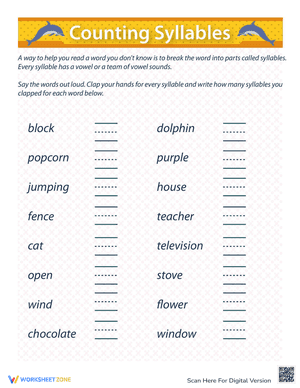
Integrating syllable instruction into a busy classroom schedule requires a mix of direct instruction and independent practice. Many teachers find success using syllable division as a 'word of the day' activity. By projecting a multi-syllabic word on the board and having the class walk through the steps of identifying vowels and applying division rules, teachers can model the mental process of decoding in real-time. This collective practice builds the confidence students need to apply these rules during independent reading time. Worksheets should be used as a tool for reinforcement rather than a primary method of instruction. After a direct lesson on a specific rule, students can work through a syllables worksheets set to practice identifying and dividing words that follow that pattern.
To keep the activity engaging, teachers can incorporate multisensory elements. For example, students can use different colored highlighters for vowels and consonants or use a small toy car to 'drive' through the division lines they have drawn. Small group intervention is another excellent venue for syllable practice. For students who struggle with phonological awareness, focusing on one syllable type or division rule at a time allows for targeted support. Teachers can use specialized worksheets that provide extra scaffolding, such as pre-marked vowels or guided prompts. This focused approach ensures that no student is left behind as the class moves on to more complex linguistic concepts. Consistent, low-stakes practice is the key to moving these skills into long-term memory.
Teacher Tips for Syllable Mastery
Successful syllable instruction requires more than just the right worksheets; it requires a strategic approach to classroom management and student engagement. Here are several tips for maximizing the impact of your syllable lessons:
- Use Real-World Examples: Incorporate students' names, classroom objects, or current science and social studies vocabulary into your syllable lessons. This makes the skill feel relevant and applicable to their broader learning.
- Consistency is Key: Dedicate 5-10 minutes each day to phonological awareness. Short, frequent bursts of practice are more effective than long, infrequent lessons.
- Encourage Self-Correction: Teach students to 'try it both ways' when encountering a VCV word. If 'ti-ger' (long i) doesn't sound right, try 'tig-er' (short i). This builds metacognition and flexibility.
- Make it Physical: Always pair visual worksheets with a physical action, such as clapping, tapping, or moving a finger. The more senses involved, the stronger the neural connections.
According to insights from The 6 Syllable Types and Why They Matter (leadinliteracy.com), understanding the six syllable types—closed, open, silent e, vowel team, r-controlled, and consonant-le—is a critical component of decoding accuracy that directly impacts a student's ability to read and spell complex words correctly.
Frequently Asked Questionss
1. What are the 6 syllable types and why are they important?
The six syllable types include closed, open, vowel-consonant-e, r-controlled, vowel team, and consonant-le. Understanding these types is essential because it helps students predict the vowel sound within a syllable. For example, knowing that a closed syllable usually has a short vowel sound allows a student to decode a new word like 'magnet' accurately on the first try. These categories provide the building blocks for all English words.
2. How can I help a child who struggles to hear syllables in words?
If a child struggles with the auditory component, start with large, distinct movements. Have them jump for each syllable or use 'arm tapping' where they tap from shoulder to wrist. Using compound words that can be physically separated, like 'cup' and 'cake,' can also help them grasp the concept of segments before moving to abstract phonetic divisions. Multisensory feedback is often the key to breaking through auditory processing difficulties.
3. At what grade level should students master multi-syllable word division?
Syllable awareness typically begins in kindergarten with simple counting. By the end of first grade, students should be familiar with the Rabbit rule (VCCV). Second and third grades are the primary years for mastering the more complex division rules and the six syllable types. Mastery of these skills is expected by the end of third grade to support the transition to reading for information, where words become significantly more complex.
4. Are there any fun activities to use alongside syllables worksheets resources?
Yes, games like 'Syllable Scavenger Hunt' or 'Syllable War' are highly effective. You can also use 'Syllable Puzzles' where students cut out words along their division lines and then piece them back together. These activities provide a playful break from traditional paper-and-pencil tasks while still reinforcing the core concepts in a memorable way. Gamification can significantly increase student motivation for phonics practice.
5. How do syllable division rules help with spelling?
Syllable division is just as important for spelling as it is for reading. When a student knows how to break a word into smaller parts, they can spell it one 'chunk' at a time. This prevents them from feeling overwhelmed by a long word and ensures that they include all the necessary sounds and vowel markers required for each segment. It turns the complex task of spelling into a logical, step-by-step process.















 Interactive Worksheet Maker
 Quiz Maker
 Word Search Maker
 Crossword Puzzle Maker
 Word Scramble Generator
 Sentence Scramble Generator
 Handwriting Worksheet Generator
 Name Tracing Generator
 Fill In The Blank Generator