The Role of Syllable Awareness in Phonological Development
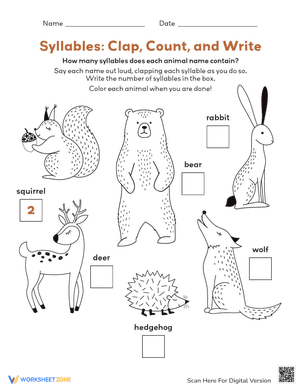
Phonological awareness represents a fundamental pillar in the journey toward literacy. It involves the ability to recognize and manipulate the spoken parts of words, such as syllables, onset-rimes, and individual phonemes. Within this hierarchy, syllable awareness serves as an early and accessible entry point for young learners. By focusing on hearing syllables, students begin to understand that spoken language is composed of discrete units of sound. This realization is vital for developing both reading and spelling skills. When children can accurately segment words into syllables, they are better equipped to handle longer, more complex words as they progress through their academic careers. Using hearing syllables worksheets provides a structured way to practice these skills in a consistent and measurable manner, ensuring that students build a strong auditory foundation before moving on to more complex phonemic tasks that require greater precision.
Classroom Implementation: Integrating Syllable Worksheets into Daily Routines
Integrating hearing syllables worksheets into the daily classroom routine does not require a complete overhaul of your existing curriculum. Instead, these resources can be used as targeted warm-ups, transition activities, or part of a dedicated phonics block. A common and effective strategy is to start the morning meeting with a quick syllable-counting exercise. Teachers can present a 'word of the day' and ask students to determine how many syllables they hear. This sets a linguistic tone for the day and keeps phonological skills sharp through regular, low-stakes practice. During small-group instruction, these worksheets can serve as a concrete tool for assessment and practice, allowing teachers to provide immediate feedback on their students' segmentation skills and ensuring that every child is on the right path toward mastery of these foundational literacy concepts.
Strategic Use of PDF Resources for Small Group Instruction
The flexibility of PDF resources allows for highly customized instruction tailored to the specific needs of different learner profiles. In a typical classroom, students will arrive with varying levels of phonological preparation. Some may already be able to segment multi-syllabic words with ease, while others might still be struggling with simpler structures. Hearing syllables worksheets in PDF format enable teachers to print exactly what is needed for each group. This prevents students from becoming overwhelmed by material that is too difficult or bored by material that is too easy, ensuring that everyone remains engaged and productive during their literacy block. According to Reading Rockets in "Phonological Awareness: Syllables", phonological awareness is a strong predictor of later reading success. Research indicates that approximately 20% of children struggle with phonological skills. Syllable awareness serves as a bridge, allowing students to transition from hearing whole words to identifying individual phonemes within spoken language.
The Mechanics of Syllable Counting: From Clapping to Tapping
The physical act of counting syllables is more than just a classroom trick; it is a cognitive strategy that helps students internalize the structure of language. Clapping is the most common method, but it is not always the most effective for every child. For some, alternative methods like 'chin-dropping' or 'finger-tapping' can be more effective. The 'chin-drop' method involves placing a hand under the chin and counting how many times the mouth opens to produce a vowel sound. Since each syllable requires the mouth to open for a vowel, this provides a direct physical link to the linguistic definition of a syllable, making the abstract concept of sound much more tangible for young learners. Expert analysis of syllable segmentation reveals that the cognitive processing required for this task involves both auditory discrimination and working memory. Students must not only hear the distinct beats but also hold those beats in their memory long enough to count them accurately. By providing a visual scaffold through hearing syllables worksheets, we reduce the burden on working memory, allowing the student to focus their mental energy on the auditory analysis of the word.
Diagnostic Applications of Hearing Syllables Worksheets
Worksheets are often viewed solely as practice tools, but they also hold significant diagnostic value for the observant educator. By analyzing a student's performance on a hearing syllables worksheet, a teacher can gain insights into their phonological processing capabilities. For instance, if a student consistently misses syllables in words with liquid consonants or nasal consonants, it may indicate a specific auditory discrimination issue. This level of detail allows for much more precise intervention than a general label ever could. These worksheets can help track progress over time, providing a clear picture of what the student can do independently and where they still require teacher scaffolding to achieve success.
Building Fluency through Multi-Syllabic Word Exposure
As students move into higher grade levels, the complexity of the words they encounter increases significantly. The transition from single-syllable words to multi-syllabic words is a major hurdle for many developing readers. Proficiency in hearing syllables is the key to overcoming this obstacle. When students are comfortable segmenting spoken words, they can apply that same logic to decoding written words. They learn to look for 'syllable chunks' rather than trying to sound out every individual letter, which is a much more efficient way to read long words. Exposure to multi-syllabic words through structured worksheets helps to build a student's mental dictionary of word parts and common spelling structures. A fluent reader recognizes patterns and processes word parts automatically, a skill built through thousands of repetitions of segmenting and blending sounds.
Teacher Tips: Enhancing Engagement during Phonics Lessons
Maintaining high levels of engagement during phonics instruction is essential for ensuring that the lessons are effective. One way to do this is to vary the way you use hearing syllables worksheets. Try turning the worksheet into a 'scavenger hunt' by placing different parts of the worksheet around the room and having students move from station to station to complete the tasks. This physical movement can help to refocus students who might otherwise struggle to sit still during a traditional lesson. Another tip is to use real-world examples that are relevant to your students' lives, such as their own names, favorite foods, or seasonal words to keep the content fresh. Remember to celebrate the 'small wins' as well. Phonological awareness can be difficult for some children, and positive reinforcement goes a long way in building the confidence that students need to persist through challenging material.
Frequently Asked Questions About Hearing Syllables
1. Why is hearing syllables easier than hearing individual phonemes?
Hearing syllables is generally easier because syllables are the natural 'beats' of our language. When we speak, we naturally break words into these larger units of sound. Individual phonemes are much smaller and often overlap in speech, making them harder to distinguish for the untrained ear. Starting with syllables allows students to experience success early on, building the auditory discrimination skills they will need for more advanced phonemic awareness tasks later in their literacy development.
2. At what age should a child be able to hear and count syllables?
Most children begin to develop basic syllable awareness between the ages of four and five. By the end of kindergarten, most students should be able to accurately clap or tap out the syllables in simple two- and three-syllable words. However, every child develops at their own pace, and some may need more targeted practice in first grade. If a student is still struggling with basic syllable counting by the middle of first grade, it may be a sign that they need additional support to catch up.
3. Do all syllables really need to have a vowel sound?
Yes, every syllable must contain exactly one vowel sound. This vowel sound can be a single vowel, a vowel team, or even a 'vowel-like' consonant sound in some unstressed syllables. The rule for students is simple: the number of vowel sounds you hear is the number of syllables in the word. This is why hearing syllables is such a powerful tool for teaching children to listen for the core sounds that make up our language, providing a foundation for future spelling and reading rules.
4. How can I help a student who 'over-counts' syllables?
Students who over-count often try to count every individual sound or letter instead of the beats. To help them, go back to basics with very clear, distinct words. Use the 'chin-drop' method, as it is much harder to 'over-drop' your chin than it is to 'over-clap.' You can also model the process by saying the word very slowly and emphasizing the vowel sounds. Once they can consistently identify the syllables in simple words, slowly increase the complexity until they master the skill.
5. Is there a difference between hearing syllables and syllable division?
Hearing syllables is an auditory skill that involves identifying sounds in spoken words. Syllable division is a written skill that involves knowing where to break a written word into its component parts. While the two skills support each other, hearing the sounds always comes first in the developmental sequence. A student must be able to hear the syllables before they can be expected to understand the rules for dividing them on paper during reading or writing tasks.















 Interactive Worksheet Maker
 Quiz Maker
 Word Search Maker
 Crossword Puzzle Maker
 Word Scramble Generator
 Sentence Scramble Generator
 Handwriting Worksheet Generator
 Name Tracing Generator
 Fill In The Blank Generator