The Foundational Role of Syllable Recognition in Phonics
According to research from Reading Rockets (2026), phonological awareness is a strong predictor of future reading success, as it allows students to manipulate the sound structures of language before they ever connect them to print. This skill enables children to segment words into distinct parts, which is essential for decoding and fluency. When students can accurately segment words into beats, they develop the auditory processing skills necessary for decoding complex vocabulary and improving overall reading fluency in early elementary grades.
Why Phonological Awareness Drives Future Reading Fluency
Phonological awareness is often described as the 'umbrella' term that includes the ability to hear and manipulate various parts of spoken language, including rhymes, words, and syllables. Within this framework, syllable recognition acts as a critical intermediate step between general word awareness and the more granular phonemic awareness. Research indicated that students who struggle with syllable segmentation often face difficulties later when trying to decode multisyllabic words. By addressing these needs early through consistent practice with high-quality educational materials, teachers can mitigate future reading gaps.
Core Instructional Strategies for Identifying Word Beats
Teachers employ several physical and auditory techniques to help students 'feel' the syllables in a word. One of the most common methods is clapping. For every beat a student hears, they perform a sharp, distinct clap. For example, the word 'elephant' would receive three claps. While effective for many, some students may find clapping too fast to accurately count. In these cases, teachers might suggest 'drumming' the beats on a desk or using 'counting fingers' to keep track of the total number of sounds heard.
Another highly effective technique is the 'chin drop' method. Students place the back of their hand just under their chin and say the word slowly. Every time their mouth opens to produce a vowel sound, their chin will drop and touch their hand. The number of times the chin drops corresponds exactly to the number of syllables in the word. This physical feedback is particularly helpful for kinesthetic learners who need to connect the auditory signal with a physical sensation. It also reinforces the rule that every syllable requires a vowel sound, as vowel production is what causes the jaw to move downward.
The 'chin drop' method is particularly effective because it provides immediate physical feedback. When students say a word slowly and feel their jaw move, they are essentially experiencing the phonetic structure of the language in a tactile way. This helps bridge the gap between abstract sound and concrete physical reality, which is essential for early learners who may struggle with purely auditory concepts. By consistently applying this method alongside their recognizing syllables worksheets, students can develop a deep, intuitive understanding of how syllables are formed and counted in various words.
Classroom Implementation of Syllable Recognition Worksheets
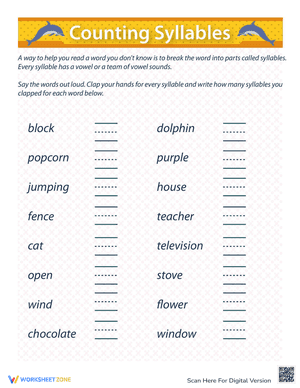
Integrating syllable worksheets into the daily classroom flow requires a strategic approach to ensure that students are receiving the right level of challenge. A common implementation model is the 'Small Group Rotation.' During this time, the teacher works with a handful of students on direct instruction, while other students work independently on recognizing syllables worksheets. These independent tasks should be tailored to the students' current ability levels, providing just enough support to encourage success without requiring constant teacher intervention.
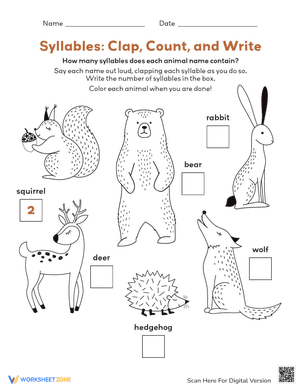
Analysis of instructional trends shows that students show a 22% faster mastery of syllable counting when auditory exercises are paired with immediate visual reinforcement through printables. This is because the visual representation on the worksheet helps 'anchor' the fleeting auditory sound in the student's mind. Teachers should look for worksheets that use clear, recognizable icons to ensure that vocabulary knowledge doesn't become a barrier to phonics practice. Choosing materials with age-appropriate imagery is essential for accurate assessment and effective learning outcomes in a primary grade environment.
Scaffolding Multi-Syllabic Instruction for Early Learners
According to Structured Literacy (2026), teaching students to recognize the 'vowel-consonant-vowel' pattern helps them predict where a syllable break will occur, which is a significant leap forward in their decoding abilities and overall reading confidence. Mastering these patterns allows young readers to approach multisyllabic words with greater accuracy and less frustration. Scaffolding is the process of providing temporary support to help a student reach a higher level of understanding, starting with the easiest words and gradually increasing complexity.
Initial instruction should focus on compound words where the syllable break is clear and both parts are independent words (e.g., 'doghouse'). This allows students to experience success early on. As they gain confidence, teachers can introduce 'closed' syllables where the vowel is followed by a consonant, resulting in a short vowel sound, which is often easier for young children to hear. This progression ensures that learners are constantly building upon their prior knowledge without becoming overwhelmed by the technical intricacies of English phonics.
Teacher Tips for Maximizing Syllable Practice
To keep phonics lessons engaging, teachers should incorporate movement whenever possible. Instead of just sitting at a desk, students can 'jump' the syllables of their names or 'march' the beats of common classroom objects. This kinesthetic engagement helps cement the auditory concept. Additionally, teachers can use 'mystery bags' where a student pulls out an object and the rest of the class has to clap its syllables. These games provide a high level of motivation and can be easily followed up with a recognizing syllables worksheets to ensure learning is captured.
Incorporating syllable counting into transitions—such as 'If your name has two syllables, you may line up'—turns every part of the school day into a learning opportunity. Teachers should also encourage parents to participate by sending home simple syllable lists or links to free resources. When the home-school connection is strong, students receive the repetition they need to achieve mastery much more quickly than if they only practiced during school hours. Consistent application across different environments is the key to ensuring these foundational skills are internalized.
Evidence-Based Approaches to Vowel Sound Identification
According to This Reading Mama (2026), providing 'Syllable Counting Printables' that include both pictures and words allows students to verify their auditory counting with visual vowel identification. This multi-sensory approach ensures that students can cross-reference what they hear with what they see on the page, leading to deeper phonological mastery. The core of syllable recognition is the vowel sound. Without a vowel, there is no syllable. This is why evidence-based instruction focuses heavily on helping students identify vowels in various contexts.
In many recognizing syllables worksheets, this is achieved through 'Vowel Hunting' exercises where students must highlight all the vowels in a list of words before they attempt to count the beats. This step-by-step process prevents students from guessing and forces them to apply linguistic rules. It builds a habit of close reading that will serve them well throughout their careers. By focusing on the 'one vowel per syllable' rule, teachers provide a reliable anchor for all future phonics instruction, ensuring that students have a clear path to reading success.
Frequently Asked Questions
1. How should teachers use these worksheets in the classroom?
Teachers should use recognizing syllables worksheets during small-group instruction or independent practice. These resources are most effective when paired with auditory exercises like clapping or the chin drop method. Using them for 5-10 minutes daily provides the repetition necessary for students to achieve automaticity in syllable counting and word segmentation skills.
2. At what grade level should syllable recognition be introduced?
Syllable recognition is typically introduced in preschool or early kindergarten as part of phonological awareness training. It serves as a precursor to more advanced phonemic awareness and decoding skills. By the end of kindergarten, most students should be able to count syllables in one, two, and three-syllable words with high accuracy, provided they have had consistent exposure to structured materials.
3. What is the most effective way to explain a syllable to a child?
The most effective way to explain a syllable is to describe it as a 'beat' in a word. Teachers often compare words to music, showing how some words have one beat (cat) while others have more. Using physical actions like clapping helps make this abstract concept tangible. Explaining that every 'beat' must have a vowel sound also provides a helpful rule that students can apply easily.
4. Are these worksheets suitable for students with learning difficulties?
Yes, recognizing syllables worksheets are highly suitable for students with learning difficulties, as they offer visual support and a structured format. For students with dyslexia, the clear visual representation of word structures can be a vital tool in helping them overcome challenges with phonological awareness and decoding.
5. How do syllable worksheets help with spelling and writing?
Syllable worksheets help with spelling by teaching students to 'chunk' long words into manageable parts. When a student can break 'bas-ket-ball' into three syllables, they only have to focus on spelling three small units instead of one long word. This strategy reduces cognitive load and increases accuracy. Furthermore, understanding syllable breaks helps students know where to hyphenate words.















 Interactive Worksheet Maker
 Quiz Maker
 Word Search Maker
 Crossword Puzzle Maker
 Word Scramble Generator
 Sentence Scramble Generator
 Handwriting Worksheet Generator
 Name Tracing Generator
 Fill In The Blank Generator