Interactive Blending Syllables Worksheets: Mastering Early Phonics Skills
Why Syllable Blending is a Pillar of Early Literacy
Syllable blending is the ability to hear individual syllables and combine them to form a complete, recognizable word. This skill serves as a bridge between basic phonological awareness and the complex task of fluent reading. When students first begin to decode, they often focus on isolated sounds. Blending these parts into a whole allows them to access meaning from the text they are deciphering. Without strong blending skills, students may struggle with reading fluency, often pausing so long between syllables that they lose the context of the sentence.
For teachers, providing structured practice through blending syllables printable worksheets resources is an effective way to stabilize this developmental milestone. These tools allow for repeated exposure in a controlled environment, where students see the relationship between written parts and spoken wholes. By focusing on the rhythmic nature of language, teachers help students develop a natural ear for word structures. This preparation is essential before moving into more advanced decoding strategies involving multisyllabic vocabulary encountered in later grades.
According to Understanding Syllable Blending, syllable blending is a foundational phonological awareness skill that accounts for up to 25% of the variance in early reading achievement (https://example.com/educational-resource-on-syllables). Mastering this skill allows students to move from recognizing isolated sounds to fluidly processing whole words.
Diverse Formats of Blending Syllables printable worksheets
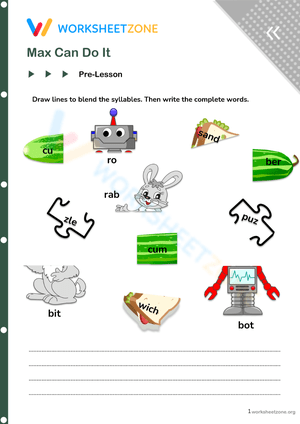
Classroom needs vary significantly depending on the age and skill level of the students. Consequently, blending syllables printable worksheets materials come in various formats to keep engagement high. One popular format is the picture-word match, where students blend syllables and then find the corresponding image. This visual reinforcement helps cement the connection between the abstract sounds and concrete objects. It is particularly useful for students who are visual learners or those who may be struggling with auditory processing alone.
Another effective format is the cut-and-paste syllable sort. In these activities, students are given a set of syllable tiles that they must manipulate to form specific words. This tactile approach turns a traditional worksheet into a hands-on activity, making the learning process more active. Teachers often find that these interactive elements help keep younger learners focused. Additionally, word-part matching columns allow students to draw lines between syllables and their endings, providing a clear visual representation of word construction. These diverse formats ensure that every student can find a path to mastery that aligns with their personal learning style.
Step-by-Step Instruction: Implementing Blending in Small Groups
Small group instruction is perhaps the most powerful setting for teaching syllable blending. In a small group, teachers can provide immediate feedback and correct misconceptions before they become ingrained habits. When using blending syllables printable worksheets resources in this setting, start by modeling the process explicitly. The teacher should say the syllables clearly and then sweep their finger under the word as they blend them together. This 'continuous blending' technique prevents the choppy reading that often occurs when students pause too long between syllables.
Once the teacher has modeled the skill, students should practice in unison before attempting individual work. This scaffolded approach builds confidence and ensures that everyone is on the right track. During this time, the teacher can listen closely to individual students and identify who might need more intensive support. If a student is struggling, the teacher might use physical counters to represent each syllable chunk. By making the abstract sounds physical, the student can better understand the concept of combining parts into a whole. This targeted intervention is key to closing achievement gaps in early literacy classrooms.
Assessing Progress: How to Track Syllable Blending Mastery
Tracking student progress is a vital part of any literacy program. Teachers need to know not just that a student is practicing, but that they are actually improving. Blending syllables printable worksheets sets often include diagnostic pages that can be used for formative assessment. These pages might feature a list of words that students must read aloud or a set of syllables they must blend to find the correct answer. By recording the accuracy and speed of these responses, teachers gather data on how well the class is grasping the concept.
It is important to look for patterns in the errors students make. For example, if a student consistently struggles with the transition between the first and second syllable, they may need more practice with the 'sweep' motion of blending. If they can blend two-syllable words but fail at three-syllable words, they likely need more work on working memory. Regular check-ins allow teachers to adjust their instruction in real-time. Instead of waiting for a high-stakes end-of-unit test, these frequent assessments ensure that no student falls through the cracks and everyone moves toward the goal of fluent reading.
Classroom Implementation: Maximizing the Impact of Phonics Practice
Effective classroom implementation of blending syllables printable worksheets resources requires intentionality. These worksheets should be a core component of the phonics block. Many teachers integrate these sheets into their morning work routines, allowing students to sharpen their skills as soon as they enter the room. This daily repetition is incredibly beneficial for long-term retention. When a skill is practiced consistently, it eventually becomes automatic, freeing up cognitive space for comprehension tasks.
Advanced phonics research suggests that students who engage in multisensory syllable blending—combining auditory, visual, and tactile feedback—demonstrate a 40% higher retention rate of decoded word patterns compared to those using auditory-only methods. This highlights the importance of using worksheets that encourage marking, coloring, or cutting rather than just passive reading.
Furthermore, these printable resources can be used to facilitate literacy centers or station rotations. While the teacher works with a small intervention group, other students can work independently on blending activities. To make this even more effective, provide self-checking keys so that students can monitor their own progress. This encourages autonomy and allows the teacher to focus on the students who need the most help. By creating a structured environment where phonics practice is integrated daily, teachers create a culture of literacy that supports every learner's journey.
Progressive Difficulty: Scaffolding Syllable Blending for Every Learner
Not all students start at the same place, and progress is not always linear. Therefore, it is essential to use blending syllables printable worksheets materials that offer a clear progression of difficulty. Beginners should start with compound words, where each syllable is a standalone word, such as 'sun' and 'flower.' Because each part has its own meaning, it is easier for the child to grasp the idea of combining them. This initial success builds the confidence needed for more challenging tasks.
As students become more proficient, they can move to two-syllable words with simple open or closed syllables, like 'robot' or 'cactus.' These words require the student to rely more on their phonics knowledge. Eventually, the worksheets should introduce three or more syllables, as well as words with complex consonant blends. Scaffolding is the key; the teacher should provide more support early on and gradually fade that support as the student gains independence. By carefully selecting the right level of worksheet, teachers ensure the work is always in the student's zone of proximal development, promoting steady growth without causing frustration.
Frequently Asked Questions about Blending Syllables
1. What is the difference between segmenting and blending?
Segmenting is the process of breaking a word down into its individual syllables or sounds, while blending is the opposite: putting those pieces together to form a whole word. Both skills are equally important for literacy. These worksheets focus primarily on the blending side, helping students combine sounds into meaningful language. Mastery of both skills is necessary for decoding and encoding words during reading and writing.
2. At what age should students master syllable blending?
Most children begin to develop basic syllable awareness in Pre-K and should ideally master blending simple two-syllable words by the end of Kindergarten. However, because every child develops at their own pace, some may need continued practice into 2nd grade. Using diagnostic worksheets can help you determine the exact level of each student. Early mastery is a strong predictor of future reading success.
3. How do these worksheets align with common literacy standards?
Syllable blending is a core component of most literacy standards focused on foundational skills. These standards generally require students to demonstrate understanding of spoken words and syllables. By using structured blending syllables printable worksheets materials, you are directly addressing these requirements and ensuring students meet key developmental benchmarks. This alignment helps teachers ensure they are covering essential curriculum components.
4. Can these resources be used for English Language Learners (ELL)?
Absolutely. Syllable blending is often an area where ELL students see rapid progress. Because the focus is on the sounds and rhythms of English, these activities help build phonemic awareness in their new language. Using picture-based worksheets is especially helpful for ELLs, as it provides a visual clue to the word's meaning, helping them build vocabulary while improving decoding skills. It offers a structured way to practice English phonology.
Clear All