


























0
Views
0
Downloads

0.0
0
Save
0 Likes
Share
Exploring Consonant Blends and Digraphs
0 Views
0 Downloads
Paste this activity's link or code into your existing LMS (Google Classroom, Canvas, Teams, Schoology, Moodle, etc.).
Students can open and work on the activity right away, with no student login required.
You'll still be able to track student progress and results from your teacher account.
Information
Description
What It Is:
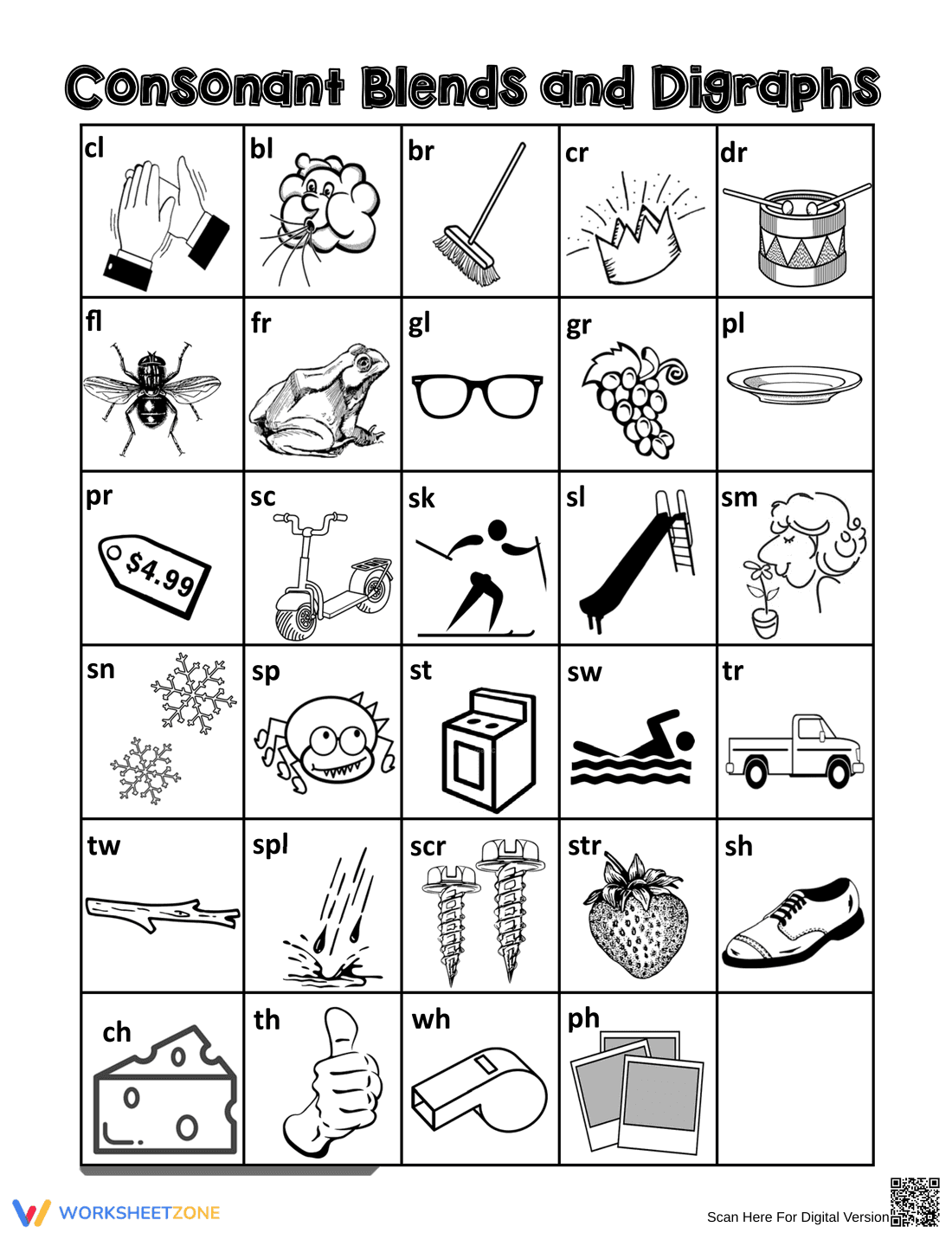
This is a phonics worksheet focusing on consonant blends and digraphs. It features a grid with 26 squares, each containing a black and white illustration paired with a two-letter consonant combination. Examples include 'cl' with clapping hands, 'bl' with blowing, 'br' with a broom, 'cr' with a crown, 'dr' with a drum, 'fl' with a fly, 'fr' with a frog, 'gl' with glasses, 'gr' with grapes, 'pl' with a plate, 'pr' with a price tag, 'sc' with a scooter, 'sk' with skiing, 'sl' with a slide, 'sm' with smelling, 'sn' with snowflakes, 'sp' with a spider, 'st' with a stove, 'sw' with swimming, 'tr' with a truck, 'tw' with a twig, 'spl' with a splash, 'scr' with screws, 'str' with a strawberry, 'sh' with a shoe, 'ch' with cheese, 'th' with a thumb, 'wh' with a whistle, and 'ph' with photographs.
Grade Level Suitability:
This worksheet is suitable for kindergarten and first grade. It's designed to introduce and reinforce early phonics skills, specifically focusing on recognizing and associating consonant blends and digraphs with corresponding images. The simple illustrations and clear labeling make it accessible for young learners.
Why Use It:
This worksheet helps students develop phonemic awareness and improve their ability to decode words. By associating visual cues (pictures) with consonant blends and digraphs, students can build a stronger understanding of letter-sound relationships. It provides a fun and engaging way to practice phonics skills.
How to Use It:
Students can use this worksheet to practice identifying consonant blends and digraphs. They can say the name of each picture and identify the beginning sound combination. The worksheet can also be used for coloring activities or as a visual aid during phonics lessons. Teachers can use it for individual practice, small group activities, or as a quick assessment tool.
Target Users:
The target users for this worksheet are kindergarten and first-grade students learning about consonant blends and digraphs. It's also suitable for ESL students who are learning English phonics. Teachers, tutors, and parents can use this worksheet to support literacy development.
This is a phonics worksheet focusing on consonant blends and digraphs. It features a grid with 26 squares, each containing a black and white illustration paired with a two-letter consonant combination. Examples include 'cl' with clapping hands, 'bl' with blowing, 'br' with a broom, 'cr' with a crown, 'dr' with a drum, 'fl' with a fly, 'fr' with a frog, 'gl' with glasses, 'gr' with grapes, 'pl' with a plate, 'pr' with a price tag, 'sc' with a scooter, 'sk' with skiing, 'sl' with a slide, 'sm' with smelling, 'sn' with snowflakes, 'sp' with a spider, 'st' with a stove, 'sw' with swimming, 'tr' with a truck, 'tw' with a twig, 'spl' with a splash, 'scr' with screws, 'str' with a strawberry, 'sh' with a shoe, 'ch' with cheese, 'th' with a thumb, 'wh' with a whistle, and 'ph' with photographs.
Grade Level Suitability:
This worksheet is suitable for kindergarten and first grade. It's designed to introduce and reinforce early phonics skills, specifically focusing on recognizing and associating consonant blends and digraphs with corresponding images. The simple illustrations and clear labeling make it accessible for young learners.
Why Use It:
This worksheet helps students develop phonemic awareness and improve their ability to decode words. By associating visual cues (pictures) with consonant blends and digraphs, students can build a stronger understanding of letter-sound relationships. It provides a fun and engaging way to practice phonics skills.
How to Use It:
Students can use this worksheet to practice identifying consonant blends and digraphs. They can say the name of each picture and identify the beginning sound combination. The worksheet can also be used for coloring activities or as a visual aid during phonics lessons. Teachers can use it for individual practice, small group activities, or as a quick assessment tool.
Target Users:
The target users for this worksheet are kindergarten and first-grade students learning about consonant blends and digraphs. It's also suitable for ESL students who are learning English phonics. Teachers, tutors, and parents can use this worksheet to support literacy development.


