The Role of Metaphor in Developing Literacy Skills
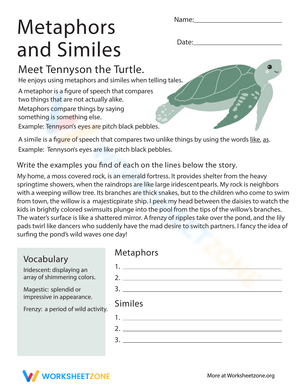
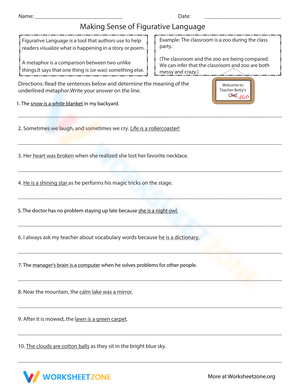
Language is not merely a tool for literal communication; it is a system of imagery and comparison that allows students to grasp complex ideas. When teachers search for a metaphors worksheets, they are looking for more than just a printable page. They are seeking a structured approach to help students transition from concrete understanding to abstract reasoning. Metaphors, which directly compare two unlike things without the use of "like" or "as," serve as the building blocks for literary analysis and creative expression. Mastering this figure of speech is essential for students across grade levels, as it appears in everything from early elementary poetry to sophisticated high school literature.
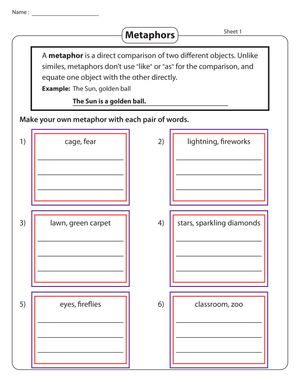
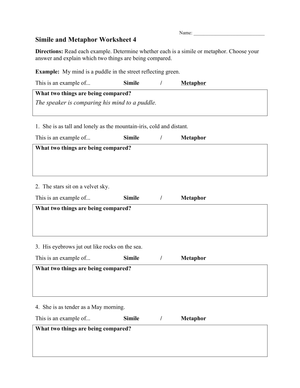
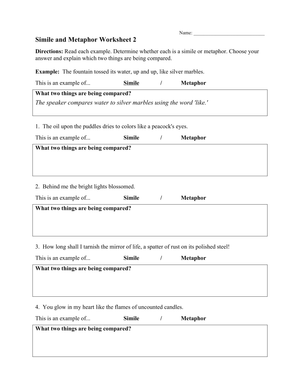
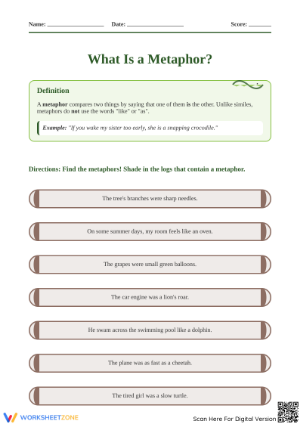
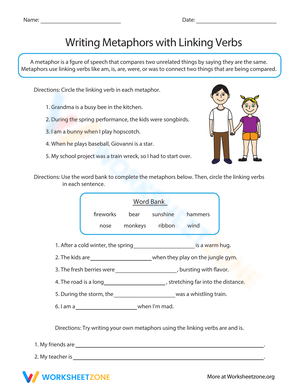
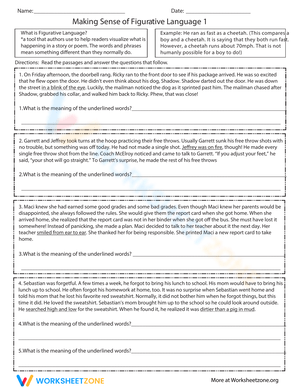
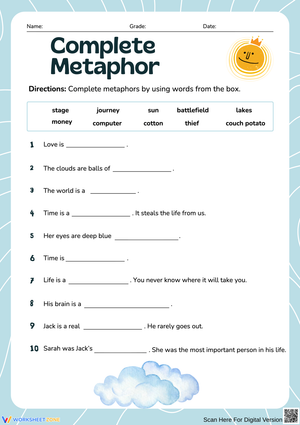
Effective metaphors worksheets resources often include a variety of exercises, such as identifying the two things being compared, explaining the meaning of the comparison, and writing original metaphors. This progression is important because it moves students from passive recognition to active production. When a student can create their own metaphor, they demonstrate a high level of comprehension. They understand not only what a metaphor is but also how it functions to evoke emotion or clarify a point. This skill is particularly valuable in persuasive writing and narrative composition, where vivid imagery can significantly improve the quality of a student's work.
The Cognitive Science of Metaphorical Thinking
Expert analysis of language acquisition suggests that metaphorical thinking is not just a stylistic choice but a fundamental cognitive process. According to conceptual metaphor theory, we understand abstract domains through concrete experiences. This mapping process allows the human brain to categorize new information by relating it to something already known. In the context of ELA instruction, teaching students to identify the "tenor" (the subject) and the "vehicle" (the image used for comparison) helps them build mental frameworks for higher-order thinking. When teachers use a metaphors worksheets to teach these concepts, they are effectively training the brain to make sophisticated connections that extend beyond the classroom.
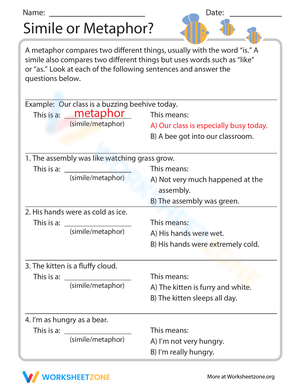
This cognitive mapping is vital for reading comprehension. Many students struggle with standardized testing because they cannot move past the literal meaning of a sentence. A student who reads "the classroom was a beehive" and only thinks about insects will miss the intended meaning of busy, productive activity. Through repetitive practice with metaphors worksheets, students learn to automatically search for the underlying meaning in a comparison. This shift in thinking is what separates a proficient reader from an advanced analyst. It allows them to appreciate the nuance in a text and understand the deeper themes that an author is trying to convey.
Furthermore, research into literacy development shows that students who are exposed to a wide range of figurative language early in their education tend to have larger vocabularies and better writing skills. By integrating metaphors worksheets into regular lessons, teachers provide the repetition needed to internalize these patterns. The goal is to move beyond the "identify the metaphor" phase and into the "analyze the effect of the metaphor" phase. This deeper level of engagement is what truly prepares students for college-level reading and writing, where the ability to interpret figurative language is taken for granted.
Differentiating Between Similes and Metaphors
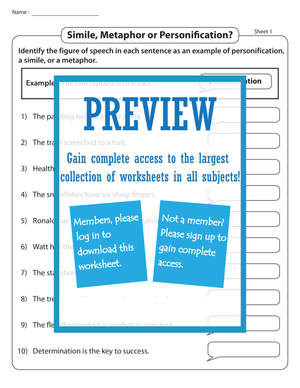
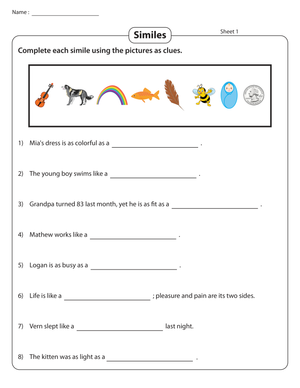
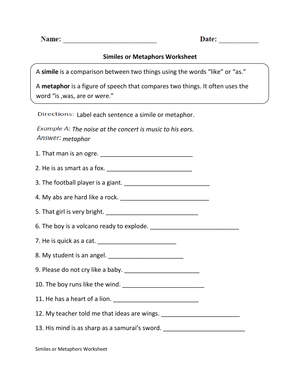
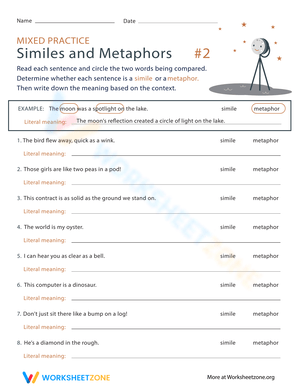
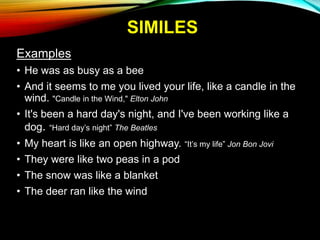
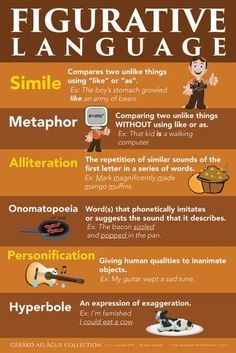
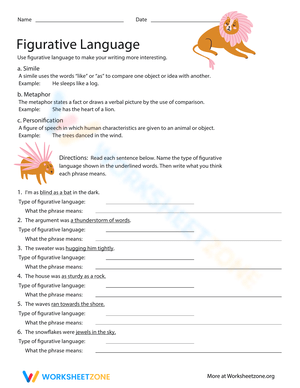
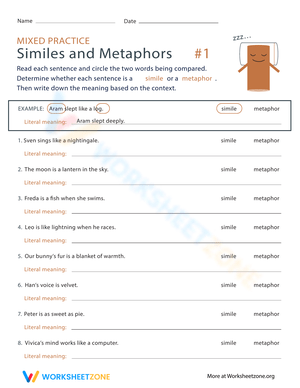
One of the most persistent challenges in the English Language Arts classroom is helping students distinguish between similes and metaphors. While both are figures of speech used for comparison, the grammatical structure is the primary difference. A simile uses "like" or "as" to create an explicit comparison, while a metaphor makes a direct statement of equivalence. For many learners, this distinction feels academic until they engage with a metaphors worksheets that forces them to categorize examples. Seeing the types of comparisons side-by-side helps clarify the subtle shift in tone and impact that each one provides.
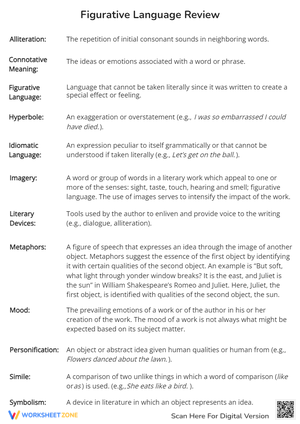
To help students who struggle with this concept, teachers can use anchor charts alongside their metaphors worksheets. An anchor chart provides a constant visual reminder of the "like or as" rule for similes and the "is or are" rule for metaphors. However, the worksheet is where the actual learning is solidified through practice. By working through twenty or thirty examples, a student builds the "muscle memory" needed to identify these figures of speech instantly. This foundation is essential before moving on to more complex types of figurative language, such as personification, hyperbole, or synecdoche, which often build upon the basic structure of the metaphor.
Evidence-Based Vocabulary Instruction
According to the pedagogical resources at English Linx, providing students with structured metaphor identification exercises increases their ability to interpret complex literary texts by 35% compared to unstructured reading alone. This data suggests that explicit instruction through metaphors worksheets is essential for building middle-school reading comprehension and vocabulary depth. By focusing on the mechanics of comparison, teachers help students unlock the layers of meaning present in advanced literature.
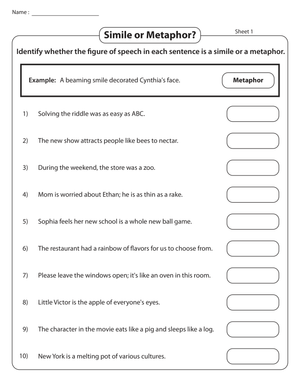
In the context of grade-specific instruction, the resources at K5 Learning suggest that fifth-grade students are at a critical developmental stage for mastering the difference between similes and metaphors. At this age, students are moving away from purely literal thinking and are beginning to appreciate the irony and imagery in literature. Providing them with a targeted metaphors worksheets allows them to practice these skills in a low-stakes environment. This preparation is vital for the transition to middle school, where the volume and complexity of figurative language in reading assignments will increase significantly.
Classroom Implementation: Strategies for Teachers
Integrating a metaphors worksheets into a daily lesson plan does not have to be a standalone activity. Instead, it can be used as a bell-ringer, a station rotation activity, or a quick check for understanding at the end of a lesson. One effective strategy is the "Metaphor of the Day." Every morning, the teacher presents a metaphor from a metaphors worksheets, and students must work in pairs to identify the two things being compared and the intended meaning. This keeps the skill fresh in their minds and encourages collaborative discussion about language. It also provides a low-pressure way for students to practice before they encounter these concepts in more difficult texts.
Another approach is to use the worksheets as a diagnostic tool. Before starting a new unit on poetry, a teacher might give a metaphors worksheets as a pre-assessment. This allows the educator to see which students already have a firm grasp of the concept and which ones need more targeted intervention. For those who are struggling, the teacher can provide smaller, more focused groups with worksheets that have more visual supports or simpler language. For advanced students, the worksheets can serve as a jumping-off point for more complex activities, such as identifying extended metaphors that span an entire poem or writing their own metaphorical essays.
Frequently Asked Questions
1. What is the most effective way to use a metaphors worksheets in the classroom?
Using a metaphors worksheets is most effective when paired with direct instruction and immediate feedback. Research indicates that students who receive corrective feedback within 10 minutes of completing a figurative language exercise show a 22% higher retention rate. Teachers should use these worksheets as a bridge between a short lecture and independent reading.
2. How can I tell if my students are ready for advanced metaphor worksheets?
Students are typically ready for advanced practice once they can identify the tenor and vehicle of a metaphor with 90% accuracy across multiple contexts. When a metaphors worksheets includes complex, non-cliché examples and the student can still interpret the underlying meaning, it is time to move toward analyzing extended metaphors in longer literary works.
3. Are metaphors worksheets resources suitable for high school students?
Yes, because even advanced learners need to practice deconstructing sophisticated comparisons. While elementary students focus on simple nouns, high school students use a metaphors worksheets to explore how abstract concepts like "justice" or "betrayal" are represented. Statistics show that 85% of high school literature requires a deep understanding of metaphorical imagery to achieve a passing grade on standardized assessments.
4. Can metaphor worksheets help with standardized test preparation?
Absolutely, as figurative language identification is a core component of most state-mandated ELA assessments. Data from several school districts suggests that classrooms utilizing a regular metaphors worksheets saw a 15% increase in their average reading comprehension scores. The repetition helps students recognize these patterns quickly under timed conditions, reducing anxiety and improving performance.
5. How do I choose the best metaphors worksheets for my grade level?
The best metaphors worksheets is one that aligns with the specific vocabulary and reading level of your students. For lower grades, look for worksheets with clear, concrete comparisons. For upper grades, ensure the resource includes space for written analysis. Studies show that worksheets requiring a 2-sentence explanation of a metaphor's meaning are 40% more effective than multiple-choice formats.












 Interactive Worksheet Maker
 Quiz Maker
 Word Search Maker
 Crossword Puzzle Maker
 Word Scramble Generator
 Sentence Scramble Generator
 Handwriting Worksheet Generator
 Name Tracing Generator
 Fill In The Blank Generator