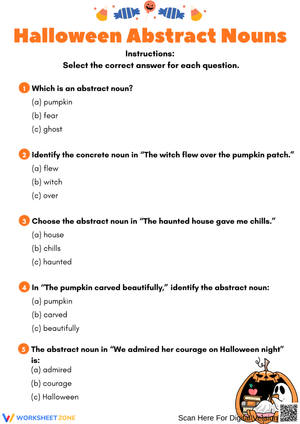
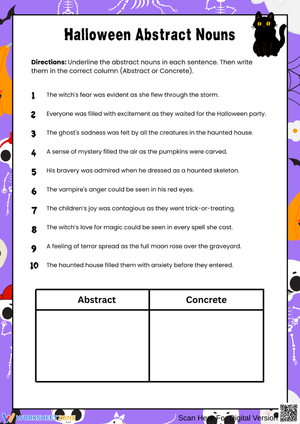
Defining the Intangible: What Are Abstract Nouns?
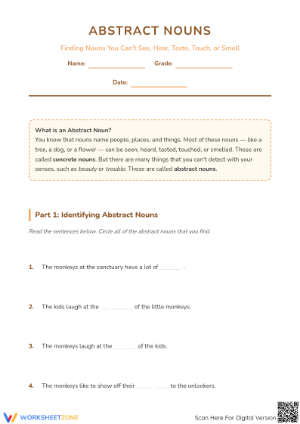
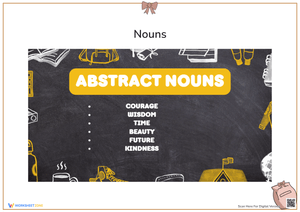
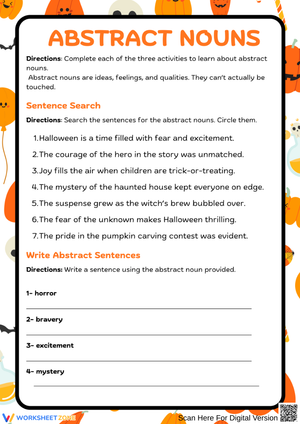
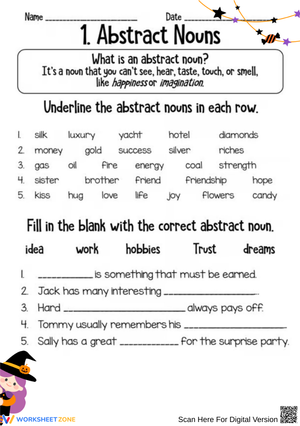
While concrete nouns refer to objects we can touch, see, or smell, abstract nouns represent the invisible forces that shape the human experience. These include emotions like joy and fear, ideas like freedom and justice, qualities like courage and patience, and states of being like peace or childhood. For elementary students, transitioning from identifying concrete objects to understanding these conceptual terms is a significant cognitive leap that requires targeted instructional support.
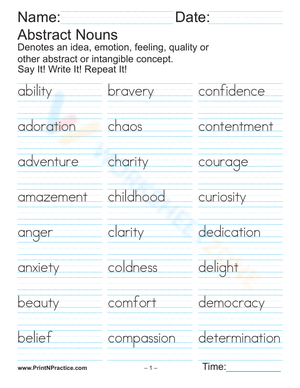
Understanding abstract nouns is a vital step in developing emotional intelligence and critical thinking. When a student learns to identify 'kindness' as a noun, they begin to categorize the world in more sophisticated ways. This shift allows them to engage with literature on a deeper level, as many themes revolve around abstract concepts like bravery or friendship. By providing students with abstract nouns worksheets in PDF format, teachers can offer the structured practice needed to bridge the gap between the physical and the conceptual.
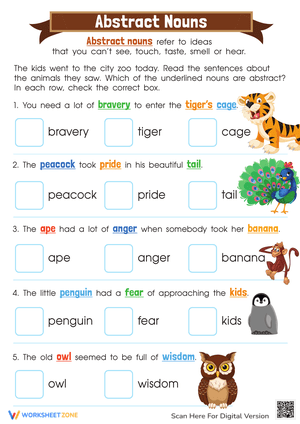
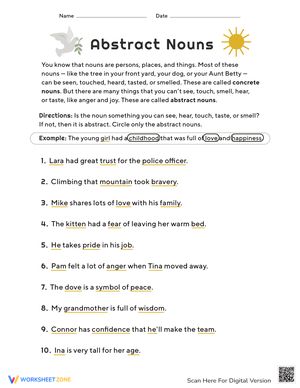
Resources suggest that introducing abstract nouns through relatable scenarios helps students internalize definitions more quickly than through rote memorization. Instruction often begins with the five senses. If you cannot see, hear, touch, taste, or smell it, it is likely an abstract noun. This heuristic helps students categorize words effectively. Teachers must guide students through these areas to build a linguistic foundation that supports future reading and writing success.
Abstract vs. Concrete: Developing Conceptual Clarity
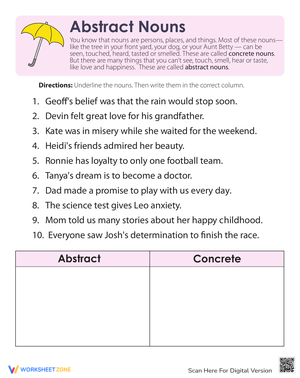
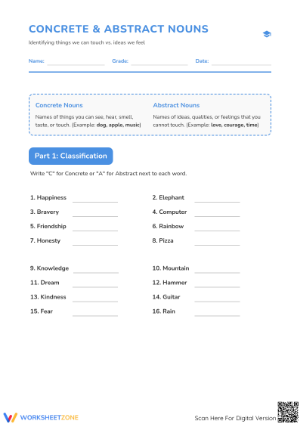
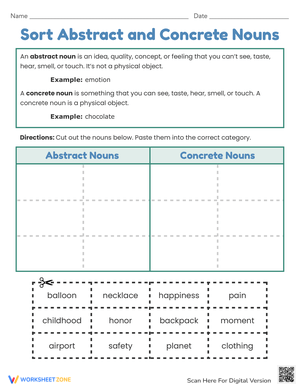
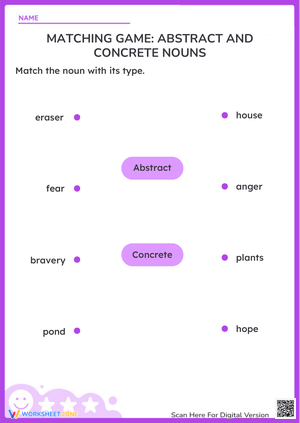
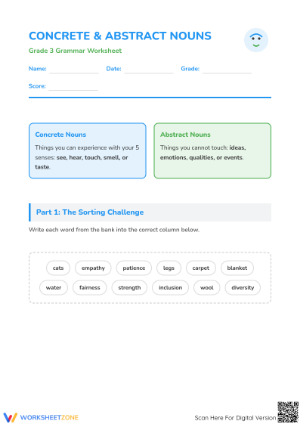
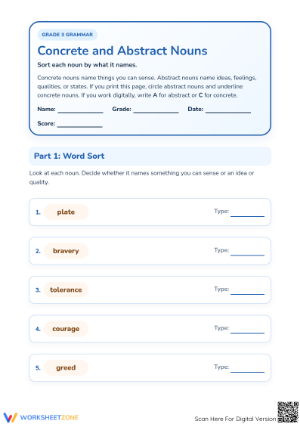
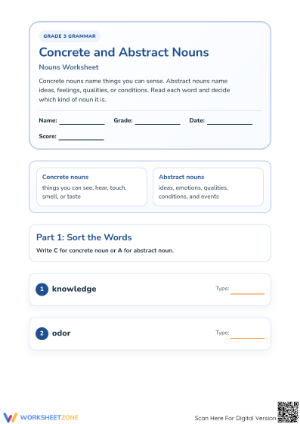
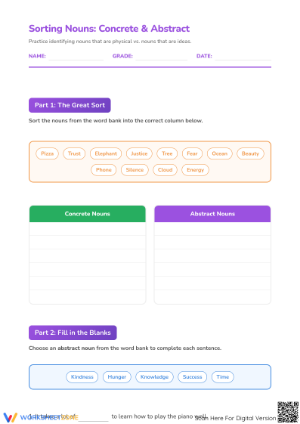
The distinction between abstract and concrete nouns is the cornerstone of early grammar instruction. Concrete nouns are the building blocks of basic sentences—the dog, the ball, the tree. They are easy to visualize and draw. Abstract nouns require a higher level of symbolic thinking. Many teachers use sorting activities where students categorize a list of words into two columns. This visual representation helps solidify the concept that while we can touch a 'book,' we cannot touch the 'knowledge' it contains.
Providing clear examples is helpful for student success. A common classroom activity involves having students identify concrete items and then brainstorming abstract nouns associated with them. For example, a 'pencil' is concrete, but the 'creativity' used to write with it is abstract. A 'trophy' is concrete, but the 'pride' of winning it is abstract. These connections help students see that abstract nouns are deeply connected to the physical world they inhabit every day.
Suffixes and Word Formation: How Abstract Nouns are Built
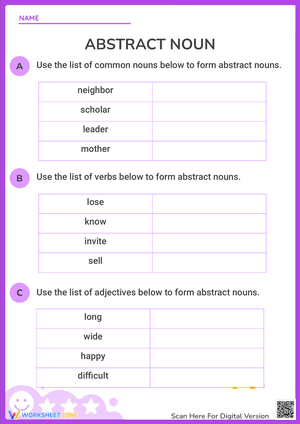
Many abstract nouns are formed by adding specific suffixes to adjectives or verbs. Common suffixes include -ness (kindness), -ion (celebration), -ship (friendship), -ity (curiosity), -ment (excitement), and -ance (importance). By focusing on these word endings, students learn a system for identifying and creating abstract terms. Morphological awareness is a powerful tool for literacy development, helping students understand how the English language functions at a deeper level.
Worksheets that focus on word transformation—asking students to turn 'brave' into 'bravery'—are effective for building this skill. It turns grammar into a logic puzzle, making it more engaging for young learners. Furthermore, teaching suffixes helps with spelling and decoding. When students understand the root word and the suffix, they can break down longer, more intimidating academic words. This approach aligns with modern literacy instruction, which emphasizes the importance of word parts in developing reading fluency.
The Role of Abstract Nouns in Descriptive Writing
As students move into middle and upper elementary grades, writing should become more descriptive and emotionally resonant. Abstract nouns are primary vehicles for expressing themes and character motivations. A story about a child who shows 'perseverance' in the face of 'hardship' is more compelling than a simple list of actions. By mastering these terms, students gain the vocabulary necessary to write more sophisticated narratives and persuasive essays. Teachers often encourage students to 'show, not tell' in their writing, and abstract nouns provide the necessary framework for this reflection.
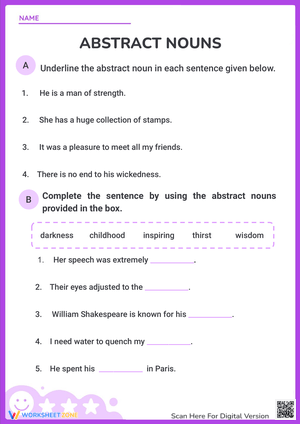
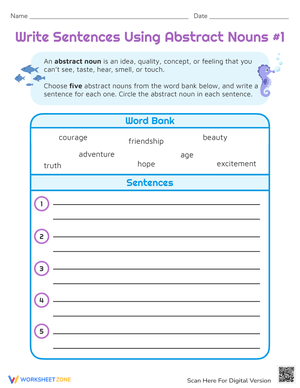
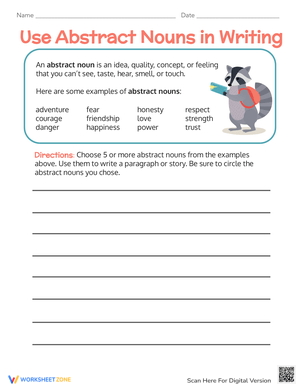
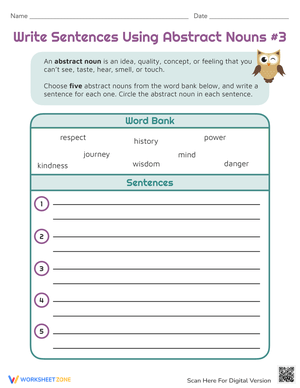
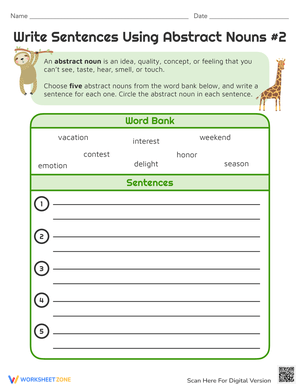
Using worksheets that prompt students to incorporate specific abstract nouns into their writing can yield impressive results. A prompt might ask a student to write about a time they felt 'gratitude.' This requires them to apply the word to their own experiences. This personal connection makes the grammatical concept more meaningful and ensures that the student will remember it. This balance between concrete detail and abstract reflection is the mark of a developing writer who is ready for more advanced academic challenges.
Teacher Tips: Strategies for Teaching Abstract Nouns
Teaching abstract concepts requires a variety of instructional approaches. One successful method is the use of anchor charts that categorize abstract nouns by type: emotions, ideas, qualities, and states. Keeping these charts visible in the classroom provides a reference point for students as they write. Another tip is to use 'Abstract Noun Charades,' where students must act out a concept like 'frustration' without speaking. This forces them to think about the physical manifestations of abstract ideas.
According to K5 Learning, abstract nouns represent ideas, qualities, or conditions that cannot be experienced with the five senses. Their research indicates that mastering these concepts is essential for transitioning from basic literacy to advanced reading comprehension, as approximately 60% of academic vocabulary in higher grades consists of abstract terms. This data point underscores the importance of introducing these concepts early and providing consistent reinforcement through high-quality instructional materials from providers like Worksheetzone.
The Cognitive Value of Mastering Abstract Concepts
The ability to think abstractly is a major milestone in child development. Around the age of seven or eight, children begin to move away from purely concrete thinking and start to grasp complex, invisible ideas. This transition coincides with the introduction of abstract nouns in the grammar curriculum. By teaching these words, teachers are not just teaching parts of speech; they are supporting the development of the brain's ability to handle symbolic thought.
Research into cognitive linguistics suggests that students who struggle with abstract noun identification often find it more difficult to grasp complex social-emotional concepts, as the language needed to label these internal states is missing from their lexicon. This connection between grammar and emotional literacy is why many teachers now integrate abstract noun lessons with social-emotional learning initiatives. When a student can name 'empathy,' they are one step closer to practicing it effectively in their daily lives.
Classroom Implementation: Activities for Every Learner
Implementing abstract noun lessons effectively requires a multi-tiered approach. For students who need extra support, visual aids like 'Abstract Noun Picture Cards' can be helpful. Even though the nouns themselves aren't physical, a picture of two people shaking hands can represent 'agreement' or 'peace.' These visual cues help students connect the abstract word to a concrete situation. Small group instruction is also an ideal setting for diving deeper into these concepts using high-quality PDF worksheets.
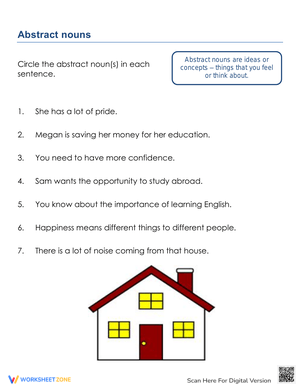
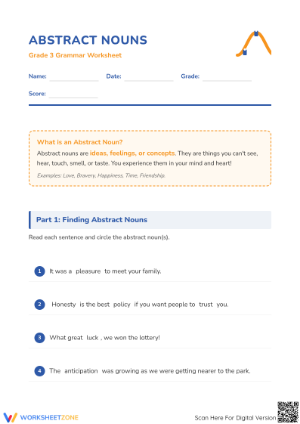
Finally, providing students with a packet of abstract nouns worksheets allows them to work at their own pace and solidify their understanding. These resources are perfect for morning work, homework, or as a fast-finisher activity. By offering a variety of ways to engage with the material, teachers ensure that every student can successfully navigate the world of abstract nouns. High-quality resources from providers like Education.com offer a wide range of printable options that are both pedagogically sound and student-friendly.
1. What is the simplest way to explain abstract nouns to young learners?
The easiest way to explain abstract nouns is to contrast them with concrete nouns. Tell students that concrete nouns are things they can see, hear, smell, taste, or touch (like a dog or a bell). Abstract nouns are things that are real but stay in our minds or hearts, like happiness or an idea. Using the 'five senses test' is the most effective way for beginners to tell the difference.
2. How can students differentiate between an abstract noun and an adjective?
A helpful trick is to use the word in a sentence with 'The' or 'His/Her.' For example, 'brave' is an adjective, but 'bravery' is a noun (The bravery of the soldier was amazing). If you can put 'the' or 'his' in front of it and it makes sense as a thing someone 'has' rather than 'is,' it is usually an abstract noun.
3. Are abstract nouns typically countable or uncountable in English grammar?
Most abstract nouns are uncountable and do not have a plural form. For example, we say 'a lot of courage,' not 'many courages.' However, there are exceptions. Some abstract nouns like 'idea' or 'dream' can be pluralized. Teachers should explain that while many abstract concepts are singular, some can be counted depending on the context.
4. Why are suffixes important when learning about abstract nouns?
Suffixes help students identify abstract nouns instantly. Endings like -ness, -tion, -ment, and -ship almost always signal that a word is an abstract noun. Teaching these suffixes helps students expand their vocabulary by showing them how to change words they already know into new forms like 'happiness' or 'friendship.'
5. At what grade level should teachers introduce abstract nouns?
Abstract nouns are typically introduced in the 2nd or 3rd grade once students have a firm grasp of concrete nouns. Continued reinforcement through the 4th and 5th grades is essential as students encounter more complex academic vocabulary and deeper themes in their reading materials.
6. Can an abstract noun ever be a concrete noun?
Occasionally, a word's category depends on how it is used. For example, 'truth' is usually abstract, but in a phrase like 'the hard truths,' it can feel more defined. Generally, the distinction remains clear, and for elementary contexts, sticking to standard definitions is the best approach for clarity.












 Interactive Worksheet Maker
 Quiz Maker
 Word Search Maker
 Crossword Puzzle Maker
 Word Scramble Generator
 Sentence Scramble Generator
 Handwriting Worksheet Generator
 Name Tracing Generator
 Fill In The Blank Generator