


























Views
Downloads
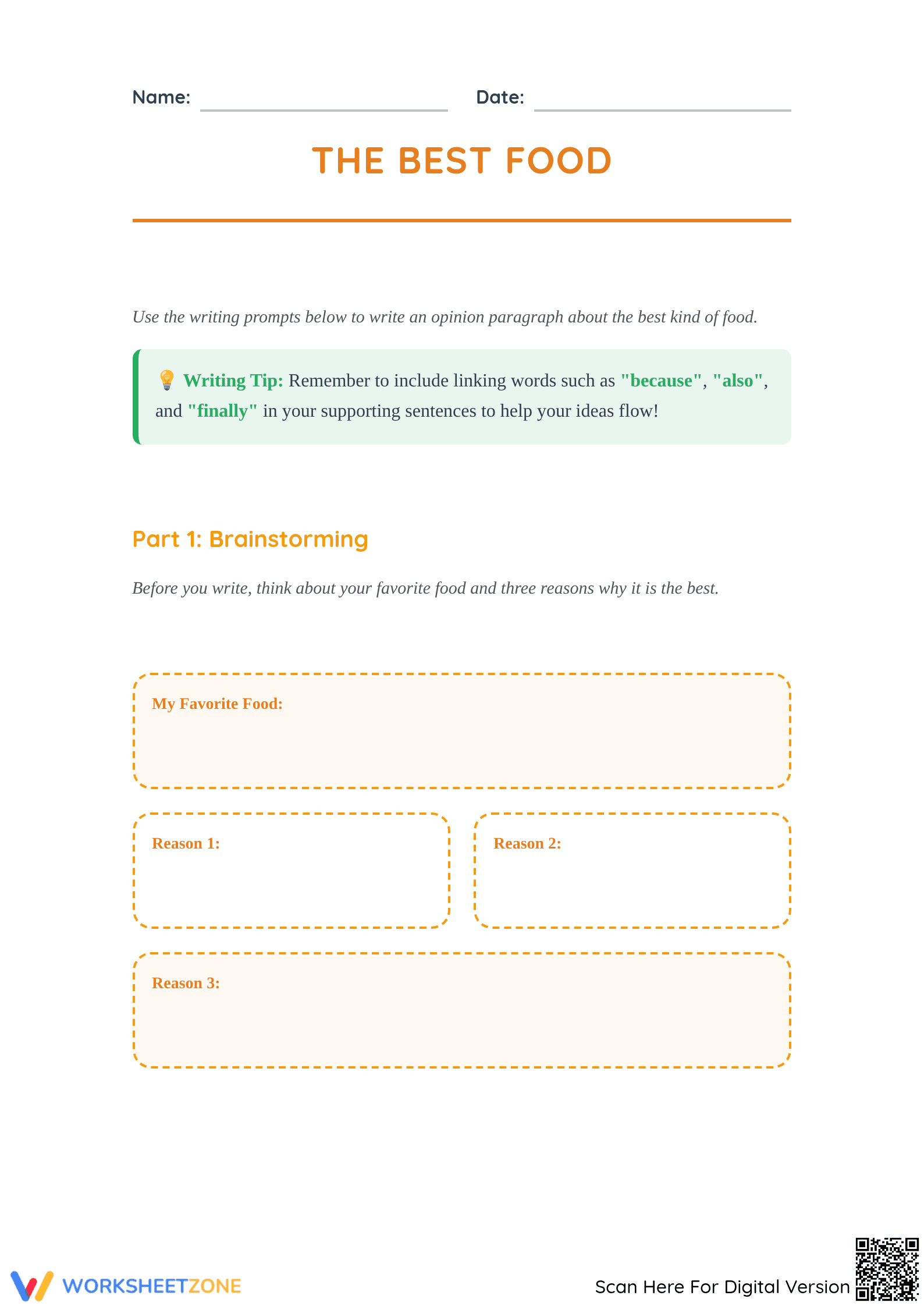


Grade 2 Opinion Writing: The Best Food | Essential
Paste this activity's link or code into your existing LMS (Google Classroom, Canvas, Teams, Schoology, Moodle, etc.).
Students can open and work on the activity right away, with no student login required.
You'll still be able to track student progress and results from your teacher account.
This Grade 2 opinion writing worksheet helps students organize their thoughts to argue for their favorite food. By providing a clear structure for brainstorming and drafting, the resource ensures students meet writing standards while expressing personal preferences. Students will learn to support their claims with three distinct reasons and connect ideas using essential transition words.
At a Glance
- Grade: 2 · Subject: English
- Standard:
CCSS.ELA-LITERACY.W.2.1— Write opinion pieces with supporting reasons and linking words- Skill Focus: Persuasive Paragraph Structure
- Format: 2 pages · 2 tasks · Answer key included · PDF
- Best For: Introductory opinion writing lessons
- Time: 30–45 minutes
The resource consists of two distinct pages designed to guide the writing process. Page one features a dedicated brainstorming area with four labeled boxes for the main topic and three supporting reasons. Page two provides a structured paragraph frame that includes specific prompts for linking words like "because" and "also," along with a designated space for a concluding sentence.
1. Print: Select the two-page PDF and print copies for your class (1 minute).
2. Distribute: Hand out the brainstorming page first to focus student thinking on reasons (1 minute).
3. Review: Use the completed paragraphs for a peer-review session or a "Gallery Walk" (5 minutes). Total teacher prep is under two minutes, making this ideal for sub plans.
This resource is explicitly aligned with CCSS.ELA-LITERACY.W.2.1. This standard requires students to write opinion pieces that introduce a topic, state an opinion, supply reasons, use linking words, and provide a concluding statement. The worksheet also supports foundational paragraph organization. Both standard codes can be copied directly into lesson plans, IEP goals, or district curriculum mapping tools.
Use this worksheet during the independent practice phase of a writing workshop. After a mini-lesson on linking words, have students complete the brainstorming page. Once checked, they move to the drafting page. It also works as a formative assessment to check if students can distinguish between an opinion and a reason. Completion time ranges from 30 to 45 minutes.
This worksheet is designed for second-grade students but is effective for third-grade students needing support or English Language Learners who benefit from sentence frames. It pairs naturally with an anchor chart on transition words. The visual layout helps students who struggle with executive functioning to stay on task.
According to Fisher & Frey (2014), graphic organizers and sentence frames are foundational for developing literacy in early elementary students. This worksheet aligns with evidence-based practices by providing a structured brainstorming phase followed by a scaffolded drafting process. By requiring students to use linking words like "because" and "also," the resource directly addresses the linguistic complexity required by CCSS.ELA-LITERACY.W.2.1. Research indicates that when students are given high-interest topics, such as favorite foods, engagement increases significantly, leading to higher-quality output and better retention of structural writing rules. This resource serves as a practical application of the gradual release of responsibility model, moving students from ideation to independent construction. Educators can rely on this approach to ensure second-grade learners meet rigorous standards while building the confidence necessary for complex argumentative writing in later grades.


