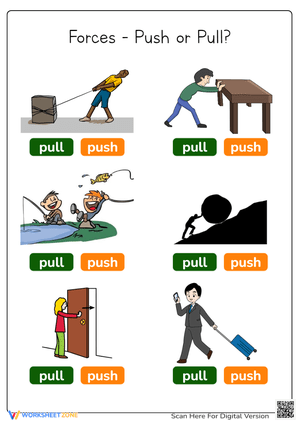
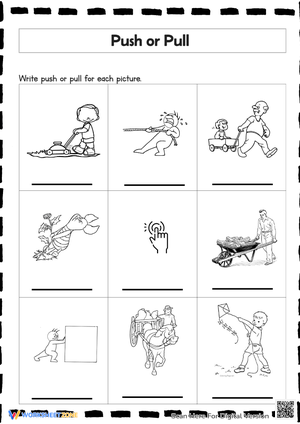
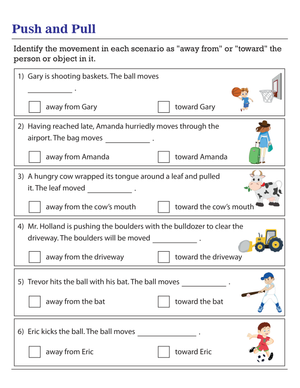
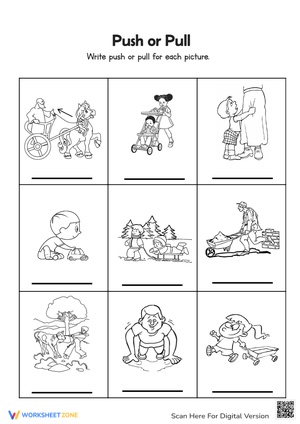
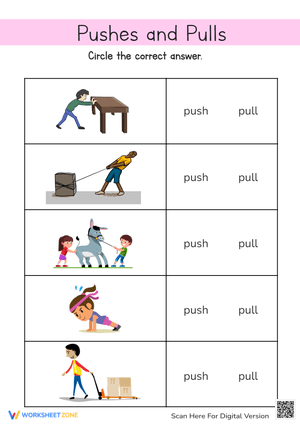
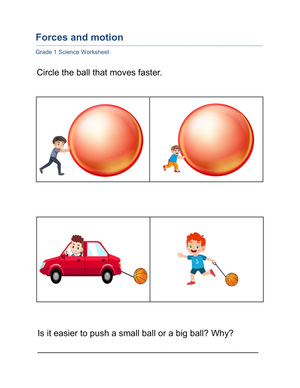
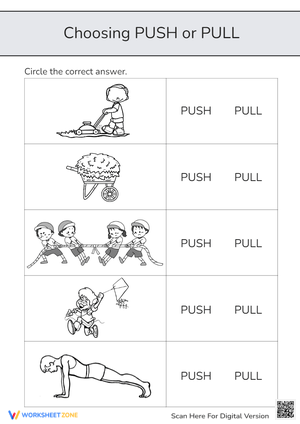
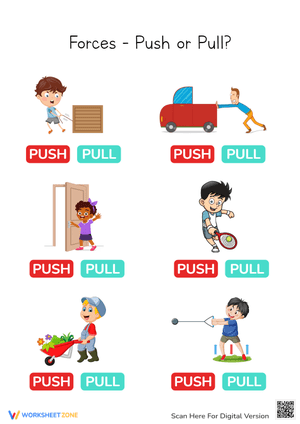
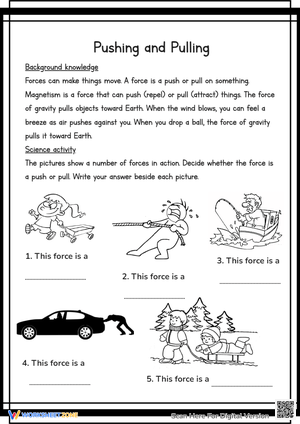
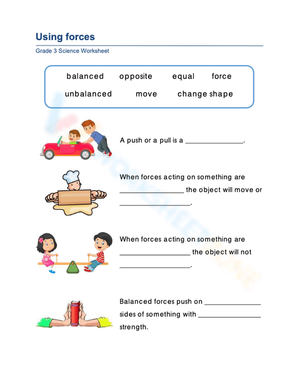
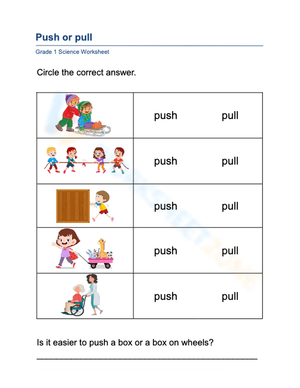
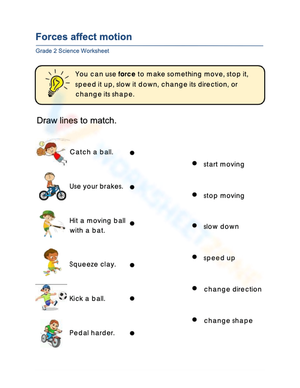
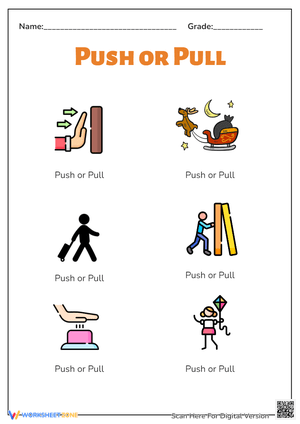
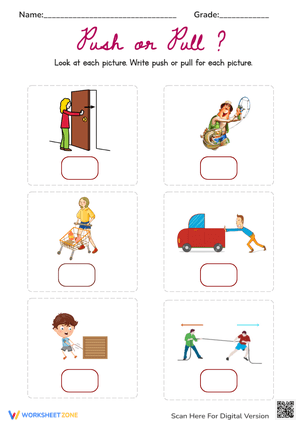
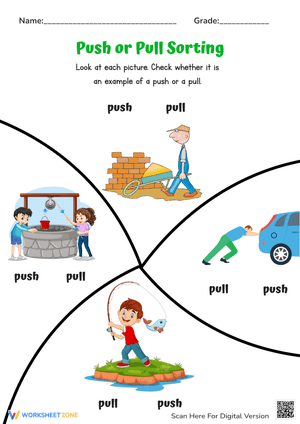
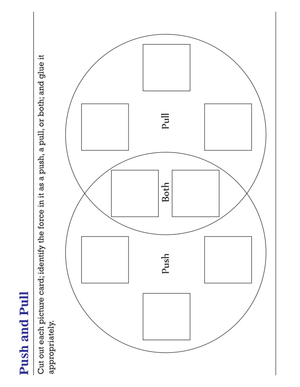
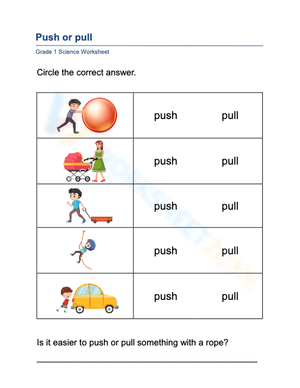
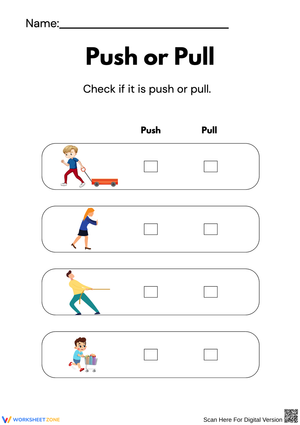
These 1st grade push and pull printable worksheets resources give teachers a direct route into one of first grade's trickiest early-science concepts — not because the idea is abstract, but because students who already know both words from everyday life still frequently reverse them the moment a worksheet image shows an ambiguous action. The set covers force identification, classification, and short written response, using task formats that keep reading demands low while the science thinking stays central.
The Specific Skills These Worksheets Target
Each worksheet isolates a clear task so students spend their cognitive energy on the science, not on decoding directions. Across the set, students work through these distinct skill areas:
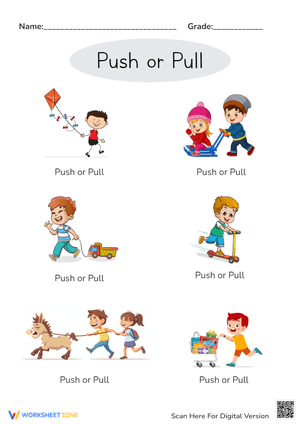
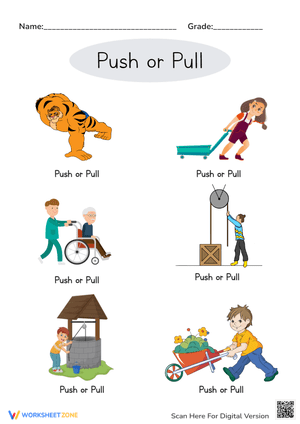
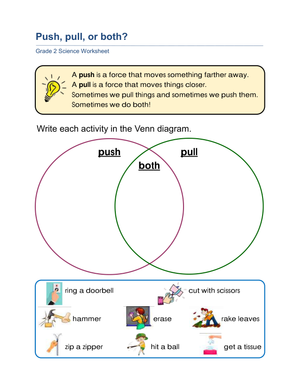
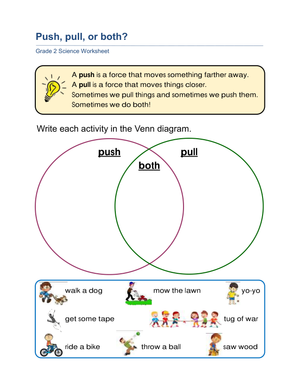
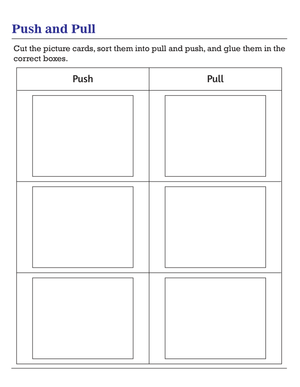
- Sort action images into push and pull categories
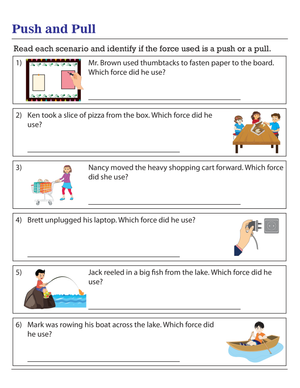
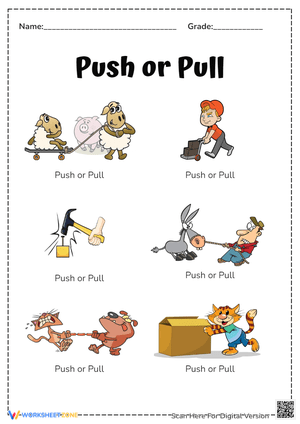
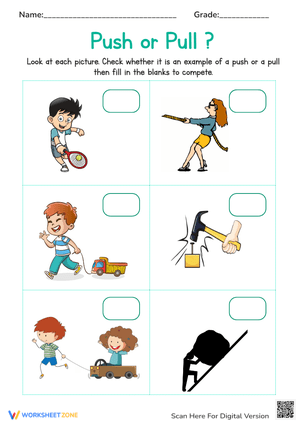
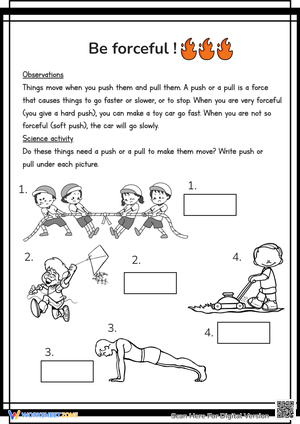
- Circle the correct force label under a single illustrated action
- Match vocabulary words to corresponding pictures
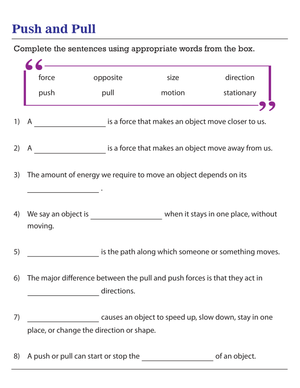
- Complete sentence frames such as I used a ___ to move the box
- Draw original push and pull examples from their own experience
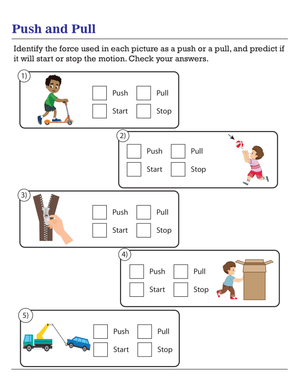
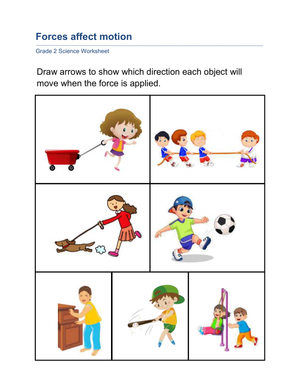
- Identify whether a force starts, stops, or changes the direction of an object's motion
That last skill — connecting force to a specific change in motion — is where 1st grade push and pull printable worksheets sets earn their instructional weight. Identifying labels is one cognitive task; explaining what a push or pull actually does to an object is a measurably harder one, and the stronger worksheets in this category ask students to demonstrate both.
Student Mistakes Worth Anticipating Before You Grade
The most consistent error across completed work is direction confusion on ambiguous images. A student who correctly marks "push" for a child sliding a box across the floor will often mark "push" again for a picture of someone pulling open a desk drawer — because both pictures show hands making contact with an object. The distinguishing factor is whether the object moves toward or away from the person applying the force, and that distinction rarely transfers from vocabulary instruction alone. It needs a physical reference point before the paper task begins.
A second pattern involves rope-and-string images. Students see a rope and write "pull" automatically, even when the image shows someone releasing tension rather than drawing anything closer. When those responses appear on finished worksheets, they signal that the student learned a visual shorthand — rope means pull — rather than the underlying concept of directional force. A quick follow-up conversation, not another worksheet, is usually what closes that gap.
How to Work These Worksheets Into Your Science Block
Five minutes of live demonstration before any printable page produces a measurable gain in response accuracy. Push a book across a table, pull a chair toward you, open the classroom door, stop a rolling ball with your hand. Name each force aloud and ask whether the object moved toward or away from you. That brief embodied reference gives students something concrete to check their answers against during independent work — far more reliable than a written definition printed at the top of the worksheet.
After the demonstration, match the worksheet format to what students just observed. If they watched several different examples in quick succession, a picture sort is the natural follow-up: it mirrors the classification thinking they just did aloud. If the lesson focused on a single action in depth, a circle-the-force page or sentence-frame worksheet keeps the focus tight. Before dismissal, ask two or three retrieval questions without any paper in front of them — What force did you use to get your backpack this morning? What force does someone apply to close a door? That unscripted retrieval loop consolidates the lesson faster than any exit ticket.
For center rotation days, 1st grade push and pull printable worksheets tasks fit cleanly across two or three stations. One station pairs a cut-and-paste sort with a small collection of classroom objects students test by hand before gluing anything down. A second station uses a draw-your-own-example page — students sketch one push and one pull from recess or the hallway. That transfer task is one of the clearest signals a teacher has that the concept has moved beyond rote label matching.
Why Low-Text, Image-Forward Formats Work at This Grade Level
First graders carry a heavy cognitive load: they are simultaneously building reading fluency, developing fine motor control, and acquiring academic vocabulary. A science worksheet that requires dense written directions or lengthy sentences shifts attention away from the science reasoning and toward decoding. The most effective format at this grade keeps text minimal, places picture cues directly at the point of decision, and gives students a physical action — circling, cutting, gluing, drawing — that focuses rather than fragments attention.
The draw-your-own format carries particular diagnostic value that circle-the-answer formats do not. When a student draws "push" as someone intentionally moving an object away and "pull" as someone drawing a wagon closer, the distinction is genuinely internalized. When a student draws "push" as someone falling into an object by accident, that tells you something specific about their understanding of intentional force application — an insight that a multiple-choice layout would never surface.
Adjusting the Set for a Range of First-Grade Learners
For students still building vocabulary, preview the words "push" and "pull" with physical gestures before handing out any worksheet, and pair oral direction-reading with a brief whole-group walkthrough of the first item. Picture-heavy pages with minimal text let these students classify rather than decode. Sentence frames such as I used a ___ to move the ___ provide a structured path to expressing science thinking in writing without the full cognitive cost of composing sentences independently.
Students ready for greater depth extend any worksheet by explaining how the force changed motion — did it start movement, stop it, or change its direction? Asking them to write or dictate two sentences — one naming the force, one describing what the object did — adds analytical weight without requiring a different worksheet entirely. For the highest-achieving students, introduce genuinely ambiguous examples like a sliding door or a drawer on a track, and let them argue which force applies and why. The full instructional value of 1st grade push and pull printable worksheets resources comes out when teachers treat the paper task as a starting point for conversation rather than a final answer.
Standard Alignment
These worksheets align to NGSS K-PS2-1, which asks students to plan and conduct investigations comparing the effects of different pushes and pulls on an object's motion, and K-PS2-2, which focuses on analyzing whether a design solution successfully changes an object's speed or direction. Though coded at the kindergarten band, most state-level frameworks reinforce both standards through first grade — particularly the language expectations around describing what a force does rather than simply naming it. The vocabulary work across the set also addresses CCSS ELA-Literacy.RI.1.4, as students repeatedly use and recognize domain-specific words — force, push, pull, motion, direction — in both receptive and expressive tasks.
Frequently Asked Questions
Do these worksheets work for emergent readers who cannot follow written directions independently?
Yes. The most effective worksheets lead with images rather than text, so students make sorting and labeling decisions based on visual information. Teachers handle directions through a brief whole-group walkthrough before releasing students to work alone, which also reduces the interruptions that slow down independent work time in centers.
In what order should the different worksheet formats be introduced?
Start with picture sort and circle-the-force formats — both require only recognition, asking students to match an action to a label. Move to matching and sentence-frame pages once students are producing consistently accurate responses on the sorting tasks. Reserve draw-your-own pages for after students have seen multiple concrete examples, because drawing from personal experience requires retrieval and transfer, which is a harder cognitive step than selecting from provided images.
How long does a typical worksheet take in a first-grade classroom?
Most worksheets run 8–12 minutes for students working independently, somewhat less when completed as a whole-group guided activity. Cut-and-paste worksheets take a few minutes longer because of the motor demands, but that added time reduces reversal errors — the sorting-and-gluing sequence slows students down enough that they reconsider direction before committing an answer to the page.
Should these worksheets replace hands-on force activities?
No. Worksheets consolidate and surface understanding that hands-on investigation builds first. A student who has pushed toy cars down ramps and pulled bins across the floor arrives at a classification task with direct sensory experience to draw on. Without that prior grounding, even a well-designed printable produces surface-level responses that look correct on paper but do not reflect real understanding of what forces do.