


























Views
Downloads

Grade 1 Push or Pull Science — Essential No-Prep Worksheet
Paste this activity's link or code into your existing LMS (Google Classroom, Canvas, Teams, Schoology, Moodle, etc.).
Students can open and work on the activity right away, with no student login required.
You'll still be able to track student progress and results from your teacher account.
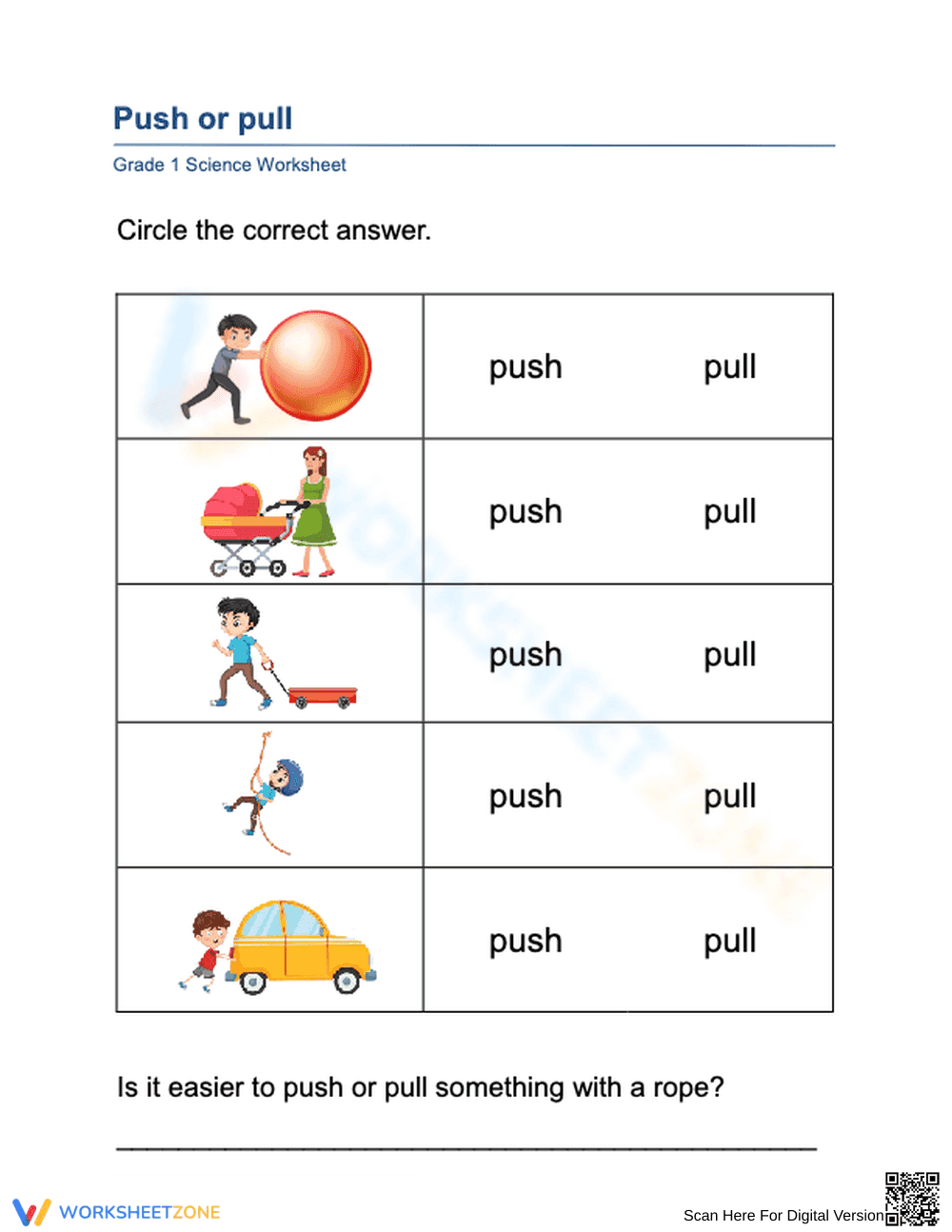
This worksheet helps first graders master fundamental concepts by distinguishing between pushes and pulls. Students observe five distinct real-world scenarios—including pushing a ball and pulling a wagon—to identify force direction. By connecting physical actions to scientific terminology, learners build a strong foundation for future physics studies and mechanical understanding.
At a Glance
- Grade: 1 · Subject: Science
- Standard:
K-PS2-1— Identify and compare the effects of different pushes and pulls on object motion.- Skill Focus: Identifying pushes and pulls in physical actions
- Format: 1 page · 6 problems · Answer key included · PDF
- Best For: Independent practice or quick science review
- Time: 10–15 minutes
The packet contains a single-page student worksheet and an answer key. It features five illustrations depicting common activities: pushing an exercise ball, pushing a carriage, pulling a wagon, climbing a rope, and pushing a toy car. A final open-ended question challenges students to apply their knowledge to a rope-based scenario, encouraging thinking about pulling mechanics and force application.
Zero-Prep Workflow
First, print the single-page worksheet (30 seconds). Second, distribute it to students for individual or small-group completion (10 minutes). Third, review the answers using the provided key (1 minute). This streamlined process ensures that teachers spend less than 2 minutes on preparation, making it an ideal choice for emergency sub plans or quick science reinforcements during busy instructional blocks.
Standards Alignment
This resource aligns with `K-PS2-1`, which requires students to identify and compare the effects of different directions of pushes and pulls on the motion of an object. While primarily a Kindergarten standard, it is frequently utilized in first-grade curricula to reinforce introductory physics concepts and observational skills. Both standard codes can be copied directly into lesson plans, IEP goals, or district curriculum mapping tools.
How to Use It
Introduce this worksheet during a unit on motion to assess students' ability to categorize force directions after a hands-on demonstration. A great formative assessment tip is to observe if students mimic the physical motions shown in the pictures while deciding on their answer. Expected completion time is roughly 12 minutes, making it perfect for a transitional block or as a science lab introduction.
Who It's For
The worksheet is designed for Grade 1 students but is also suitable for Kindergarteners needing an extra challenge. The visual-heavy design makes it accessible for English Language Learners and students with IEP accommodations. It pairs naturally with a hands-on "Push/Pull" scavenger hunt around the classroom or playground area to reinforce the identified concepts.
The K-PS2-1 standard focuses on the foundational science of motion, specifically the binary categorization of force as either a push or a pull. This Grade 1 worksheet provides the structured practice necessary to bridge the gap between physical experience and conceptual labeling. According to Fisher & Frey (2014), using visual representations to anchor scientific vocabulary is a critical step in the gradual release of responsibility, allowing students to move from guided observation to independent application. By analyzing six distinct scenarios, students demonstrate mastery of directional force concepts. The inclusion of a clear answer key supports immediate feedback, which research indicates is vital for retaining early scientific principles. This resource is designed to be a high-impact, low-prep tool that fits into any primary science curriculum focusing on forces, motion, and the physical world.


