


























Views
Downloads

Penguin Life Cycle Printable Worksheet | Grade 3-4
Paste this activity's link or code into your existing LMS (Google Classroom, Canvas, Teams, Schoology, Moodle, etc.).
Students can open and work on the activity right away, with no student login required.
You'll still be able to track student progress and results from your teacher account.
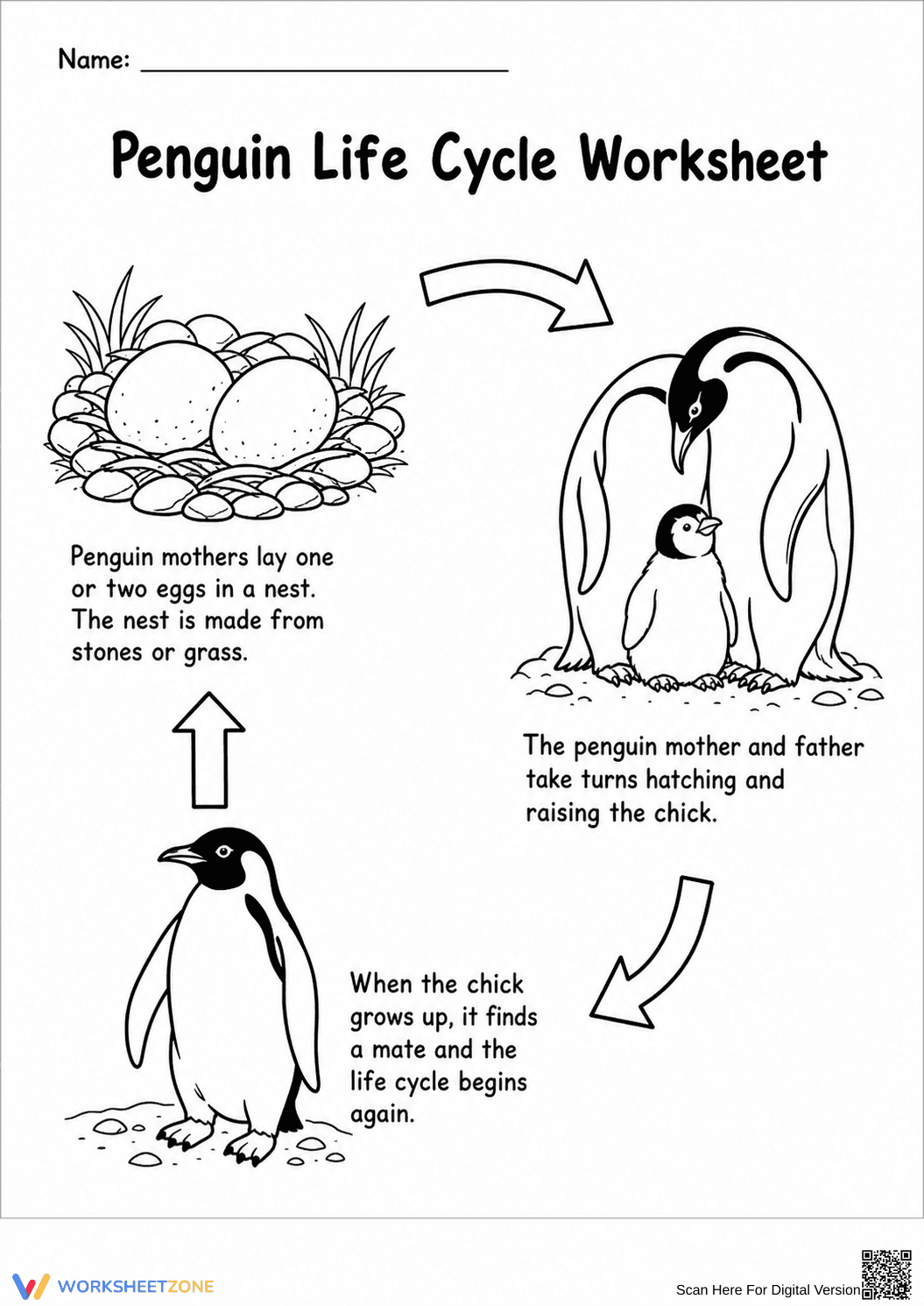
This Grade 3 and 4 science worksheet introduces students to the fascinating penguin life cycle through a clear, visual model. By reading about and observing the three main developmental stages, learners easily grasp how these unique birds grow and reproduce in their natural habitat.
At a Glance
- Grade: 3-4 · Subject: Science
- Standard:
3-LS1-1— Develop models to describe unique organism life cycles- Skill Focus: Penguin Life Cycle Stages
- Format: 1 page · 3 informational blocks · No answer key needed · PDF
- Best For: Introduction to animal life cycles
- Time: 15–20 minutes
This single-page PDF features a circular diagram illustrating the three primary stages of a penguin's life. It includes detailed text descriptions for egg-laying habits, the collaborative role of parents in hatching chicks, and the transition to adulthood and mating. The clear illustrations and concise text make it an ideal reference tool for elementary science notebooks, reading comprehension practice, or classroom displays.
Zero-Prep Workflow
- Print: Generate the required number of copies for your science group in seconds.
- Distribute: Hand out the worksheets during your biology block or as a quick transition activity.
- Review: Discuss the three stages as a whole class to check for understanding before students glue them into their journals. Total teacher prep time is under 2 minutes, making it perfect for sub plans.
Standards Alignment
The primary standard addressed is 3-LS1-1, which requires students to develop models to describe that organisms have unique and diverse life cycles but all have in common birth, growth, reproduction, and death. This worksheet serves as a foundational model for comparing the penguin's life cycle to other animals. Both standard codes can be copied directly into lesson plans, IEP goals, or district curriculum mapping tools.
How to Use It
Use this worksheet during the "Explain" phase of a 5E lesson cycle to provide direct information about avian development before moving into independent research. It also serves as an excellent formative assessment tool; ask students to flip the page over and sketch the cycle from memory. Expect students to spend 15 to 20 minutes reading and discussing the content.
Who It's For
This resource is tailored for third and fourth-grade students studying biology, animal adaptations, or polar habitats. It is particularly effective for visual learners and English Language Learners who benefit from the pairing of simple text and clear imagery. Pair this with a non-fiction text about Antarctica or a video clip of emperor penguins for a comprehensive science lesson.
According to the RAND AIRS 2024 report, high-quality visual models in elementary science significantly improve the retention of biological sequences and life cycle stages. This worksheet aligns with the 3-LS1-1 standard, which focuses on the student's ability to develop models to describe unique organism life cycles. By isolating the penguin life cycle into three distinct, manageable stages, the resource reduces cognitive load while maintaining scientific accuracy. Research emphasizes that instructional frameworks are most effective when supported by clear, static diagrams that students can reference during independent practice. This printable PDF provides that essential anchor, ensuring that third and fourth-grade learners can articulate the specific reproductive and developmental milestones of penguins within a broader ecological context. Utilizing such targeted visual aids fosters deeper comprehension of complex biological concepts in young learners.


