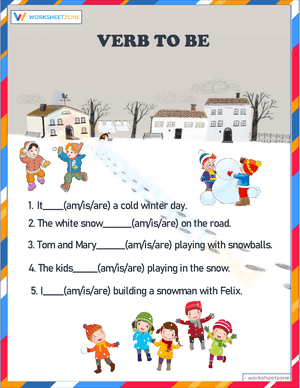
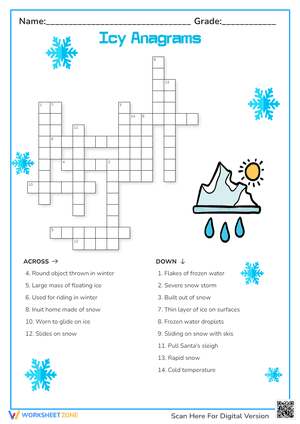
These winter printable worksheets sets give K–5 teachers ready-to-use, skill-focused practice across math, ELA, and science during the months when keeping academic momentum is hardest. Each worksheet pairs a specific learning target with a winter image or context — snowfall data for bar graphs, animal adaptation text for reading comprehension — so the seasonal framing does real instructional work rather than just decorating the page.
Skills Each Worksheet Builds
The math worksheets center on skills that benefit from concrete, visual contexts: counting within 20 using sets of mittens or snowflakes, addition and subtraction embedded in seasonal word problems, and bar graphing built around temperature data or snowfall totals recorded across a week. Students in grades 3–5 encounter elapsed time problems — "the blizzard started at 9:15 a.m. and ended at 2:40 p.m.; how many hours did it last?" — area and perimeter tasks set inside an ice rink, and multi-step problems that require students to organize given information before computing.
ELA worksheets build vocabulary, fluency, and writing in a connected sequence. Tier 2 vocabulary — blizzard, hibernate, migration, frigid, insulation — appears in context sentences and matching tasks rather than isolated definitions, which is the difference between students actually internalizing a word and forgetting it by Friday. Reading comprehension passages run 100–200 words with text-dependent questions that direct students to underline evidence in the text rather than answer from background knowledge. Writing worksheets include structured prompts: some ask for a sequenced narrative, others ask students to state and support an opinion, and several begin with a four-box graphic organizer before the drafting lines start.
The science worksheets cover three intersecting strands. The water cycle — specifically the freeze-and-melt pathway water takes in winter — appears in labeled diagram tasks and short-answer questions. Animal adaptation worksheets ask students to sort behaviors (hibernation, migration, staying active year-round) and then explain why a specific adaptation helps a species survive, not just name it. A third strand covers weather observation: recording daily temperature, identifying cloud types, and reading simple weather maps with standard symbols.
Mistakes These Worksheets Help You Surface
Winter-themed materials introduce one predictable error pattern in math: students attend to the illustration rather than the problem. On a worksheet showing snowmen holding numbered signs, several students will count the total number of snowmen visible on the page rather than read the addition equation. The fix is fast — point to the numbers before students begin and say "the snowmen are just holding the numbers; the problem is here" — but you have to anticipate it, or you spend the last few minutes of the block correcting the same confusion across multiple papers.
In science, students reliably overgeneralize hibernation. After a worksheet on bears and groundhogs, they apply "goes to sleep in winter" to every animal in the next activity — including birds and caribou, which migrate, and rabbits, which remain active in burrows all season. That overgeneralization is diagnostic information worth using: it shows the student grasped one example but has not yet built the categorical distinction. Turning it into a sorting activity the next day ("let's separate these animals into three columns") is more instructive than marking the item wrong and moving on.
Writing prompts with a winter setting produce a third deflection: students treat "write about a snowy day" as permission to retell a personal memory and ignore the actual writing target. If the goal is sensory detail, the prompt has to direct attention there explicitly — "write three sentences; each one must appeal to a different sense" — or the page fills with narrative retelling that never touches the intended skill.
Building These Worksheets Into Your January and February Routine
The transition window between the arrival bell and morning meeting — roughly eight minutes in most elementary schedules — is where these worksheets earn their place. A single math or vocabulary worksheet gives students something to start immediately, keeps the room quiet during attendance, and produces a quick formative data point you can scan before instruction begins. January re-entry after winter break is particularly well-suited to this structure: the low-stakes seasonal format eases students back in before they are ready for new content.
Keep a separate folder specifically for indoor recess days. Stock it with the winter printable worksheets pages that lean toward fun: snow-trail mazes, color-by-number snowflake symmetry activities, and logic puzzles where students identify which animal left each set of tracks. Keeping these apart from the academic stack preserves their novelty — students know the indoor recess folder is not the same as morning work, and that distinction matters for engagement. When an unplanned cold-weather lockdown hits, you distribute the folder without setup or explanation.
During small-group literacy intervention, the reading comprehension worksheets with text-dependent questions are a strong tool. Working through one with four students lets you narrate your thinking aloud — "I'm going back to paragraph two to find the word that describes how the Arctic fox stays warm" — in a way that is easier to model with a short seasonal text than with a full anthology passage.
Matching Each Worksheet to Where Students Actually Are
The range of readiness in a typical classroom is why a well-structured winter printable worksheets set spans multiple difficulty levels within the same seasonal theme. Students who need more support do better with worksheets that include visual anchors: a number line printed at the bottom of a math page, a word bank for fill-in-the-blank vocabulary tasks, diagram labels partially completed. Reducing the problem count from ten to five also matters — some students shut down when they see a full page of items, and a penguin in the corner does not override that response.
Students working above grade level handle harder tasks within the same seasonal context. A bar graph showing snowfall across five cities becomes a multi-step comparison exercise: "How much more did Buffalo receive than Denver over the full week?" A reading passage about penguin colonies becomes a written analysis task where students annotate the text, identify the two main adaptations described, and write a paragraph defending which one they believe is more critical for survival. The seasonal framing stays consistent; the cognitive demand rises without requiring entirely separate thematic materials.
Standard Alignment
The math worksheets align with CCSS operations and algebraic thinking standards — CCSS.MATH.CONTENT.2.OA.A.1 at the lower grades, CCSS.MATH.CONTENT.4.OA.A.3 for multi-step problem work in grades 3–5 — and with the measurement and data strand that requires students to represent and interpret data in bar graphs and line plots. In classroom terms, these winter printable worksheets resources sit in the practice-and-consolidation phase of a unit, not the introduction phase. Teachers typically deploy them after the core concept has been taught, using the seasonal context to extend practice without the flatness of a generic drill sheet.
ELA worksheets address CCSS.ELA-LITERACY.RI standards for informational reading at each grade band, specifically the anchor standards for citing textual evidence and determining central ideas. Vocabulary worksheets align with CCSS.ELA-LITERACY.L.3.4 and adjacent standards for using context clues and word relationships. The animal adaptation and water cycle content connects to NGSS life and earth sciences performance expectations — particularly 2-LS4-1 and 3-LS4-3 — which ask students to use evidence to explain how organisms respond to environmental conditions.
Frequently Asked Questions
What grade levels do these worksheets cover?
The set spans kindergarten through grade 5. Kindergarten and first-grade worksheets address number sense within 10–20, letter recognition, and basic vocabulary matching. Grades 2–3 work with word problems, short informational passages, and labeled science diagrams. Grades 4–5 worksheets include multi-step math, longer texts with analytical questions, and extended writing tasks. Each worksheet in the set is labeled with its target grade range, so sorting before distributing takes under a minute.
Are these practice tools or assessments?
These are practice tools. The seasonal context and familiar format lower student anxiety, which often produces more honest formative data than a cold-format quiz — students show you what they actually know rather than shutting down. If you want a summative grade, use a completed worksheet as portfolio evidence or a conferencing anchor rather than a standalone test score.
Will parents understand that the winter theme is not replacing the curriculum?
A brief note in the header — "This week we are practicing two-digit subtraction; the winter theme is a seasonal context" — eliminates the most common parent misread. Parents who see a snowman on a math page sometimes assume the work is decorative rather than academic. One sentence of framing removes that confusion before it reaches you as a question at afternoon pickup.















 Interactive Worksheet Maker
 Quiz Maker
 Word Search Maker
 Crossword Puzzle Maker
 Word Scramble Generator
 Sentence Scramble Generator
 Handwriting Worksheet Generator
 Name Tracing Generator
 Fill In The Blank Generator