


























Views
Downloads

Essential Grade 2 Blends Worksheet: Phonics in Context
Paste this activity's link or code into your existing LMS (Google Classroom, Canvas, Teams, Schoology, Moodle, etc.).
Students can open and work on the activity right away, with no student login required.
You'll still be able to track student progress and results from your teacher account.
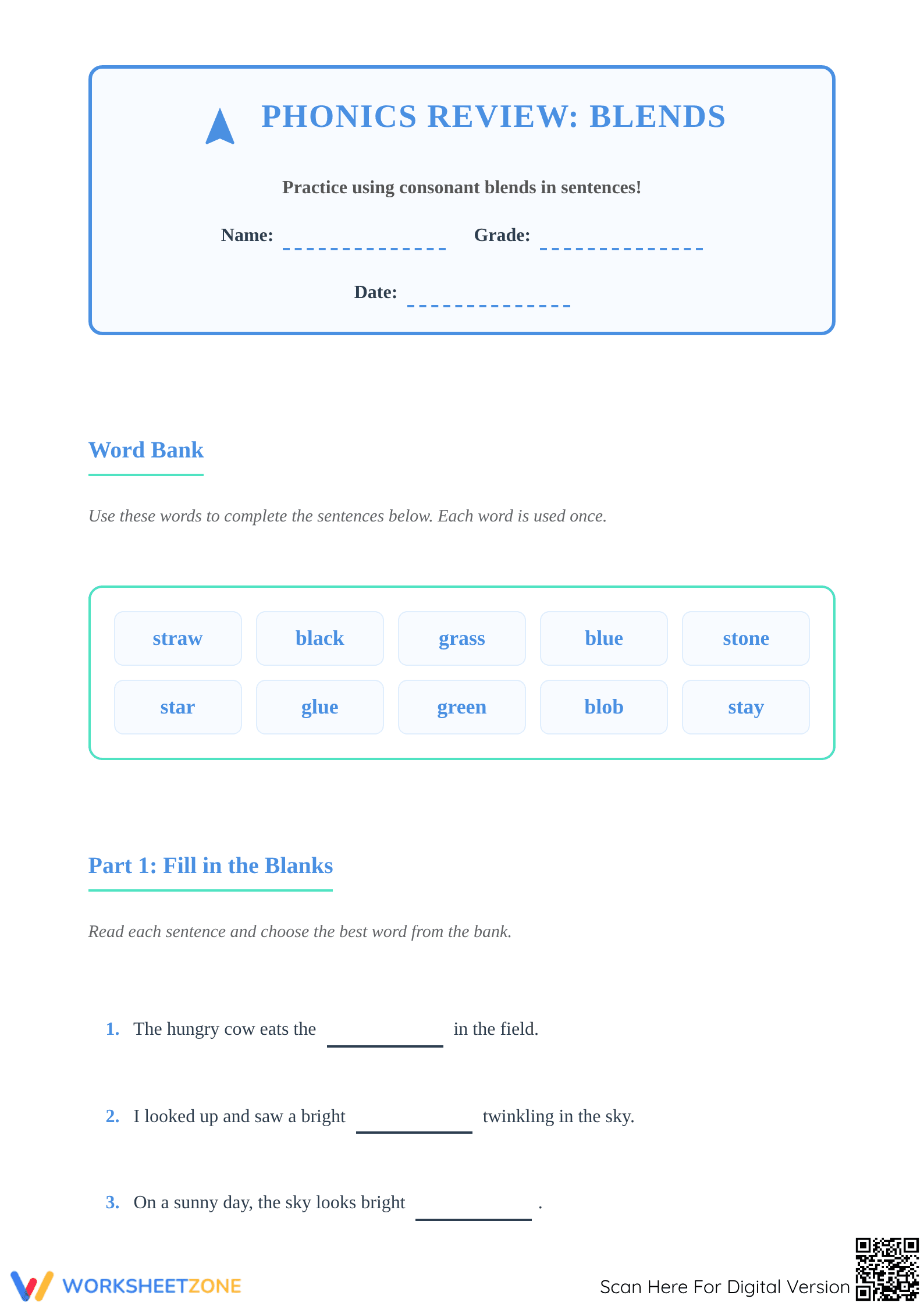
Phonics mastery in second grade requires moving from isolated sounds to fluid application in sentences. This worksheet provides structured practice with consonant blends, helping students recognize and use words like 'straw', 'grass', and 'stone' in context. By bridging decoding and comprehension, students build the fluency needed for advanced reading success.
At a Glance
- Grade: 2 · Subject: English Language Arts
- Standard:
CCSS.ELA-LITERACY.RF.2.3— Know and apply grade-level phonics and word analysis skills in decoding words- Skill Focus: Consonant Blends (L, R, S blends)
- Format: 3 pages · 15 problems · Answer key included · PDF
- Best For: Independent practice and phonics reinforcement
- Time: 15–20 minutes
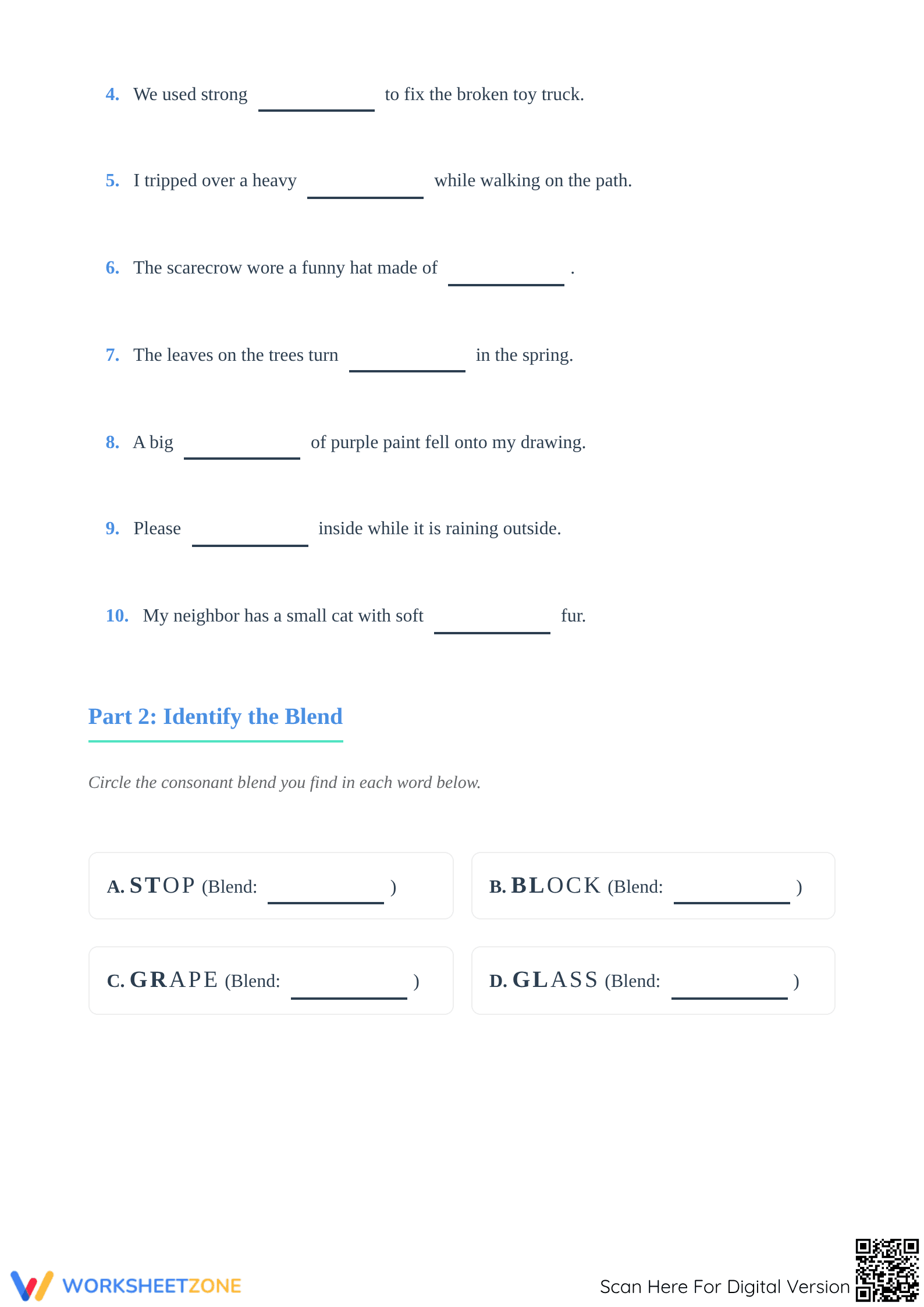
This comprehensive three-page PDF features 15 distinct tasks designed for second-grade learners. It includes a 10-word bank focusing on common consonant blends, 10 context-heavy fill-in-the-blank sentences, 4 identification tasks where students isolate specific blends in words like 'STOP' and 'GRAPE', and a creative writing section for independent application. A full answer key ensures easy grading and immediate feedback for the teacher.
This resource is designed for immediate classroom deployment with a total prep time of under 2 minutes. Step 1: Print the three-page set for your class (30 seconds). Step 2: Distribute to students for independent work or literacy centers (30 seconds). Step 3: Use the provided answer key for rapid whole-class review or individual feedback (60 seconds). It is an ideal "sub plan" or morning work solution that requires zero teacher setup beyond simple printing.
This worksheet aligns primarily with CCSS.ELA-LITERACY.RF.2.3, requiring students to know and apply grade-level phonics and word analysis skills in decoding words. By focusing on blends in context, it also supports CCSS.ELA-LITERACY.L.2.2, which emphasizes command of the conventions of standard English spelling. Both standard codes can be copied directly into lesson plans, IEP goals, or district curriculum mapping tools to track student progress throughout the school year.
Use this worksheet as a formative assessment after a direct instruction lesson on consonant blends. Observe whether students can select the semantically correct word from the bank, which indicates both phonics proficiency and reading comprehension. It also serves as an excellent homework assignment or center activity for literacy rotations. Expect students to complete the full set in 15 to 20 minutes depending on their current reading level and vocabulary familiarity.
This resource is perfect for second-grade students practicing phonics, as well as first-grade students ready for extension or third-grade students needing remedial support. It pairs naturally with an anchor chart on common blends or a shared reading passage that features descriptive vocabulary. The structured layout ensures that students stay focused on the task without being overwhelmed by cluttered graphics or complex instructions.
Mastering consonant blends is a critical milestone in the "Learning to Read" phase of primary education. According to the RAND AIRS 2024 report on literacy foundations, students who demonstrate automaticity with complex phonics patterns like blends show significantly higher fluency rates in late elementary grades. This worksheet targets CCSS.ELA-LITERACY.RF.2.3, providing the specific, repetitive practice necessary to move from laborious decoding to automatic word recognition. By placing these blends within context sentences, the activity ensures that phonics instruction is not isolated but integrated into meaningful reading experiences. This approach aligns with the ScienceDirect TpT Analysis of high-impact instructional materials, which emphasizes the value of multimodal phonics practice—identification, contextual application, and independent generation—to solidify orthographic mapping in young learners. Teachers can use the 15 included tasks as a reliable measure of student progress toward grade-level reading benchmarks.


