


























Views
Downloads

Grade 3 Chicken Life Cycle — Printable No-Prep Worksheet
Paste this activity's link or code into your existing LMS (Google Classroom, Canvas, Teams, Schoology, Moodle, etc.).
Students can open and work on the activity right away, with no student login required.
You'll still be able to track student progress and results from your teacher account.
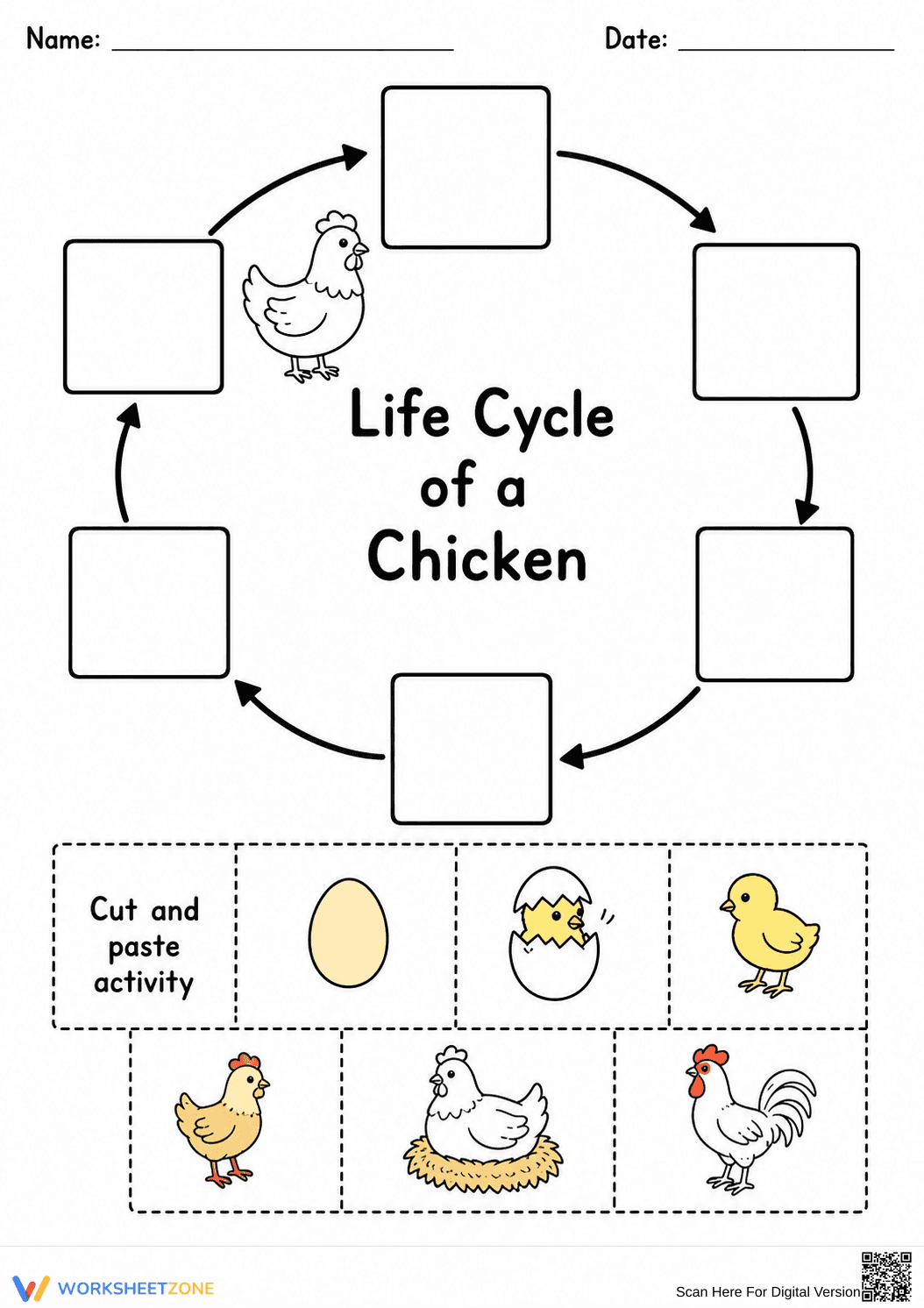
This hands-on science worksheet helps students sequence the stages of a chicken's development through an engaging cut-and-paste activity. By physically moving the images into the correct circular flow, young learners build a concrete understanding of biological growth, reproduction, and continuous life cycles.
At a Glance
- Grade: 3 · Subject: Science
- Standard:
3-LS1-1— Develop models to describe organism life cycles- Skill Focus: Sequencing biological life cycles
- Format: 1 page · 6 tasks · No answer key · PDF
- Best For: Independent practice and science centers
- Time: 15–20 minutes
What's Inside
This single-page resource features a clear, circular diagram with six blank boxes representing the continuous stages of a chicken's life. At the bottom, students find a dashed cut-out section containing six illustrations: an egg, a hen on a nest, a hatching egg, a baby chick, a growing chicken, and an adult rooster. The visual design minimizes reading barriers, allowing students to focus entirely on the scientific sequencing task.
Zero-Prep Workflow
This worksheet is designed for immediate classroom implementation with a streamlined workflow:
- Print (1 minute): Generate copies directly from the PDF file. No special formatting is required.
- Distribute (1 minute): Hand out the sheets along with scissors and glue sticks.
- Review (3 minutes): Quickly check student work visually as they paste the final pieces.
With under two minutes of total teacher prep time, this activity is an excellent addition to emergency sub plans or busy science blocks.
Standards Alignment
This activity aligns directly with primary standard 3-LS1-1: Develop models to describe that organisms have unique and diverse life cycles but all have in common birth, growth, reproduction, and death. Both standard codes can be copied directly into lesson plans, IEP goals, or district curriculum mapping tools.
How to Use It
Teachers can deploy this resource effectively during a dedicated life sciences unit. It works beautifully as an independent center activity after a whole-class reading about farm animals or oviparous creatures. Alternatively, use it as a formative assessment to check if students can accurately order the developmental stages. Observe whether they correctly place the hatching egg before the chick for immediate insight into their logical sequencing skills. Expect completion within 15 to 20 minutes.
Who It's For
This resource is ideal for second and third-grade general education students, as well as homeschool learners studying basic biology. The heavy reliance on visual cues makes it highly accessible for English Language Learners. Pair this cut-and-paste activity with an anchor chart showing various animal life cycles to reinforce the concept.
Understanding biological progression is a foundational element of early elementary science education. When students engage with standard 3-LS1-1 to develop models to describe organism life cycles, they build essential cognitive frameworks for later biological studies. According to a ScienceDirect TpT Analysis, hands-on manipulative tasks like cut-and-paste sequencing significantly improve retention of scientific conceptual models and vocabulary compared to passive reading alone. By physically moving the stages of a chicken's development into a continuous loop, learners internalize the cyclical nature of birth, growth, reproduction, and death. This tactile approach bridges the gap between abstract scientific concepts and concrete understanding, ensuring young learners can accurately visualize and explain how living things change over time. Incorporating these interactive models into daily instruction supports long-term academic success in the sciences.


