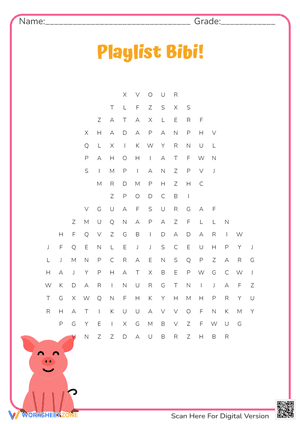
For high schoolers word search sets address a specific scheduling problem that secondary teachers encounter regularly: the gap minutes — between finishing discussion and dismissal, or after a timed assessment, or during the long Friday block — when students need something content-adjacent but not cognitively demanding. These worksheets use 20x20 or larger grids with backward and diagonal word placements, pull word banks from AP-level glossaries and high-frequency standardized test vocabulary lists, and include optional extension prompts that move students from letter recognition into active usage. What arrives in the PDF is not a filler activity dressed up as instruction — it is repeated orthographic exposure to the exact terminology students will encounter in primary sources, lab reports, and test passages.
Why Word Searches Hold Up in Grades 9–12
The skepticism about using word searches with older students is understandable — a 10x10 grid of animal names belongs in second grade. But the underlying mechanism, spaced retrieval of unfamiliar terms, does not become less valuable as students age. When a junior locates endoplasmic reticulum in a dense grid, she processes the full 21-letter sequence, loses it, and finds it again. That rediscovery reinforces the orthographic pattern in working memory. A biology student who hesitates on that term in a primary text loses comprehension momentum at exactly the wrong moment; a word search used in the days before the reading removes that hesitation before it becomes a comprehension problem.
The extension task is where the instructional return concentrates. After completing the search, students who are required to write one sentence per word — using each term the way a textbook would — cross the line from visual recognition into production. Several worksheets in the set include that writing prompt directly on the page, which removes the need for teachers to design a follow-up task separately.
Subjects and Word Banks Across the Set
The collection spans core secondary disciplines. Subject coverage includes:
- Life and physical sciences — mitosis stage names, organelle vocabulary, chemistry element nomenclature, biome classifications
- History and civics — constitutional law terminology, Reconstruction-era legislative vocabulary, Cold War geopolitical language
- English language arts — rhetorical devices, narrative structure terms, character and thematic vocabulary from commonly assigned novels
- Standardized test preparation — high-frequency SAT and ACT academic vocabulary drawn from Tier 3 word lists that appear across multiple question types
Grid difficulty is not uniform across the set. Some worksheets restrict placement to horizontal and vertical orientations, which suits students working through a heavy vocabulary load or those new to the format. Others use the full eight-direction search with true diagonals and reversals — a level of visual complexity that makes the task genuinely demanding for seniors who are accustomed to rigorous analytical work.
Building These Worksheets Into Your Lesson Plans Without Losing Instructional Time
The strongest placement is as a bell ringer. The strongest placement for a for high schoolers word search activity is at the start of class, before direct instruction begins. Set the worksheet on desks before students arrive. Most will begin independently, which quiets the room without any classroom management intervention. The vocabulary they scan during those first three to five minutes functions as an advance organizer — a retrieval practice warm-up that primes recall for the lesson that follows. This is a straightforward application of the testing effect: low-stakes retrieval before instruction measurably improves retention of the subsequent content.
A second high-value placement is the period immediately after a major assessment. After two hours of AP exam multiple-choice, students cannot productively absorb new material, but an unstructured period invites behavioral problems. A subject-relevant word search occupies attention without adding performance pressure to students who are already depleted. Teachers running block schedules find this particularly useful during long Friday afternoon periods — the final 30 minutes are rarely productive for new material, and a content-aligned puzzle keeps students working rather than drifting.
For early finishers, maintain a folder of word searches organized by current unit topic. Students who complete assigned work ahead of peers pull a worksheet independently. The task is quiet, self-directed, and content-adjacent — which makes it defensible instructionally rather than a management placeholder.
Patterns in Student Work Worth Watching and Correcting
The most common problem is false completion. A student searching for photosynthesis will sometimes circle photo and count it found. This is not carelessness — it is pattern-matching behavior that accelerates under task pressure. Periodic spot checks during the activity catch this quickly, and one visible correction in front of the class usually resolves the behavior without further follow-up.
A second pattern surfaces with ELL students at intermediate proficiency: visual confusion between letters with similar shapes — b/d, p/q, n/u — when scanning diagonals. This is not a reading disability indicator. It reflects the normal demands of operating in a second orthographic system, and it identifies which students need a brief orientation to the grid structure before working independently.
With advanced students, the problem runs the other direction: they finish in under three minutes and disengage. The practical solution is a non-negotiable extension requirement. For students who move through the grid quickly, the sentence-writing task is the assignment — not the bonus. Making that expectation explicit in the instructions before students begin eliminates most early-finish disengagement without requiring a separate differentiated worksheet.
Adjusting These Worksheets for a Range of Learners
For students reading significantly below grade level or receiving instructional support, select grids that limit word placement to horizontal and vertical directions. The vocabulary exposure is identical to what peers receive; only the visual complexity of the search drops. This makes it practical to run one word search activity across a mixed-ability class without visibly sorting students into different materials — a small but real benefit in secondary classrooms where students are acutely aware of ability tracking.
For AP-enrolled and high-achieving students, the most effective routine pairs for high schoolers word search with a vocabulary journal maintained across the unit. After locating all the words, students enter each term in the journal with a self-generated definition and one original sentence drawn from the current unit's content. That sequence — visual location, written definition, applied sentence — addresses multiple vocabulary acquisition pathways in a single 15-minute session and builds retention that outpaces flashcard review alone.
English language learners at the secondary level carry a specific burden: they are simultaneously acquiring conversational English and domain-specific academic language in every class period. A word search that isolates the written form of a term — asking students to locate mitochondria visually before they are asked to define or use it — builds orthographic confidence without the immediate cognitive weight of comprehension demands. Two minutes spent reading the word list aloud as a class before releasing students to work independently consistently reduces questions during the search itself.
Standard Alignment
These worksheets align directly with CCSS.ELA-Literacy.L.9-10.6 and CCSS.ELA-Literacy.L.11-12.6, which require students to acquire and accurately use general academic and domain-specific vocabulary appropriate to the grade level and discipline. In classroom terms, this standard surfaces most practically in content-area reading — students need to move through dense primary and secondary sources without stopping at unfamiliar terminology. A subject-specific word search used in the two to three days before a unit's anchor text introduces critical vocabulary in a low-demand context, making the subsequent definition lesson faster and the reading itself more fluent. The activity functions as the first exposure in a multi-step vocabulary sequence, not a replacement for explicit instruction but a more efficient entry point than asking students to encounter the words cold inside a college-level passage.
Frequently Asked Questions
Are these worksheets appropriate for AP and honors-level courses?
Yes. Students in AP courses benefit from the same orthographic exposure to technical vocabulary as any other student — the acquisition mechanism is identical regardless of course level. The key adjustment is treating the extension task as mandatory rather than optional, so the activity remains substantive for students who move through the grid quickly. For honors classes, select grids with the full eight-directional format and word banks drawn from the relevant AP exam glossary.
Can I assign these digitally on Chromebooks or tablets?
The PDF format uploads cleanly to Google Classroom, Canvas, and Schoology. Students complete each worksheet digitally using annotation or drawing tools in Google Drive's PDF viewer or any PDF reader installed on school devices. For digital submission, asking students to highlight found words rather than cross them out makes teacher review significantly faster and keeps the grid legible for self-checking.
How do I justify using this format during an instructional period if an administrator asks?
Document the vocabulary standard being targeted and note that the word bank maps directly to current unit content. In the lesson plan, list the activity under vocabulary pre-teaching or retrieval practice rather than enrichment or free choice. A for high schoolers word search set built around a biology unit glossary or an SAT Tier 3 word bank is straightforward to defend — the word list on the page is the evidence of content alignment, and the research supporting low-stakes retrieval practice as a vocabulary acquisition strategy is well established.
Do the worksheets include answer keys?
Each worksheet comes with a corresponding answer key showing the location and orientation of every hidden word. This supports self-checking during independent work, partner verification in paired activities, and fast teacher review when the worksheet is graded on completion rather than accuracy — which is the appropriate grading approach for a bell-ringer or brain-break context.















 Interactive Worksheet Maker
 Quiz Maker
 Word Search Maker
 Crossword Puzzle Maker
 Word Scramble Generator
 Sentence Scramble Generator
 Handwriting Worksheet Generator
 Name Tracing Generator
 Fill In The Blank Generator