




























Views
Downloads
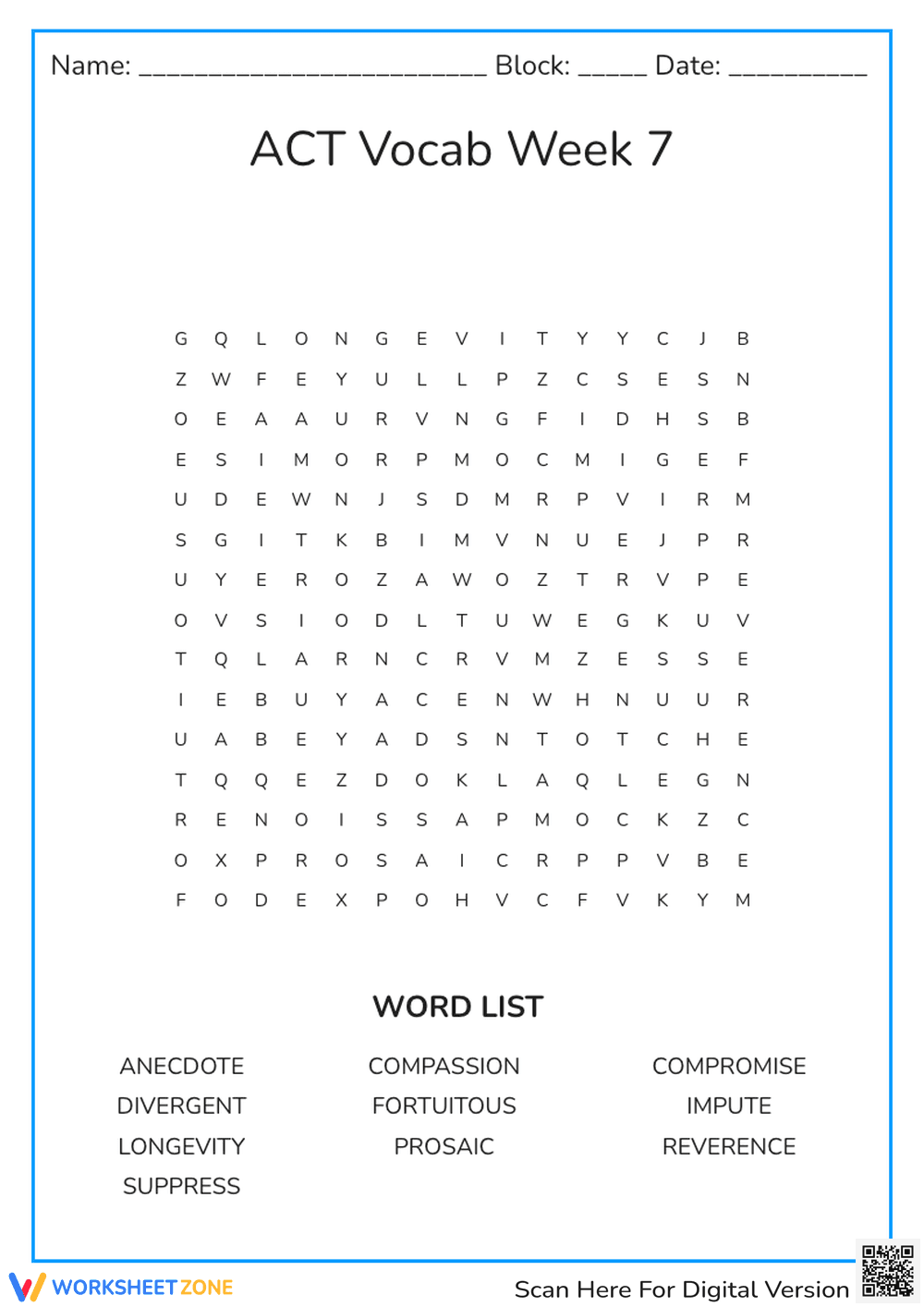

Grade 9 ACT Vocabulary Week 7 — Printable Worksheet

Paste this activity's link or code into your existing LMS (Google Classroom, Canvas, Teams, Schoology, Moodle, etc.).
Students can open and work on the activity right away, with no student login required.
You'll still be able to track student progress and results from your teacher account.
This Grade 9 ACT vocabulary worksheet provides students with a focused word search activity to reinforce recognition of 10 high-frequency academic terms. By engaging with words like fortuitous and reverence in a visual format, learners build the orthographic mapping necessary for college entrance exam success. This resource serves as an effective bridge between direct instruction and independent reading mastery.
At a Glance
- Grade: 9 · Subject: ELA
- Standard:
CCSS.ELA-LITERACY.L.9-10.4— Determine or clarify the meaning of unknown and multiple-meaning words- Skill Focus: ACT Vocabulary Recognition
- Format: 1 page · 10 problems · Answer key included · PDF
- Best For: Bell ringers or fast finishers
- Time: 10–15 minutes
This single-page PDF features a 15x15 letter grid containing 10 essential ACT-level vocabulary words. The layout includes a clear word list at the bottom, including complex terms such as anecdote, impute, and suppress. The clean design ensures high legibility for classroom printing or digital display, allowing students to focus entirely on the linguistic patterns within the puzzle.
Zero-Prep Workflow
- Print: Generate the single-page PDF in under 30 seconds for your entire class.
- Distribute: Hand out the sheets as students enter the room to establish an immediate academic focus.
- Review: Spend 1 minute at the end of the session reviewing the definitions of the 10 terms to ensure conceptual understanding.
Total teacher prep time is under 2 minutes, making this an ideal solution for sub-plans or unexpected schedule shifts.
The primary standard addressed is CCSS.ELA-LITERACY.L.9-10.4, which requires students to determine or clarify the meaning of unknown and multiple-meaning words and phrases. By identifying these specific academic tier-two words, students prepare for the rigorous reading demands of the ACT. Both standard codes can be copied directly into lesson plans, IEP goals, or district curriculum mapping tools.
Use this worksheet as a First Five bell ringer at the start of an ELA block to settle the class while introducing new academic vocabulary. For a formative assessment, observe which students struggle with word patterns or letter orientation, which may indicate a need for additional decoding support. Expected completion time is 10 to 15 minutes depending on student familiarity with the list.
This resource is designed for Grade 9 students preparing for standardized testing, including those in honors or general education tracks. It pairs naturally with a weekly vocabulary log or an anchor chart displaying the definitions and synonyms for the Week 7 word list. It is also suitable for ELL students who benefit from visual word recognition tasks.
According to the RAND AIRS 2024 report on secondary literacy, consistent exposure to high-frequency academic vocabulary is a significant predictor of performance on college entrance exams like the ACT. This worksheet targets CCSS.ELA-LITERACY.L.9-10.4 by focusing on 10 specific tier-two words, including longevity and divergent, which frequently appear in complex informational texts. Research from Fisher & Frey (2014) suggests that word-play activities, such as word searches, can lower student anxiety toward difficult vocabulary while reinforcing spelling and visual recognition. By integrating these 10 terms into a weekly routine, educators provide the repeated exposures necessary for long-term retention. This printable resource offers a structured, low-stakes environment for students to interact with the language of higher education, ensuring they are better equipped for the linguistic demands of Grade 9 and beyond.


