




























Views
Downloads
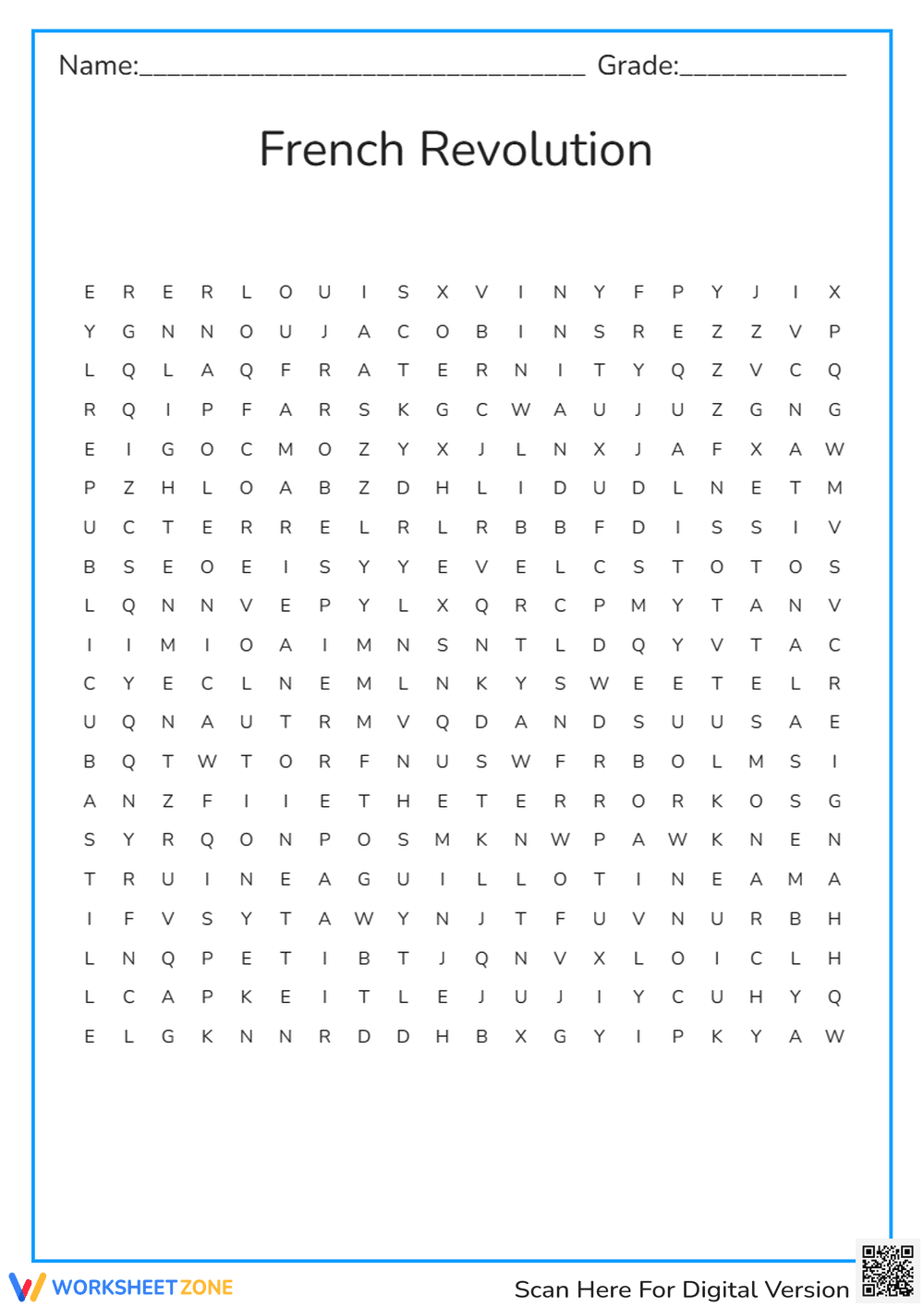


French Revolution Word Search | Grade 11 Essential

Paste this activity's link or code into your existing LMS (Google Classroom, Canvas, Teams, Schoology, Moodle, etc.).
Students can open and work on the activity right away, with no student login required.
You'll still be able to track student progress and results from your teacher account.
This Grade 11 French Revolution word search provides a focused way for students to internalize the essential vocabulary of the era. By identifying 18 key terms ranging from Guillotine to Enlightenment, learners strengthen their recognition of the people, events, and ideologies that shaped modern democracy. This activity serves as a foundational step toward mastering complex historical narratives.
At a Glance
- Grade: 11 · Subject: World History
- Standard:
RH.11-12.4— Determine the meaning of domain-specific words and phrases in historical texts- Skill Focus: Vocabulary Recognition
- Format: 2 pages · 18 problems · Answer key included · PDF
- Best For: Vocabulary reinforcement and early finisher activities
- Time: 15–20 minutes
Inside this resource, you will find a professionally formatted word search grid and a corresponding word list containing 18 high-leverage terms. The worksheet is spread across two pages to ensure high legibility for high school students. It includes a comprehensive list of terms such as Robespierre, the Reign of Terror, and the National Assembly, providing a broad overview of the revolutionary period's most significant elements.
The zero-prep design of this resource allows for immediate classroom implementation. Step 1: Print the two-page PDF (30 seconds). Step 2: Distribute the puzzle to students as they enter the room or finish a primary source analysis (1 minute). Step 3: Review the definitions of the 18 terms as a whole-class wrap-up to ensure conceptual understanding (5 minutes). Total teacher preparation time is under 2 minutes, making this an ideal solution for unexpected schedule changes or substitute plans.
This resource is aligned with CCSS.ELA-LITERACY.RH.11-12.4, which requires students to determine the meaning of symbols, key terms, and other domain-specific words as they are used in a history or social studies context. By isolating these terms, the worksheet supports the prerequisite knowledge needed for standard RH.11-12.1, citing specific textual evidence. Both standard codes can be copied directly into lesson plans, IEP goals, or district curriculum mapping tools.
Use this worksheet as a bell-ringer at the start of a unit to gauge prior knowledge and spark interest. Alternatively, assign it as a formative assessment after a lecture to check for term recognition. Teachers should observe which terms students find most quickly; often, the longer terms like National Assembly require more focused scanning, mirroring the attention to detail needed for reading historical documents. Completion typically takes 15 to 20 minutes.
This resource is designed for Grade 11 World History students, including those in AP European History courses. It is particularly effective for English Language Learners (ELLs) who benefit from visual word recognition and repetitive exposure to academic vocabulary. Pair this worksheet with a primary source excerpt from the Declaration of the Rights of Man or an anchor chart detailing the Three Estates to provide a comprehensive instructional experience.
According to the RAND AIRS 2024 report on secondary literacy, structured vocabulary exposure is a critical component of historical comprehension for Grade 11 students. This French Revolution word search utilizes 18 high-frequency domain-specific terms to reinforce the lexical foundation necessary for analyzing complex primary sources. By engaging with terms like National Assembly and Enlightenment in a low-stakes format, students build the cognitive recognition required for more rigorous evaluative tasks. Research from Fisher & Frey (2014) emphasizes that word-level familiarity precedes the ability to synthesize historical arguments. This resource aligns with CCSS.ELA-LITERACY.RH.11-12.4 by focusing on the precise terminology of the revolutionary era. Educators can utilize this tool to bridge the gap between initial exposure and deep conceptual mastery, ensuring that students possess the linguistic tools to navigate the nuances of 18th-century European political shifts and social upheavals effectively.


